
North Africa (1852–1863 CE) Consolidation of …
Years: 1852 - 1863
North Africa (1852–1863 CE)
Consolidation of French Rule and Regional Developments
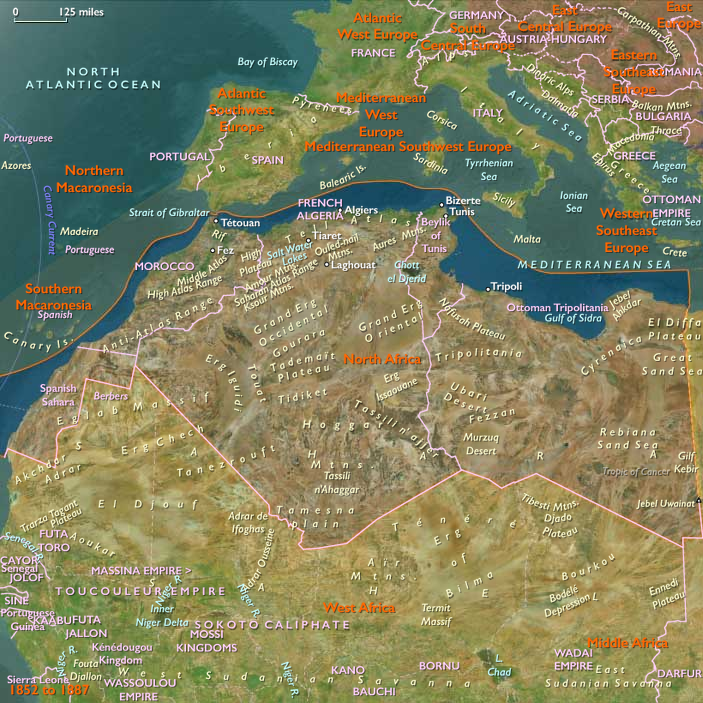
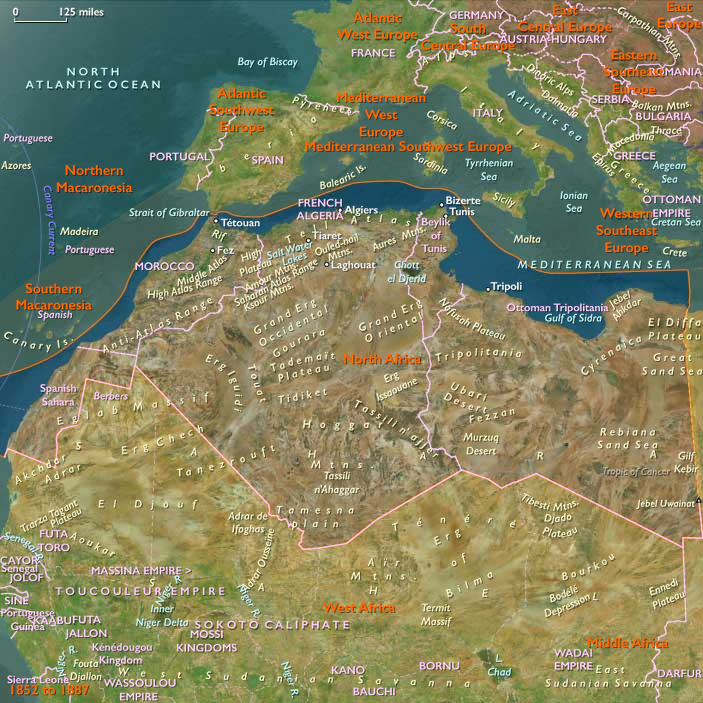
The period from 1852 to 1863 witnesses continued French consolidation in Algeria, administrative reforms aimed at stabilizing colonial rule, and shifting regional dynamics driven by Ottoman struggles and European pressures.
French Colonial Consolidation and Administration in Algeria
Following the defeat and exile of Abdelkader ibn Muhieddine—who is released from prison by Napoleon III in 1852 and moves to Damascus, earning accolades for protecting Christians during an 1860 massacre—French colonization intensifies. European settlement expands aggressively, encouraged by policies promoting migration and the opening of new lands. Land expropriation from indigenous communities leads to increased settlements and deepens disparities between wealthy grands colons and poorer petits blancs, shaping a rigid colonial hierarchy.
Under the Second Empire, governance evolves as Napoleon III reinstates military control, creating in 1858 a separate Ministry of Algerian Affairs. This administration supervises Algeria through a military governor general supported by a civil minister. Napoleon III, profoundly influenced by his visits in the early 1860s, limits European settlement to coastal regions and seeks to preserve interior lands for indigenous populations through direct dealings with tribal leaders, known as the politics of the grands chefs.
Despite these efforts, land speculation and aggressive colonization practices benefit primarily European interests, exacerbating tensions and fostering resentment among local populations.
Regional Developments: Morocco and Tunisia
Morocco faces escalating European pressures due to its strategic position near Algeria and critical Mediterranean trade routes. In response, Moroccan authorities pursue cautious internal reforms, but European influence steadily grows. A war with Spain in 1860, resulting from disputes over the Ceuta enclave, leads to Moroccan defeat and territorial concessions, underscoring the kingdom's vulnerability.
Tunisia, nominally under Ottoman control, experiences heightened European economic penetration, notably by France, Britain, and Italy. The arrival of cholera, previously absent, leads locals to blame European sanitation practices, further fueling suspicion and resentment. Economic influence progressively weakens Ottoman and local authority, setting conditions ripe for future colonial domination.
Ottoman Administration and Sanusi Influence in Libya
Ottoman governance in Tripolitania remains tenuous, largely restricted to coastal cities, while inland regions are effectively autonomous. The Sanusi movement, under its founder, the Grand Sanusi Muhammad ibn Ali as Sanusi, significantly expands influence across Cyrenaica, particularly after establishing the central lodge at Al Jaghbub in 1859. Sanusi lodges (zawiyas) promote an austere, disciplined Islam that attracts widespread Bedouin adherence, creating a robust socio-religious network that serves as an alternative to Ottoman rule.
The Ottoman administration struggles to enforce authority due to internal corruption and limited effectiveness, failing notably to control interior regions dominated by tribal and religious authorities like the Sanusi order.
Socioeconomic Transformations
Across North Africa, socioeconomic changes accelerate due to increased European economic activities, trade penetration, and colonization. Indigenous societies face disruption as traditional landholding and commerce patterns transform, causing widespread impoverishment and displacement.
Urban centers in Algeria, Tunisia, and Morocco undergo modest modernization, benefiting mainly European settlers and commercial interests. Conversely, indigenous populations in rural areas experience intensified economic marginalization, laying the groundwork for future resistance.
By 1863, North Africa remains firmly under European influence, highlighted by French dominance in Algeria, increasing economic penetration by Europeans in Tunisia and Morocco, and a weakening Ottoman presence overshadowed by emerging local entities such as the influential Sanusi movement in Libya.
People
Groups
- Arab people
- Berber people (also called Amazigh people or Imazighen, "free men", singular Amazigh)
- Bedouin
- Islam
- Ottoman Empire
- Alawi dynasty
- Morocco, 'Alawi (Filali) Sultanate of
- Tunis, Beylik of
- United States of America (US, USA) (Washington DC)
- Britain (United Kingdom of Great Britain and Ireland)
- Spain, Bourbon Kingdom (first restoration) of
- France, constitutional monarchy of
- Algeria, French Colony of
- Senussi, or Sanussi
Topics
Subjects
Regions
Subregions
Years: 1852 - 1863
People
Groups
- Arab people
- Berber people (also called Amazigh people or Imazighen, "free men", singular Amazigh)
- Bedouin
- Islam
- Ottoman Empire
- Alawi dynasty
- Morocco, 'Alawi (Filali) Sultanate of
- Tunis, Beylik of
- United States of America (US, USA) (Washington DC)
- Britain (United Kingdom of Great Britain and Ireland)
- Spain, Bourbon Kingdom (first restoration) of
- France, constitutional monarchy of
- Algeria, French Colony of
- Senussi, or Sanussi
Topics
Subjects
Regions
Subregions