
North Africa (532–675 CE) Byzantine Reconquest, …
Years: 532 - 675
North Africa (532–675 CE)
Byzantine Reconquest, Berber Autonomy, and the Advent of Islam
Tribal Dynamics and Regional Fragmentation
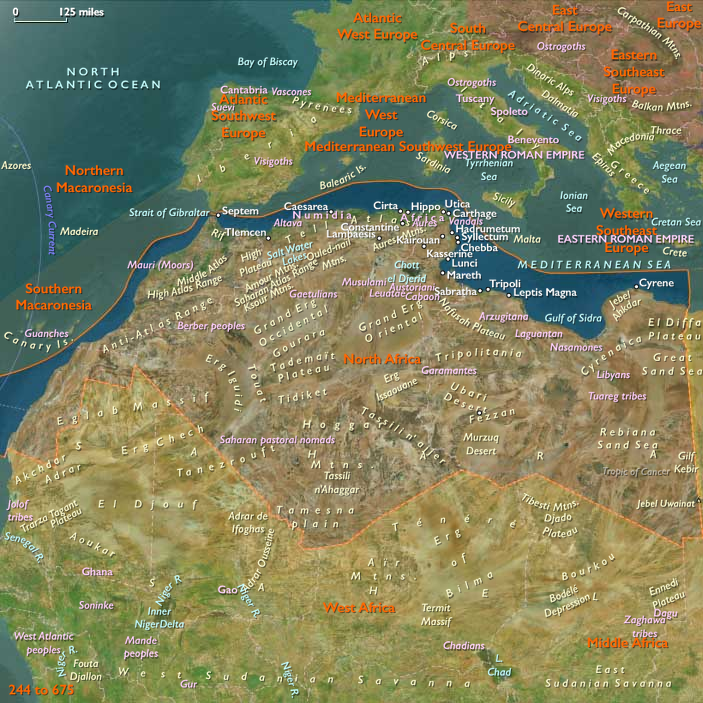
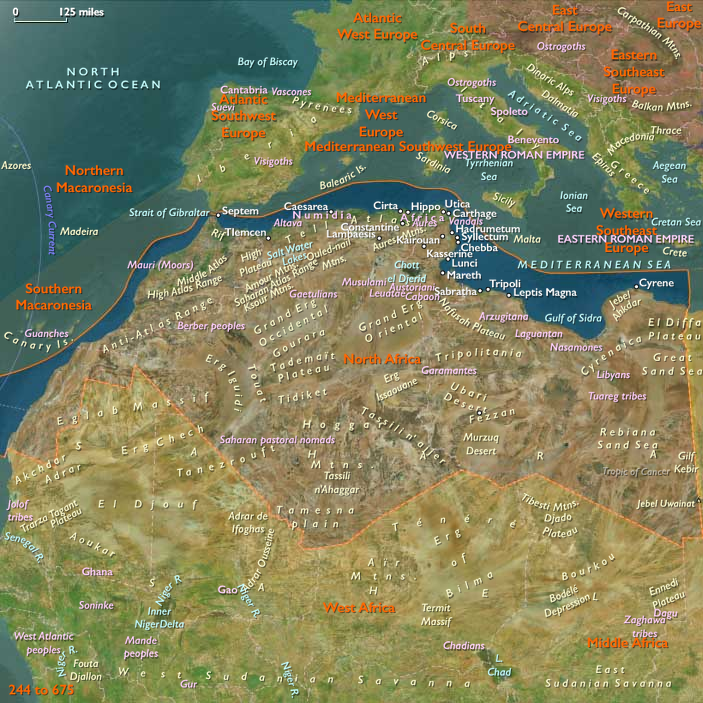
During the sixth and seventh centuries CE, the decline of Byzantine authority in North Africa was closely paralleled—and in many areas caused—by the rise and consolidation of independent Berber and nomadic tribal confederations, each shaping distinct regional dynamics.
In the rugged Aurès Mountains of northeastern Algeria, indigenous Berber groups consistently asserted autonomy. These Aurès tribes, leveraging their mountainous terrain, effectively resisted successive attempts at control by Romans, Vandals, and Byzantines alike, symbolizing sustained tribal independence.
Across the Numidian highlands and mountainous interiors, the Austoriani and Leutae (Levathae) Berber groups became increasingly assertive. Frequently clashing with Byzantine garrisons, these tribes challenged imperial control and contributed directly to widespread rural instability and territorial fragmentation, progressively undermining Byzantine administrative effectiveness.
Further to the south and southwest, in the semi-arid hinterlands of southwestern Tunisia and southeastern Algeria—regions collectively known as Arzugitana—the Arzuges emerged as influential pastoral nomads. These tribes, predominantly camel-herders, capitalized on the weakened Byzantine military presence, regularly disrupting rural settlements and trade routes, thus deepening economic instability and rural impoverishment.
Westward, toward the interior of present-day Algeria, the powerful tribal confederation known as the Laguatan (Laguantan) gained prominence during this period. Particularly aggressive, the Laguatan staged frequent raids into Byzantine-held territories, notably in Tripolitania and Cyrenaica, significantly destabilizing imperial frontier defenses and accelerating Byzantine administrative withdrawal from extensive interior areas.
The Cabaon and Alatava tribes, though smaller in scale, similarly contributed to regional fragmentation, inhabiting and controlling smaller, strategically important inland territories. Their periodic resistance and raids accentuated the mosaic of independent tribal authority that typified much of inland North Africa at this time.
In Cyrenaica and eastern Tripolitania, the ancient Nasamones, historically prominent since classical antiquity, continued to hold local influence. Though somewhat diminished politically, their presence underscored the persistence of indigenous identities and tribal governance structures in eastern North Africa, frequently challenging the legitimacy of imperial administrative rule.
Across the wider region, the broad term Libyans, as used by Byzantine sources, referred collectively to the indigenous Berber populations resisting centralized imperial control. This generalized term indicates the breadth and depth of tribal resistance and the widespread erosion of imperial authority during late antiquity.
Further south, across the Sahara, Tuareg tribes retained control of vital trans-Saharan trade networks. While less involved directly in coastal politics, the Tuareg’s dominance over desert trade profoundly influenced economic conditions and trade dependencies of the coastal cities. Their control of commerce routes thus shaped regional economies, underscoring the interconnected nature of coastal prosperity and inland desert dynamics.
Overall, these tribal groups vividly illustrate North Africa’s profound regional fragmentation, cultural continuity, and the complex human geography of late antiquity. Their increasing autonomy, assertive military actions, and economic roles directly contributed to the decline of Byzantine governance, setting the stage for the transformative Arab-Islamic period that followed.
Byzantine Reconquest and Imperial Restoration (532–565 CE)
In 533 CE, the Byzantine general Belisarius, under orders from Emperor Justinian I in Constantinople, lands in North Africa with approximately sixteen thousand soldiers. Within a year, Belisarius decisively destroys the Vandal Kingdom, reestablishing Roman imperial authority. This swift campaign ends a century of Vandal rule, during which the Vandals had maintained a warrior caste exploiting the region economically but largely leaving civil administration to Roman elites.
However, local opposition significantly delays full Byzantine control, prolonging conflict for another twelve years. Even after consolidation, Byzantine governance in North Africa proves significantly weaker than classical Roman administration. Despite constructing an impressive series of fortifications, Byzantine rule suffers from official corruption, military ineffectiveness, administrative incompetence, and a noticeable lack of interest from distant Constantinople. Consequently, many rural areas revert quickly to autonomous Berber rule, limiting effective imperial governance primarily to fortified coastal cities and regions.
Berber Autonomy and Weakening Byzantine Control (566–639 CE)
Following Emperor Justinian’s death in 565 CE, the Byzantine hold over North Africa steadily deteriorates. The distant imperial administration is preoccupied with pressing threats elsewhere, exacerbating administrative neglect and corruption in African provinces. Byzantine-controlled areas, notably in Cyrenaica and Tripolitania, become heavily militarized, resembling armed camps under unpopular governors imposing burdensome taxes to support military expenditures. Meanwhile, urban infrastructure—such as water systems, public services, and commercial facilities—declines significantly due to neglect.
Despite the steady erosion of imperial authority, Byzantine presence prolongs the Roman ideal of imperial unity in North Africa and prevents complete Berber ascendancy along coastal regions. However, effective Byzantine control shrinks predominantly to coastal cities such as Carthage, Leptis Magna, and Caesarea (Cherchell), while rural and interior regions largely revert to autonomous Berber chieftains.
Early Arab Incursions and Islamic Expansion (640–675 CE)
The arrival of Islam in North Africa, propagated by Arab armies and traders, profoundly reshapes the region’s religious, cultural, and social landscape. In contrast to previous invasions, the introduction of Islam proves transformative, gradually penetrating almost all aspects of society. Despite its eventual dominance, Islamization and Arabization are gradual, complex processes, with many local customs persisting alongside new Islamic social norms and political structures.
Following the death of the Prophet Muhammad in 632 CE, Islamic armies rapidly expand from the Arabian Peninsula into surrounding regions. Arab commander 'Amr ibn al-'As advances from Egypt into Cyrenaica and subsequently into Tripolitania, capturing isolated Byzantine garrisons along the coast and consolidating Arab rule by the mid-640s.
Further westward expansion proves slower and more challenging. In 663 CE, the Arab general Uqba ibn Nafi invades the interior region of Fezzan, capturing Germa. However, stiff Berber resistance in Tripolitania initially halts further Arab advance. It is only with strategic necessity—recognizing North Africa’s importance in controlling the Mediterranean—that the Umayyad Caliphate, ruling from Damascus after 661 CE, initiates a systematic conquest of the Maghreb.
In 670 CE, Uqba ibn Nafi founds the strategic military base at Kairouan (Al Qayrawan), approximately 160 kilometers south of modern Tunis, to anchor further military campaigns. From Kairouan, Arab forces stage relentless assaults on Byzantine-held territories, significantly undermining Byzantine control.
Byzantine governance in Tripolitania becomes increasingly tenuous, confined mostly to heavily fortified coastal towns, farms, and watchtowers. The rural populace, having turned to tribal chieftains during prior periods of neglect under the Vandals and Byzantines, fiercely resists reincorporation into the imperial administrative framework, further facilitating Arab expansion.
Conclusion: Cultural Transformation and Strategic Realignment
By the close of 675 CE, North Africa is fundamentally transformed. Byzantine power, though persisting nominally, is effectively eclipsed by ascending Arab authority. Independent Berber kingdoms assert increasing autonomy, frequently collaborating with Arab forces against Byzantine interests. Islam begins its pervasive cultural and religious influence, reshaping North African society profoundly and enduringly.
This period thus marks a critical historical juncture, initiating North Africa’s long-term transition from its Roman and Byzantine heritage toward an Islamic cultural and political identity, setting the stage for the region’s medieval trajectory.
People
Groups
- Arab people
- Berber people (also called Amazigh people or Imazighen, "free men", singular Amazigh)
- Numidians
- Tuaregs, or Touareg, people
- Africa proconsularis (Roman province)
- Vandals (East Germanic tribe)
- Mauretania Caesariensis (Roman province)
- Mauretania Tingitana (Roman province)
- Africa Byzacena (Roman province)
- Libya Superior, or Cyrenaica (Roman province)
- Christianity, Arian
- Christianity, Nicene
- Vandals and the Alans, Kingdom of the
- Christianity, Chalcedonian
- Sardinia, Vandal
- Roman Empire, Eastern: Justinian dynasty
- Africa, praetorian prefecture of
- Islam
- Rashidun Caliphate
- Umayyad Caliphate (Damascus)
Topics
- Migration Period
- Vandalic War
- Ad Decimum, Battle of
- Tricamarum, Battle of
- Arab-Byzantine Wars
- Muslim Conquest of Egypt
- Muslim conquest of the Maghreb
Subjects
Regions
Subregions
Related Events
Showing 10 events out of 58080 total
Years: 532 - 675
People
Groups
- Arab people
- Berber people (also called Amazigh people or Imazighen, "free men", singular Amazigh)
- Numidians
- Tuaregs, or Touareg, people
- Africa proconsularis (Roman province)
- Vandals (East Germanic tribe)
- Mauretania Caesariensis (Roman province)
- Mauretania Tingitana (Roman province)
- Africa Byzacena (Roman province)
- Libya Superior, or Cyrenaica (Roman province)
- Christianity, Arian
- Christianity, Nicene
- Vandals and the Alans, Kingdom of the
- Christianity, Chalcedonian
- Sardinia, Vandal
- Roman Empire, Eastern: Justinian dynasty
- Africa, praetorian prefecture of
- Islam
- Rashidun Caliphate
- Umayyad Caliphate (Damascus)
Topics
- Migration Period
- Vandalic War
- Ad Decimum, Battle of
- Tricamarum, Battle of
- Arab-Byzantine Wars
- Muslim Conquest of Egypt
- Muslim conquest of the Maghreb
Subjects
Regions
Subregions