
North Africa (628–639 CE) Final Decades …
Years: 628 - 639
North Africa (628–639 CE)
Final Decades of Byzantine Rule, Intensified Berber Autonomy, and Initial Arab Inroads
Between 628 and 639 CE, Byzantine North Africa reaches a critical stage of fragmentation, significantly weakened by decades of neglect, internal corruption, and escalating tribal independence. Concurrently, early Arab incursions into the region mark the beginning of a profound shift toward Islamic dominance.
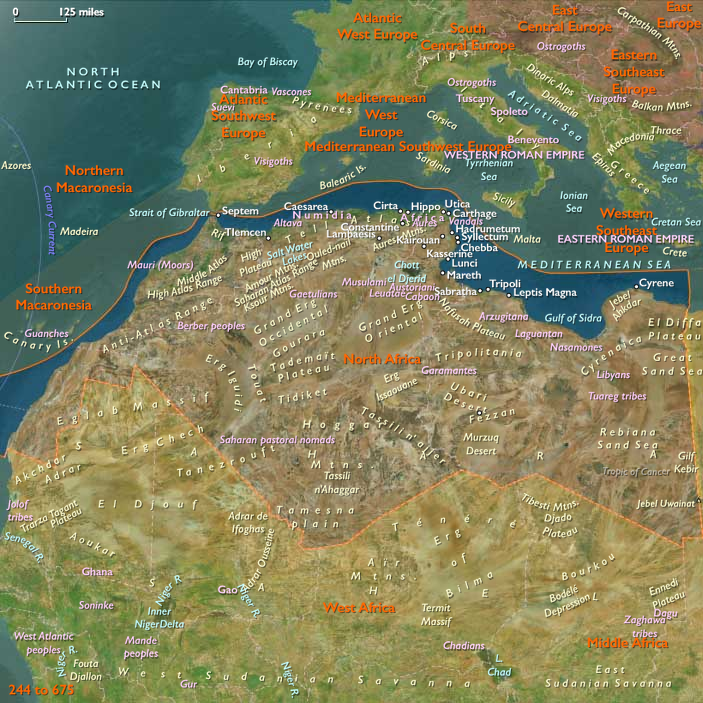
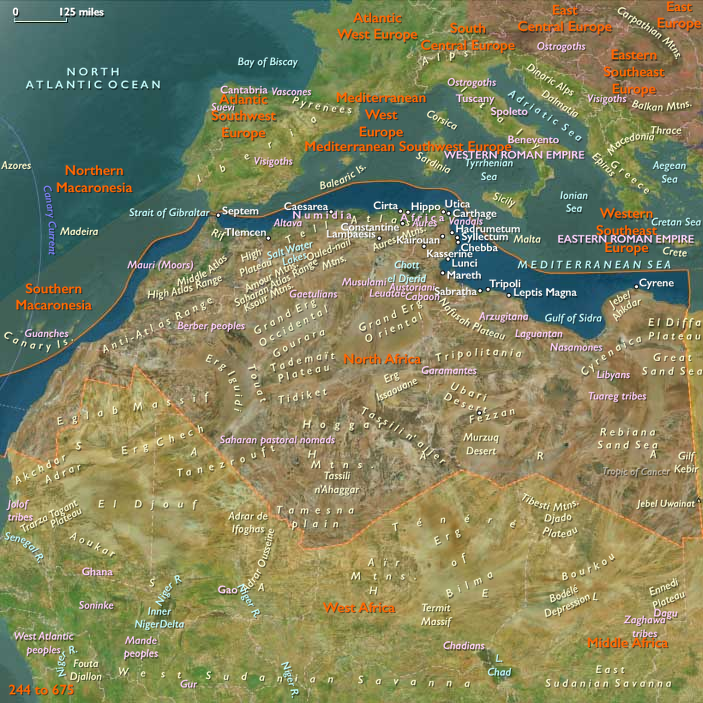
Byzantine governance remains nominally intact only within fortified coastal urban centers, most notably Carthage, Leptis Magna, and Caesarea (Cherchell). Although these cities continue modest prosperity through Mediterranean trade networks, their connection to inland regions grows increasingly tenuous, as deteriorating infrastructure and pervasive insecurity intensify rural isolation.
Heavy imperial taxation and administrative inefficiencies exacerbate local dissatisfaction, causing deepening alienation among both urban elites and rural populations. Public works, roads, and agricultural infrastructure deteriorate markedly, contributing to economic decline and widespread disenchantment with distant imperial authority.
Throughout the interior and frontier regions, powerful Berber confederations and tribes further consolidate their independence. The Aurès Mountains remain a bastion of resilient tribal autonomy, with local tribes vigorously defending their territorial independence. In the Numidian highlands, the prominent Austoriani and Leutae tribes exploit Byzantine vulnerability, expanding territories and increasing raids on Byzantine-held rural settlements.
To the southwest, in the expansive region of Arzugitana, pastoral Arzuges tribes intensify their territorial control, disrupting Byzantine agricultural productivity and trade routes. Meanwhile, the aggressive Laguatan confederation continues to significantly destabilize Byzantine territories in Tripolitania and Cyrenaica through persistent raids, undermining coastal defense and communication lines, further eroding imperial territorial cohesion.
Smaller Berber groups, such as the Cabaon and Alatava, similarly fortify localized autonomy within fragmented interior regions, frequently challenging imperial outposts. In eastern North Africa, the historical presence of the Nasamones underscores persistent indigenous continuity and local governance independent of weakening Byzantine administration.
Collectively labeled as "Libyans" by Byzantine officials, these diverse indigenous groups symbolize the region-wide trend toward decentralized political structures, widespread indigenous resistance, and profound territorial fragmentation.
In the Saharan interior, Tuareg tribes maintain control over critical trans-Saharan trade routes, influencing economic and strategic dynamics of coastal regions. Their dominance ensures sustained yet fragile connectivity between coastal economic centers and Saharan trade, reflecting complex regional interdependencies.
Amid this extensive fragmentation, a new external dynamic emerges. In 639 CE, Arab-Islamic forces under the command of 'Amr ibn al-'As launch initial incursions from recently conquered Egypt into Cyrenaica and subsequently advance toward Tripolitania. Though initially limited in scale, these Arab expeditions rapidly capture isolated Byzantine outposts along the coast, signaling a major strategic shift that threatens remaining Byzantine control.
Culturally, orthodox Christianity retains strongholds within urban centers but increasingly struggles against regional instability and tribal autonomy. In contrast, rural and Berber-controlled territories exhibit localized religious and cultural traditions, increasingly detached from imperial norms.
By the end of 639 CE, Byzantine authority in North Africa appears severely weakened and increasingly untenable. With powerful Berber confederations and tribal groups firmly in control of interior and rural regions, coupled with early Arab advances from the east, the region stands poised on the brink of significant political and cultural transformation. The next decades will decisively reshape North Africa, heralding its gradual transition into the Islamic era.
People
Groups
- Polytheism (“paganism”)
- Arab people
- Berber people (also called Amazigh people or Imazighen, "free men", singular Amazigh)
- Numidians
- Tuaregs, or Touareg, people
- Africa proconsularis (Roman province)
- Mauretania Caesariensis (Roman province)
- Mauretania Tingitana (Roman province)
- Africa Byzacena (Roman province)
- Libya Superior, or Cyrenaica (Roman province)
- Christianity, Chalcedonian
- Africa, praetorian prefecture of
- Roman Empire, Eastern: Heraclian dynasty
- Islam
- Rashidun Caliphate
Topics
Subjects
Regions
Subregions
Related Events
Showing 10 events out of 56840 total
Years: 628 - 639
People
Groups
- Polytheism (“paganism”)
- Arab people
- Berber people (also called Amazigh people or Imazighen, "free men", singular Amazigh)
- Numidians
- Tuaregs, or Touareg, people
- Africa proconsularis (Roman province)
- Mauretania Caesariensis (Roman province)
- Mauretania Tingitana (Roman province)
- Africa Byzacena (Roman province)
- Libya Superior, or Cyrenaica (Roman province)
- Christianity, Chalcedonian
- Africa, praetorian prefecture of
- Roman Empire, Eastern: Heraclian dynasty
- Islam
- Rashidun Caliphate
Topics
Subjects
Regions
Subregions