
Northeastern North America (1612 to 1623 …
Years: 1612 - 1623
Northeastern North America
(1612 to 1623 CE): Expanding European Colonization, Indigenous Alliances, and Epidemic Devastation
Between 1612 and 1623 CE, Northeastern North America saw significant European settlement expansion, deepened indigenous alliances, intensified rivalries, and severe demographic consequences from epidemic disease. Permanent French and English colonies solidified their positions, transforming regional economics and alliances. Indigenous peoples faced strategic realignments driven by economic opportunities, diplomatic complexities, and catastrophic population declines from new diseases, particularly evident in the devastating epidemic of 1616–1619 in New England.
European Colonial Foundations and Growth
French Expansion in New France
Under the leadership of Samuel de Champlain, French settlements along the St. Lawrence River Valley—notably Quebec City (established in 1608)—became thriving trade hubs. Champlain strengthened relationships with the Huron (Wendat), Montagnais, and Algonquin, securing their position as key intermediaries in the profitable fur trade.
In 1615, Champlain deepened alliances with the Huron, enhancing Quebec’s influence over inland indigenous trade routes. These diplomatic ties became vital to France’s colonial and commercial strategies.
English Colonial Expansion: Newfoundland and Maritime Colonies
English settlements grew more stable in Newfoundland, notably around St. John’s, Cupids (founded in 1610), and Ferryland (1621), reflecting increased English commitment to permanent northern colonies. Further south, though beyond the immediate geographic boundary, the English Plymouth Colony (1620) emerged, indirectly influencing indigenous-European interactions throughout the northeastern region.
Indigenous-European Trade Networks
French-Indigenous Commercial Alliances
The French developed robust fur-trade relationships with their indigenous allies—the Huron, Montagnais, Algonquin, and Mi’kmaq. Indigenous nations eagerly embraced access to European commodities (metal tools, firearms, textiles, beads), significantly transforming their economies and enhancing their geopolitical influence.
English and Basque Maritime Activity
English fishermen along Newfoundland and maritime coasts maintained growing economic contacts with coastal indigenous communities, slowly introducing alternative trading partnerships. Meanwhile, Basque whalers continued seasonal whale-oil extraction at Red Bay and the Strait of Belle Isle, with limited but stable indigenous interactions.
Indigenous Alliances and Territorial Rivalries
Haudenosaunee Confederacy: Conflicts and Strategic Diplomacy
The Haudenosaunee Confederacy (Five Nations)—Mohawk, Seneca, Onondaga, Cayuga, and Oneida—faced increased competition for dominance in fur trade routes and regional influence. Champlain’s 1615 conflict supporting his Algonquin and Huron allies against the Mohawk deepened hostility between the Confederacy and French-aligned indigenous nations, laying the groundwork for ongoing regional conflicts.
Algonquin and Huron Alliances with the French
Champlain’s alliances with the Algonquin and especially the influential Huron Confederacy were critical. Positioned as central intermediaries between European traders and interior indigenous nations, these alliances significantly bolstered the political, economic, and military positions of both indigenous nations and French colonists.
Mi’kmaq Stability and Coastal Influence
The Mi’kmaq leveraged their strategic coastal positions to maintain strong economic and diplomatic ties with Europeans, particularly the French. Their adaptive strategy preserved cultural and territorial stability amid intensifying European pressures.
Interior Indigenous Nations: Great Lakes and Ohio Valley Dynamics
Stability Among Great Lakes Algonquian Tribes
Communities such as the Potawatomi in Michigan, and further north the Ojibway, Cree, Cheyenne, and Arapaho, continued traditional subsistence practices. Tribes like the Kickapoo, Menominee, Sauk, and Fox maintained stable agricultural communities, cautiously positioning themselves for advantageous roles in expanding trade networks.
Miami and Illinois Positioning
In the Ohio Valley, the strategically located Miami and Illinois further solidified their positions along important river routes, anticipating greater involvement in European trade.
Siouan-speaking Peoples: Stability and Westward Migrations
Eastern Siouan Communities
Siouan-speaking peoples (Dakota, Assiniboine, Winnebago/Ho-Chunk) continued stable settlements in Wisconsin and Upper Michigan, largely shielded from direct European influences. Ancestors of future Plains nations (Omaha, Iowa, Kansa, Osage, Quapaw) prepared for westward migrations due to increasing eastern territorial pressures.
Mandan, Hidatsa, and Crow Expansion
Further west, the Mandan and Hidatsa nations consolidated prosperous agricultural villages along the Missouri River, facilitating trade with Plains and eastern tribes. The Crow, having separated from their Hidatsa kin, expanded westward, displacing the Shoshone and solidifying alliances with the Kiowa and Kiowa Apache.
Plains Indigenous Communities: Stability Amid Regional Shifts
Pawnee Cultural Continuity
The ancestors of the Pawnee maintained stable agricultural and ceremonial communities along the central Plains river valleys. Despite growing regional competition, their political and cultural resilience endured.
Gros Ventre and Tsuu T’ina Isolation
Northern tribes such as the Gros Ventre (around Lake Manitoba) and Tsuu T’ina (Sarcee) (northern Saskatchewan) retained traditional hunting lifestyles, largely protected from early European impacts by geographic isolation.
Devastating Demographic Impacts of Disease
New England Epidemic of 1616–1619
Between 1616 and 1619, a catastrophic epidemic ravaged the indigenous populations of coastal New England, particularly around Massachusetts Bay. The Wampanoag suffered particularly severe losses, with mortality estimates suggesting up to ninety percent of southern Massachusetts’s coastal native population perished.
Modern research suggests that the epidemic's primary cause was likely leptospirosis, a bacterial infection caused by the spirochaete bacterium Leptospira. Severe leptospirosis, known as Weil’s disease, produces symptoms including jaundice, kidney failure, and internal bleeding. Known historically by various names ("rice field jaundice," "autumn fever," "nanukayami fever," "cane-cutter’s disease," and "Schlammfieber"), leptospirosis was probably introduced inadvertently by European sailors and traders.
Historically proposed causes of this epidemic had included bubonic plague, smallpox, typhus, influenza, yellow fever, chickenpox, and combined infections of hepatitis B and D. However, recent evidence strongly favors leptospirosis due to its symptom profile and potential for rapid and devastating spread in populations lacking immunity.
Consequences of Epidemic Depopulation
This profound demographic collapse significantly weakened indigenous social structures, leaving coastal territories vulnerable to colonization and dramatically altering regional indigenous-European dynamics. Areas severely depopulated by the epidemic became more easily settled by European colonists, reshaping the geopolitical landscape of the region for centuries to come.
Strategic Depopulation and Haudenosaunee Dominance
Other regions, including the Central Appalachians and Upper Ohio Valley, remained notably depopulated due to disease, reinforcing the Haudenosaunee’s dominance over these territories. The sustained demographic vacuum reinforced strategic indigenous territorial management, influencing regional political relationships.
Newfoundland’s Beothuk: Increasing Pressures
Rising Risks from Expanded European Contact
Newfoundland’s indigenous Beothuk faced increasing threats as English coastal presence expanded, posing significant long-term risks including resource competition, disease transmission, and territorial displacement. Their cultural isolation, while providing temporary protection, increasingly came under severe pressure.
Indigenous Artistic and Cultural Resilience
Continuity of Artistic Practices
Indigenous communities sustained vibrant cultural traditions, such as ceremonial pottery, intricate beadwork, shell gorgets, and ornate tobacco pipes, reinforcing identity amid dramatic external pressures.
Persistence of Ritual Traditions
Communities preserved robust ceremonial practices, including Haudenosaunee Longhouse rituals, Mi’kmaq seasonal celebrations, and Pawnee religious ceremonies, ensuring cultural continuity amid regional geopolitical shifts and demographic crises.
Environmental Context and Indigenous Adaptations
Continued Adaptation to Little Ice Age Conditions
Climatic variability associated with the Little Ice Age persisted, challenging traditional indigenous subsistence strategies. Nevertheless, indigenous communities demonstrated significant resilience, adapting effectively through diversified agriculture, ecological knowledge, and seasonal mobility.
Legacy of the Era (1612–1623 CE)
The period 1612–1623 CE saw dramatic changes across Northeastern North America, defined by the expansion of permanent European colonies, complex indigenous alliances and rivalries, and devastating demographic collapse from disease, exemplified by the catastrophic epidemic of 1616–1619. Indigenous societies responded with strategic diplomacy, territorial realignments, and remarkable cultural resilience, profoundly influencing the region’s subsequent geopolitical, demographic, and cultural landscapes.
People
Groups
- Iroquois (Haudenosaunee, also known as the League of Peace and Power, Five Nations, or Six Nations)
- Algonquin, or Algonkin, people (Amerind tribe)
- Portuguese people
- Basque people
- Maliseet, or Wolastoqiyik, people (Amerind tribe)
- Abenaki people (Amerind tribe)
- Beothuk people
- Ho-Chunk (Amerind tribe)
- Mi'kmaq people (Amerind tribe)
- Penobscot people (Amerind tribe)
- Thule people
- English people
- Osage Nation (Amerind tribe)
- Wyandot, or Wendat, or Huron people (Amerind tribe)
- Mohawk people (Amerind tribe)
- England, (Tudor) Kingdom of
- Yankton Sioux Tribe
- Iowa (Amerind tribe)
- Ponca (Amerind tribe)
- Nanticoke people (Amerind tribe)
- Powhatan (Amerind tribe)
- Yuchi (Amerind tribe)
- Kiowa people (Amerind tribe)
- Tsuu T'ina; also Sarcee, Sarsi, Tsu T'ina, Tsuut'ina (Amerind tribe)
- Plains Apache, or Kiowa Apache; also Kiowa-Apache, Naʼisha, Naisha (Amerind tribe)
- Mohegan people (Amerind tribe)
- Massachusett people (Amerind tribe)
- Dakota, aka Santee Sioux (Amerind tribe)
- Cherokee, or Tsalagi (Amerind tribe)
- Sauk, or Sac, people (Amerind tribe)
- Meskwaki, or Fox tribe (Amerind tribe)
- Lenape or Lenni-Lenape (later named Delaware Indians by Europeans)
- Ojibwa, or Ojibwe, aka or Chippewa (Amerind tribe)
- Seneca (Amerind tribe)
- Cayuga people(Amerind tribe)
- Onondaga people (Amerind tribe)
- Oneida people (Amerind tribe)
- Lakota, aka Teton Sioux (Amerind tribe)
- Mahican (Amerind tribe)
- Innu (Montagnais, Naskapi) (Amerind tribe)
- Iroquoians, St. Lawrence
- Susquehannock (Amerind tribe)
- Narragansett people (Amerind tribe)
- Pequots (Amerind tribe)
- Wampanoag (Amerind tribe)
- Catawba people (Amerind tribe)
- Quapaw, or Arkansas (Amerind tribe)
- Omaha (Amerind tribe)
- Pawnee (Amerind tribe)
- Kaw, or Kanza, people (Amerind tribe)
- Caddo (Amerind tribe)
- Mandan (Amerind tribe)
- Hidatsa people (Amerind tribe)
- Shoshone, Shoshoni, or Snakes (Amerind tribe)
- Crow people, aka Absaroka or Apsáalooke (Amerind tribe)
- Cheyenne people (Amerind tribe)
- Arapaho people (Amerind tribe)
- Gros Ventre or “Atsina” people (Amerind tribe)
- Assiniboine people (Amerind tribe)
- Cree (Amerind tribe)
- Tuscarora (Amerind tribe)
- Kickapoo people (Amerind tribe)
- Potawatomi (Amerind tribe)
- Menominee (Amerind tribe)
- Spain, Habsburg Kingdom of
- Spaniards (Latins)
- New France (French Colony)
- Spain, Habsburg Kingdom of
- Florida (Spanish Colony)
- France, (Bourbon) Kingdom of
- England, (Stuart) Kingdom of
- London Company, The (also called the Virginia Company of London)
- Plymouth Company, The (also called the Virginia Company of Plymouth)
- Virginia (English Colony)
- Plymouth Council for New England
Topics
- Little Ice Age (LIA)
- Colonization of the Americas, Spanish
- North American Fur Trade
- Little Ice Age, Warm Phase II
- Colonization of the Americas, English
- Beaver Wars, or French and Iroquois Wars
Commodoties
- Fish and game
- Weapons
- Hides and feathers
- Gem materials
- Domestic animals
- Grains and produce
- Textiles
- Ceramics
- Strategic metals
- Salt
- Fuels, lubricants and sealants
- Manufactured goods
- Tobacco
Subjects
- Commerce
- Public health
- Decorative arts
- Conflict
- Exploration
- Faith
- Government
- Custom and Law
- Technology
- Catastrophe
- Human Migration
Regions
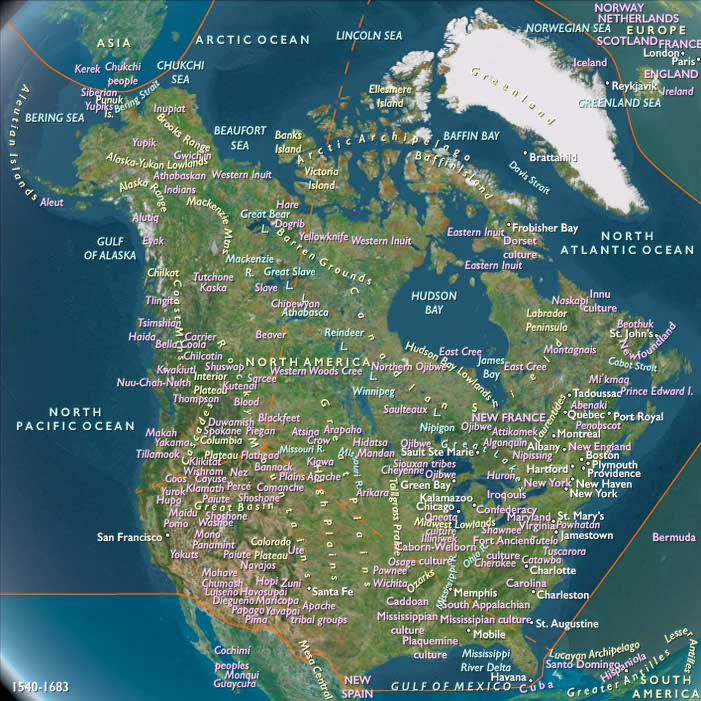
Subregions
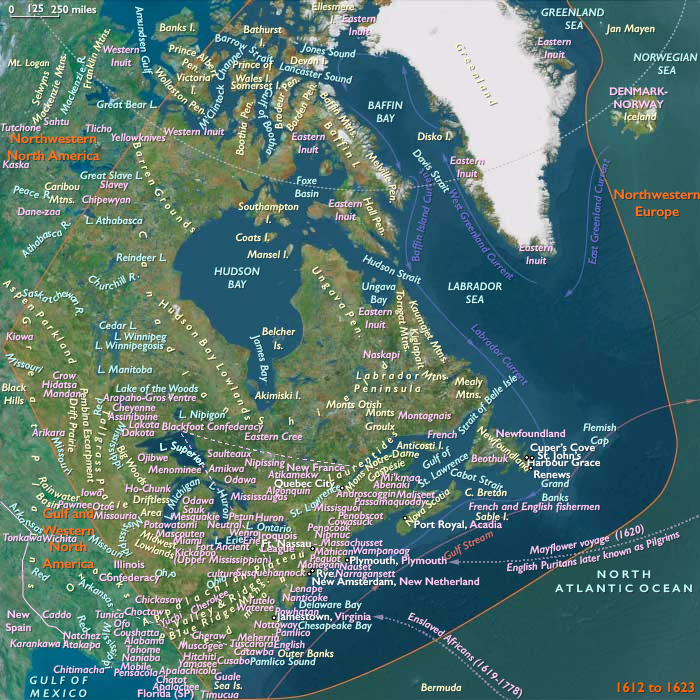
Years: 1612 - 1623
People
Groups
- Iroquois (Haudenosaunee, also known as the League of Peace and Power, Five Nations, or Six Nations)
- Algonquin, or Algonkin, people (Amerind tribe)
- Portuguese people
- Basque people
- Maliseet, or Wolastoqiyik, people (Amerind tribe)
- Abenaki people (Amerind tribe)
- Beothuk people
- Ho-Chunk (Amerind tribe)
- Mi'kmaq people (Amerind tribe)
- Penobscot people (Amerind tribe)
- Thule people
- English people
- Osage Nation (Amerind tribe)
- Wyandot, or Wendat, or Huron people (Amerind tribe)
- Mohawk people (Amerind tribe)
- England, (Tudor) Kingdom of
- Yankton Sioux Tribe
- Iowa (Amerind tribe)
- Ponca (Amerind tribe)
- Nanticoke people (Amerind tribe)
- Powhatan (Amerind tribe)
- Yuchi (Amerind tribe)
- Kiowa people (Amerind tribe)
- Tsuu T'ina; also Sarcee, Sarsi, Tsu T'ina, Tsuut'ina (Amerind tribe)
- Plains Apache, or Kiowa Apache; also Kiowa-Apache, Naʼisha, Naisha (Amerind tribe)
- Mohegan people (Amerind tribe)
- Massachusett people (Amerind tribe)
- Dakota, aka Santee Sioux (Amerind tribe)
- Cherokee, or Tsalagi (Amerind tribe)
- Sauk, or Sac, people (Amerind tribe)
- Meskwaki, or Fox tribe (Amerind tribe)
- Lenape or Lenni-Lenape (later named Delaware Indians by Europeans)
- Ojibwa, or Ojibwe, aka or Chippewa (Amerind tribe)
- Seneca (Amerind tribe)
- Cayuga people(Amerind tribe)
- Onondaga people (Amerind tribe)
- Oneida people (Amerind tribe)
- Lakota, aka Teton Sioux (Amerind tribe)
- Mahican (Amerind tribe)
- Innu (Montagnais, Naskapi) (Amerind tribe)
- Iroquoians, St. Lawrence
- Susquehannock (Amerind tribe)
- Narragansett people (Amerind tribe)
- Pequots (Amerind tribe)
- Wampanoag (Amerind tribe)
- Catawba people (Amerind tribe)
- Quapaw, or Arkansas (Amerind tribe)
- Omaha (Amerind tribe)
- Pawnee (Amerind tribe)
- Kaw, or Kanza, people (Amerind tribe)
- Caddo (Amerind tribe)
- Mandan (Amerind tribe)
- Hidatsa people (Amerind tribe)
- Shoshone, Shoshoni, or Snakes (Amerind tribe)
- Crow people, aka Absaroka or Apsáalooke (Amerind tribe)
- Cheyenne people (Amerind tribe)
- Arapaho people (Amerind tribe)
- Gros Ventre or “Atsina” people (Amerind tribe)
- Assiniboine people (Amerind tribe)
- Cree (Amerind tribe)
- Tuscarora (Amerind tribe)
- Kickapoo people (Amerind tribe)
- Potawatomi (Amerind tribe)
- Menominee (Amerind tribe)
- Spain, Habsburg Kingdom of
- Spaniards (Latins)
- New France (French Colony)
- Spain, Habsburg Kingdom of
- Florida (Spanish Colony)
- France, (Bourbon) Kingdom of
- England, (Stuart) Kingdom of
- London Company, The (also called the Virginia Company of London)
- Plymouth Company, The (also called the Virginia Company of Plymouth)
- Virginia (English Colony)
- Plymouth Council for New England
Topics
- Little Ice Age (LIA)
- Colonization of the Americas, Spanish
- North American Fur Trade
- Little Ice Age, Warm Phase II
- Colonization of the Americas, English
- Beaver Wars, or French and Iroquois Wars
Commodoties
- Fish and game
- Weapons
- Hides and feathers
- Gem materials
- Domestic animals
- Grains and produce
- Textiles
- Ceramics
- Strategic metals
- Salt
- Fuels, lubricants and sealants
- Manufactured goods
- Tobacco
Subjects
- Commerce
- Public health
- Decorative arts
- Conflict
- Exploration
- Faith
- Government
- Custom and Law
- Technology
- Catastrophe
- Human Migration
Regions
Subregions