
Northeastern North America (676–819 CE): Localized Late…
676 CE to 819 CE
Northeastern North America (676–819 CE): Localized Late Woodland Landscapes and the Dissolution of the Hopewell World
Between 676 and 819 CE, Northeastern North America completed the long transformation from the continent-spanning ceremonial interaction systems of earlier centuries into a mosaic of mature Late Woodland societies rooted within individual watersheds. The forests, rivers, wetlands, and floodplains remained the enduring framework of life, while inherited Hopewell traditions survived only as localized ceremonial practices integrated into increasingly independent regional communities. Rather than representing cultural collapse, these centuries witnessed the final dissolution of an older institutional landscape into numerous self-sustaining regional societies that would provide the foundations for the Early Medieval world.
Environmental Continuity
The ecological framework remained fundamentally unchanged. Hardwood forests continued covering the Ohio Valley, lower Great Lakes, and Appalachian uplands, while marshes, floodplains, river terraces, and extensive fisheries sustained mature Woodland economies. Seasonal flooding renewed fertile agricultural clearings, and the Ohio, Mississippi, Great Lakes, and St. Lawrence watersheds continued functioning as the principal environmental corridors through the subregion.
Throughout the Canadian Shield, Atlantic watersheds, northern forests, Labrador, Hudson Bay, and the eastern Arctic, communities maintained distinct ecological adaptations that reflected local environments rather than continent-wide cultural systems.
Human Adaptation
Communities continued combining hunting, fishing, gathering, and horticulture in proportions that varied considerably between regions. Indigenous crops remained important throughout much of the subregion, while maize became increasingly significant in portions of the Ohio Valley, lower Great Lakes, and adjacent interior watersheds without yet replacing older subsistence strategies across the region as a whole.
The bow and arrow had become the standard hunting technology throughout most temperate portions of the subregion, improving hunting efficiency while reinforcing village defense and localized territorial organization. Village life became increasingly stable in many favorable river valleys, although seasonal mobility continued in northern forests, Atlantic coasts, and Arctic environments.
Economic Organization
Economic life became increasingly regional.
Household production, localized exchange, canoe transportation, fisheries, and neighboring watershed relationships now formed the principal economic framework. Long-distance exchange continued in limited forms, but prestige goods from distant regions circulated less frequently than during the mature Hopewell period. Pottery, woodworking, basketry, textiles, and stone industries increasingly reflected regional traditions rather than broadly shared ceremonial styles.
River transportation remained indispensable, yet movement increasingly linked neighboring communities rather than continent-spanning ceremonial systems.
Institutions
The defining transformation of the age was the final localization of Woodland institutions.
Inherited Hopewell ceremonial landscapes persisted in many river valleys but now functioned primarily as regional or local gathering places rather than components of an extensive interaction sphere. Ceremonial life increasingly centered upon individual villages, neighboring alliances, seasonal gatherings, and regional traditions that reflected local ecological conditions.
Across the Upper Mississippi region, effigy mound construction continued flourishing as one distinctive regional ceremonial expression, while communities elsewhere developed increasingly localized ritual landscapes. In portions of the lower Great Lakes, villages became somewhat larger and more permanent, foreshadowing the nucleated communities of the following epoch. Across the Mississippi corridor, modest demographic concentration anticipated—but did not yet produce—the later urban and ceremonial developments associated with Cahokia.
Throughout the northern forests and eastern Arctic, institutions remained closely tied to seasonal mobility, maritime adaptation, and kinship networks, illustrating the continuing diversity of Woodland society.
Political Systems
Political authority remained decentralized throughout the subregion. Village leaders, respected elders, ritual specialists, and extended kin groups continued organizing local society through consensus, reciprocal obligation, and seasonal cooperation rather than centralized government.
Regional alliances became increasingly important as neighboring communities strengthened long-standing relationships while broader ceremonial interaction gradually faded. Political organization therefore became more localized without becoming more hierarchical.
Legacy of the Age
Between 676 and 819 CE, Northeastern North America completed the final transition from the broad institutional landscape inherited from the Hopewell world to a diverse constellation of mature Late Woodland regional societies. Rivers, forests, wetlands, and floodplains remained the enduring framework of life, while villages, localized ceremonial traditions, regional exchange, and increasingly varied horticultural systems established the foundations from which the Early Medieval cultures of eastern North America would emerge. The old Hopewell interaction sphere had not disappeared abruptly; rather, it had gradually dissolved into numerous resilient regional traditions, each deeply rooted within its own watershed and ecological landscape.
Images
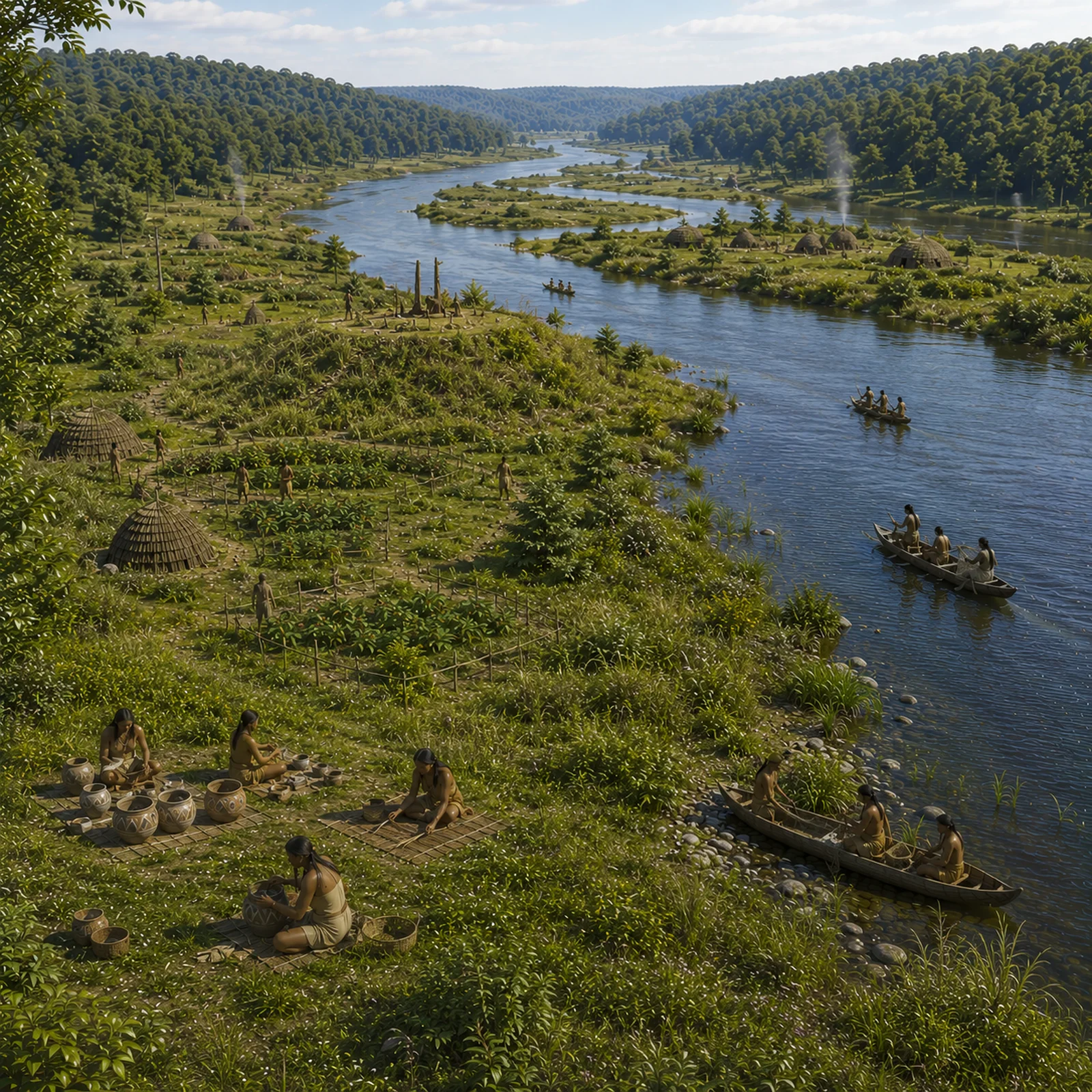
Northeastern North America inthe Early Medieval (Lower) age
Groups
Commodities
Subjects
Regions
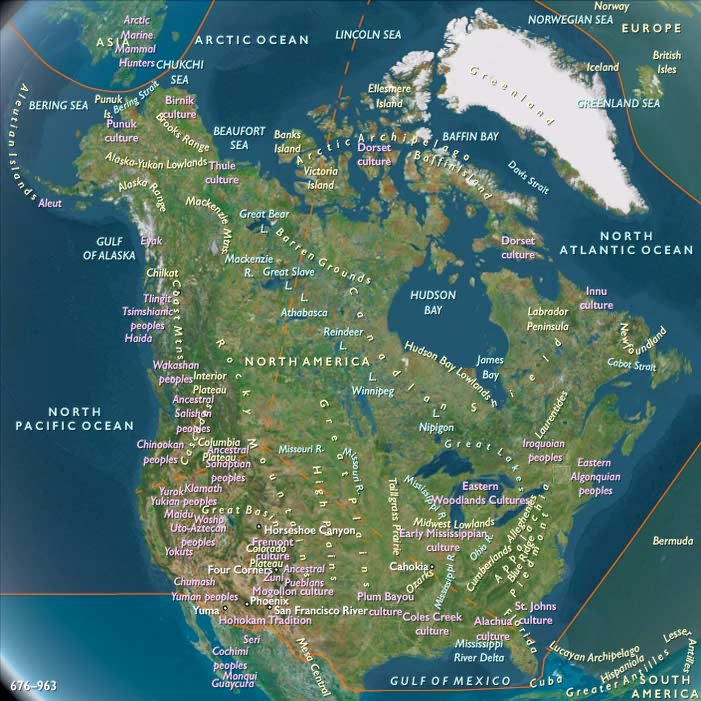
Northern North America
View →Subregions
