
Northern Australia (1684–1827 CE): Monsoon Cycles, Rock …
Years: 1684 - 1827
Northern Australia (1684–1827 CE): Monsoon Cycles, Rock Art Lineages, and Torres Strait Gateways
Geography & Environmental Context
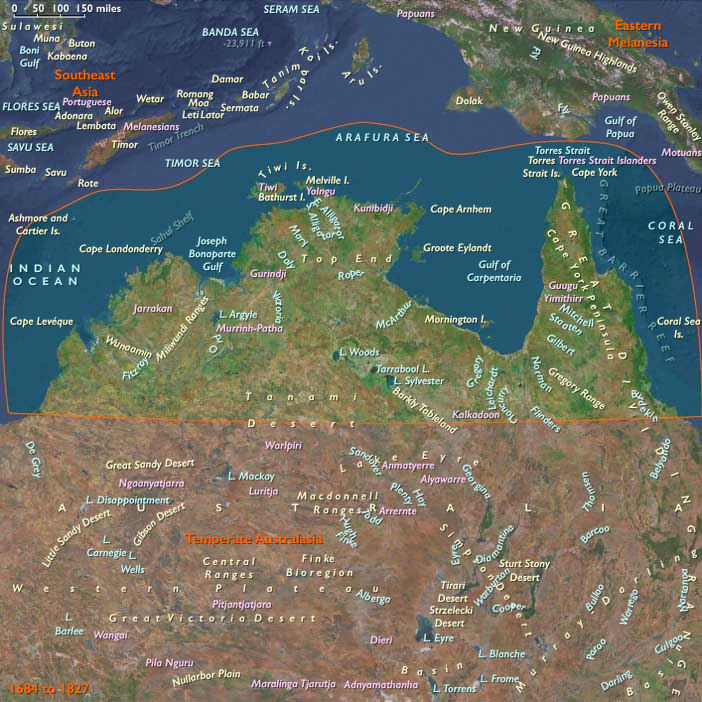
Northern Australia comprises the northern third of the continent—the Kimberley (WA), Arnhem Land and the Top End (NT), the Cape York Peninsula (QLD), and the Gulf of Carpentaria coasts and islands. Anchors include the sandstone escarpments of Arnhem Land, Kakadu’s floodplains, the Mitchell Plateau rivers, the Wessel and Tiwi islands, Princess Charlotte Bay and Shelburne Bay on Cape York, and the mangrove-fringed estuaries of the Gulf. Landscapes span monsoon savannas, tidal flats, reefed shores, spring-fed billabongs, and vast seasonal wetlands.
Climate & Environmental Shifts
Within the tail of the Little Ice Age, variability sharpened the wet–dry contrast: heavy monsoon years expanded floodplains and fisheries; lean years concentrated people and game at perennial waterholes. Cyclones periodically reset coastal ecologies—realigning mangrove belts and salinizing low grounds—while ENSO swings altered wet-season onset. Despite shocks, the redundancy of river–wetland–coast resource webs kept long-term productivity high.
Subsistence & Settlement
Wet–dry seasonality structured mobility and foodways:
-
Wet season: Camps clustered on higher ground as floodwaters rose; subsistence focused on barramundi, mullet, turtles, freshwater mussels, lilies, and yams.
-
Dry season: Groups dispersed across savanna and stone country, hunting kangaroos, wallabies, and emus; harvesting grass seeds and fruits; firing country to renew pasture and ease travel.
-
Coasts & islands (Tiwi, Wessel, Gulf, Cape York): Year-round dugong, turtle, fish, shellfish, and seabird harvests, with seasonal moves to exploit rookeries and reef pulses.
-
Settlement nodes were rock shelters, bark-shelter clusters, stone arrangements, and ceremony grounds aligned to sacred places, water, and travel lines.
Technology & Material Culture
-
Toolkits: Ground-edge axes, backed blades, hammerstones; hardwood spears, throwing sticks, shields, digging sticks; fiber nets and basketry.
-
Fisheries engineering: Stone/timber weirs and tidal fish traps in estuaries (Top End, Arnhem Land); large lift-nets and woven fences on floodplains.
-
Watercraft: Bark canoes and rafts widely; dugout canoes in Cape York via Torres Strait exchange enhanced offshore range and cargo capacity.
-
Art: Continuities and innovations in rock art—X-ray and dynamic figures in Kakadu–Arnhem Land; marine/faunal and ceremonial panels on Cape York; bark paintings elaborating ancestral narratives.
-
Ornament & textiles: Shell, feather, and hair-string adornments; body painting for ceremony; twined bags and mats.
Movement & Interaction Corridors
-
Stone country & floodplain circuits (Kimberley–Arnhem Land): Ochre (notably high-grade Kimberley reds), pearl shell, and sacred designs moved along inland–coast paths.
-
Cape York–Torres Strait gateway: Dense ties with Torres Strait Islanders transmitted dugouts, shell valuables, drums, songs, and dance forms; ritual specialists and voyaging crews circulated seasonally.
-
Gulf of Carpentaria littoral: Estuary-to-island rounds linked claypan soaks, mangrove creeks, and offshore islets.
-
External threads: From the 18th century, Macassan trepangers (Sulawesi) seasonally visited Arnhem Land and the Gulf for trepang (sea cucumber), bringing iron, cloth, rice, tobacco, and dugout-building knowledge; camps (processing sites, tamarind plantings) punctuated coasts and entered oral histories.
Cultural & Symbolic Expressions
The Dreaming (Tjukurpa) mapped spirit-beings across stone, water, and coast.
-
Ceremony: Dry-season gatherings featured song, dance, and exchange; initiation cycles integrated youth into law and country.
-
Iconography: Rock and bark art layered ancestral beings, marine species, and contact motifs (dugouts, Macassan praus) without displacing older cosmograms.
-
Totemic geographies: River mouths, reefs, headlands, and billabongs served as loci of story and right-of-use, maintained through ritual performance and careful harvest rules.
Environmental Adaptation & Resilience
-
Fire management: Mosaic burning refreshed pasture, protected groves, opened travel, and steered game—limiting catastrophic late-dry fires.
-
Hydro-ecological timing: Weir opening/closure, yam and lily harvests, and rookery access were sequenced by star risings, wind shifts, and flood marks.
-
Distributed mobility: Multi-camp territories and kin ties across coast–inland–island belts absorbed cyclone and drought shocks.
-
Diversification via exchange: Torres Strait and Macassan links supplied iron and new vessel forms, improving repair/tooling while households retained core bushcraft resilience.
Transition
From 1684 to 1827, Northern Australia remained a world tuned to monsoon pulses and ancestral routes. Rock art canons deepened; fish weirs and wetland calendars underwrote food security; coastwise exchange intensified—first through Torres Strait, then Macassan seasons that stitched Arnhem Land and the Gulf into a wider Arafura network. European ships were still rare and episodic, but by the 1820s outside currents—materials, pathogens, and stories—were lapping northern shores. The next era would bring closer, riskier entanglements; the knowledge systems honed here were the ballast.
slanders.
-
Art: Arnhem Land rock art flourished, with X-ray paintings depicting fish, turtles, and ancestral beings. Bark paintings recorded cosmological narratives.
-
Textiles and adornments: fiber string bags, body painting, and shell ornaments emphasized both utility and ceremonial symbolism.
Movement & Interaction Corridors
Mobility was guided by ecological calendars and ritual ties:
-
Kimberley and Arnhem Land: Exchange of ochre, pearl shell, and ritual knowledge connected clans across coasts and escarpments.
-
Cape York Peninsula: Networks linked inland and coastal communities, while Torres Strait connections introduced new goods, dugout canoes, and ceremonial influences.
-
Gulf of Carpentaria: Seasonal gatherings along estuaries and islands reinforced ties through exchange and ceremony.
-
Rivers and coasts functioned as highways, guiding seasonal migrations and ritual journeys. No direct European contact occurred in this age, though Macassan trepangers from Sulawesi would soon begin visiting northern coasts in the 18th century.
Cultural & Symbolic Expressions
Spiritual life centered on the Dreaming, expressed in story, song, and image:
-
Rock art depicted both everyday animals and ancestral beings, layering centuries of imagery in Arnhem Land galleries such as Ubirr and Nourlangie.
-
Ceremonies with body painting, dance, and chants reaffirmed ties to land, sea, and spirit.
-
Cape York rituals emphasized initiation and connection to marine spirits.
-
Totemic landscapes encoded cosmological memory into rivers, cliffs, and wetlands, ensuring continuity across generations.
Environmental Adaptation & Resilience
Communities developed flexible strategies to endure environmental stresses:
-
Firestick farming maintained open woodlands and promoted yam growth and game hunting.
-
Food storage—smoked fish, dried kangaroo, and cakes of grass seeds—provided security during lean months.
-
Wetland management included careful regulation of fish trap use and yam harvesting.
-
Mobility allowed groups to relocate when cyclones or drought disrupted local resources.
-
Torres Strait exchanges diversified economies, supplying exotic shells, dugout canoes, and ritual paraphernalia that enriched local systems.
Transition
Between 1540 and 1683, Northern Australia remained defined by wet–dry rhythms, fire regimes, and ritual landscapes. Seasonal calendars structured life, while artistic and ceremonial traditions deepened connections to land and sea. Canoe voyages and exchanges tied Cape York to Torres Strait Islanders, foreshadowing broader regional linkages. Though still untouched by European settlement, the foundations of continuity and resilience laid in this period prepared communities for the external currents that would soon enter their coasts.
Groups
- Australians, Indigenous
- Bininj
- Yolngu
- Tiwi people
- Yanyuwa
- Garrwa people
- Wardaman peopl
- Jawoyn
- Torres Strait Islanders
Topics
Commodoties
Subjects
Regions
Subregions
Years: 1684 - 1827
Groups
- Australians, Indigenous
- Bininj
- Yolngu
- Tiwi people
- Yanyuwa
- Garrwa people
- Wardaman peopl
- Jawoyn
- Torres Strait Islanders
Topics
Commodoties
Subjects
Regions
Subregions