
Northern South Atlantic (7,821–6,094 BCE): Early Holocene …
Years: 7821BCE - 6094BCE
Northern South Atlantic (7,821–6,094 BCE): Early Holocene Warming and Growing Green Patches
Geographic & Environmental Context
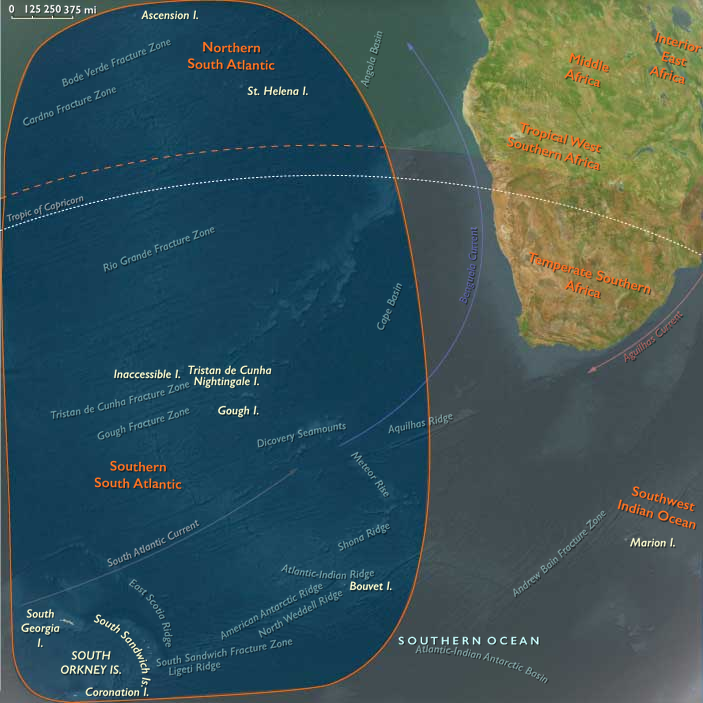
The subregion of Northern South Atlantic includes Saint Helena and Ascension Island. Cliff-bound coastlines, talus aprons, and a few pocket beaches edged uplifted volcanic plateaus; crater basins and lava fields structured interior microhabitats.
Climate & Environmental Shifts
Early Holocene warming raised sea level toward modern stand, drowning some glacial benches and reworking beaches. Trades remained persistent; SSTs warmed; dust flux slackened relative to glacial highs. Convective showers and cloud-cap moisture marginally increased effective precipitation on windward slopes.
Subsistence & Settlement
No humans. Vegetation thickened in gullies and cloud-capture zones—ferns, herbs, grasses, with incipient shrublands on Saint Helena’s higher ridges. Seabirds expanded nesting on stabilized ledges; turtles found higher beach crests as seas rose; reef flats hosted diverse invertebrates and fish nurseries.
Technology & Material Culture
Holocene microliths and early ceramics developed elsewhere; island surfaces remained entirely natural—lava, soil crusts, shells, and guano.
Movement & Interaction Corridors
Gyre circulation and trades continued to shuttle marine life; pelagic predators tracked eddies spun from the South Equatorial Current. Seabird flyways stitched west Africa, Brazil, and these mid-ocean outliers.
Cultural & Symbolic Expressions
None human—only ecological “rituals” of colony return and turtle nesting seasons.
Environmental Adaptation & Resilience
Plants exploited fog drip and hollows; seabirds shifted colonies after storm rockfalls; turtle nesting migrated upslope with rising seas; nutrient loops (guano → soil → plants → detritivores) intensified.
Transition
By 6,094 BCE the islands held a larger, still patchy terrestrial green, while surrounding seas surged with Holocene productivity.
Topics
Subjects
Regions
Subregions
Years: 7821BCE - 6094BCE
Topics
Subjects
Regions
Subregions