
Northern West Indies (7,821–6,094 BCE) Early …
Years: 7821BCE - 6094BCE
Northern West Indies (7,821–6,094 BCE) Early Holocene — River–Coast Foraging on Hispaniola; Banks as Blue Larders
Geographic and Environmental Context
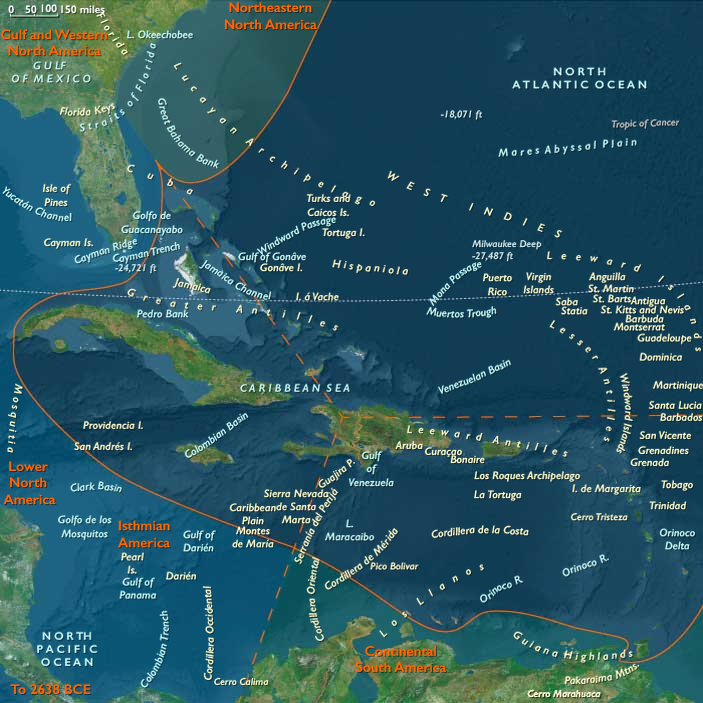
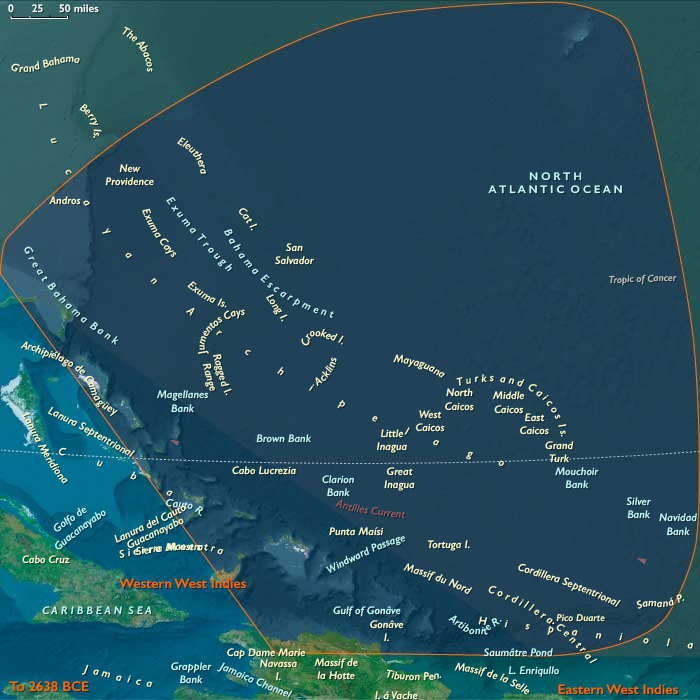
Northern West Indies includes the Outer Bahamas (Lucayan archipelago), the Turks & Caicos Islands, and northern Hispaniola — northern Haiti (Cap-Haïtien, Massif du Nord) and the Cibao/north coast of the Dominican Republic (Santiago de los Caballeros, Puerto Plata).
Anchors: Andros–Abaco–Eleuthera–San Salvador–Exuma banks, Turks & Caicos banks and passes, Cap-Haïtien–Massif du Nord, Cibao–Puerto Plata–Santiago river valleys and coastal shelves.
-
Mature Andros/Eleuthera lenses; Cibao fluvial belts stable; reef flats diversified.
Climate & Environmental Shifts
-
Warm, humid optimum; storms episodic but predictable.
Subsistence & Settlement
-
Northern Hispaniola: shellfish, reef fish, turtle, manatee; deer/hutía inland; camps near river mouths and beach ridges.
-
Bahamas/Turks & Caicos: brief sojourns for fishing/rookeries; no durable villages.
Technology & Material Culture
-
Bone gorges/harpoons, shell adzes; dugouts likely for near-shore.
Movement & Interaction Corridors
-
North coast canoe lanes linked Cibao estuaries; calm-season jumps onto Caicos banks.
Cultural & Symbolic Expressions
-
Shell-heap cemeteries and ancestral loci begin on Hispaniola.
Environmental Adaptation & Resilience
-
River–reef coupling provided year-round protein; storm mobility critical.
Transition
By 6,094 BCE, northern Hispaniola underwrote stable Archaic lifeways; the banks were known but lightly used.
Topics
Commodoties
Subjects
Regions
Subregions
Years: 7821BCE - 6094BCE
Topics
Commodoties
Subjects
Regions
Subregions