
Northwest Europe (1276–1287 CE): Consolidation, Conflict, and …
Years: 1276 - 1287
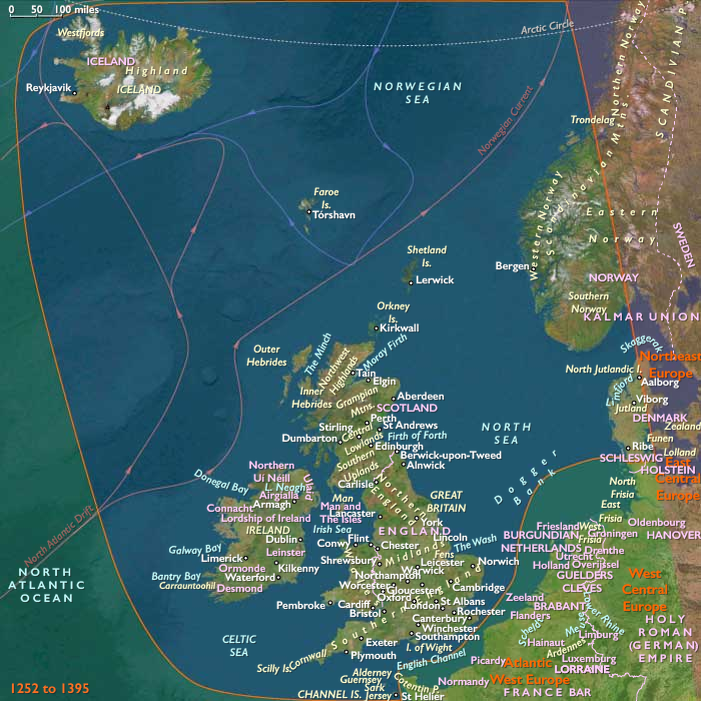
Northwest Europe (1276–1287 CE): Consolidation, Conflict, and Cultural Flourishing
England: Transition and Welsh Conquest
Edward I (r. 1272–1307) ascended firmly to the throne after the death of Henry III in 1272 (formally crowned in 1274). Known as the "Hammer of the Scots" and a powerful consolidator of royal authority, Edward vigorously pursued legal reforms and administrative centralization. His reign also witnessed aggressive military campaigns into Wales, culminating in the defeat of the last independent Welsh prince, Llywelyn ap Gruffudd, in 1282. Following the decisive Battle of Orewin Bridge, Wales was effectively annexed, and in 1284, the Statute of Rhuddlan formalized the integration of Wales into the English crown, significantly expanding Edward's domain.
Scotland: Stability and Succession Concerns
Under Alexander III, Scotland continued its period of stability and relative prosperity. However, Alexander's untimely death in 1286, after a tragic riding accident, plunged Scotland into a succession crisis. The lack of a direct adult heir precipitated uncertainty, setting the stage for subsequent tensions and the involvement of Edward I in Scottish affairs.
Ireland: Norman Dominance and Gaelic Resistance
Norman control remained robust in eastern and southern Ireland, particularly around major urban centers like Dublin, Waterford, and Limerick. Nonetheless, powerful Gaelic lords in Ulster and Connacht persisted in resisting Norman expansion. Continuous skirmishes reinforced a status quo of fragmented territorial authority, preventing full Norman consolidation.
Denmark: Continued Royal Consolidation
Eric V Klipping maintained efforts to stabilize Denmark, although his reign remained challenged by internal disputes, particularly with noble and ecclesiastical factions. Despite these tensions, his policies generally strengthened royal governance and legal administration, laying groundwork for future stability.
Norway: Magnus VI's Legal and Administrative Reforms
Magnus VI Lagabøte (r. 1263–1280) continued his notable reign, known primarily for significant legal reforms. His modernization and codification of Norwegian laws culminated in the creation of the Magnus Lagabøte's Landslov (National Code), enacted around 1276, significantly centralizing royal authority and enhancing administrative uniformity across Norway.
Iceland: Continued Cultural Flourishing
Despite Norway’s increasing influence, Iceland’s cultural production remained vibrant. The traditional Althing continued to function, symbolizing Icelandic resilience and autonomy within the Norwegian sphere. Literary activities, particularly saga-writing, thrived, further enriching Iceland’s unique intellectual legacy. The Icelandic poem known as Njal's Saga, composed between about 1230 and 1290, both glorified and repudiated Iceland’s Saga Age (870–1050), offering an idealized recreation of the Sturlung Age (1100–1280), during which it was written. Similarly, the Völsunga saga, a legendary narrative composed in the late thirteenth century, retold parts of the "Edda" and integrated motifs and characters common with the "Nibelungenlied," weaving supernatural elements into its tale.
Economic Growth and Urban Development
Economic expansion continued unabated, driven by vigorous trade across the North Sea and Baltic regions. Major urban centers—London, Bergen, Bruges, and Dublin—saw significant infrastructural growth. Trade in wool, timber, fish, and luxury goods such as spices and fine cloth bolstered regional prosperity and facilitated greater intercultural interactions.
Religious and Intellectual Trends
The influence of mendicant orders—the Dominicans and Franciscans—remained prominent in urban and rural communities. Their efforts in preaching, charity, and education reinforced religious devotion and intellectual inquiry. Figures like Roger Bacon, who continued to foster advancements in scholasticism, science, and philosophy, had been significantly influenced by the earlier English philosopher and theologian Robert Grosseteste, whose translations and commentaries on Aristotle deeply shaped scholastic thought.
Literary Developments
The Middle English romance Havelok the Dane, composed between 1280 and 1290, gained popularity during this period. Notable for its exploration of ideal kingship, detailed depiction of working-class life, and interest in legal practices, it exemplified the growing literary sophistication of the era.
Legacy of the Era
By 1287 CE, Northwest Europe had witnessed substantial shifts: England’s dramatic conquest of Wales, Scotland’s looming succession crisis, ongoing Gaelic-Norman tensions in Ireland, Norway’s significant legal reforms, Denmark’s gradual stabilization, and Iceland’s continued cultural resilience. These developments collectively marked a definitive step toward the centralized monarchies and distinctive regional identities characteristic of later medieval Europe.
People
- Alexander III of Scotland
- Edward I of England
- Eric V of Denmark
- Henry III of England
- Llywelyn the Last
- Magnus VI of Norway
- Roger Bacon
Groups
- Gaels
- Irish people
- Denmark, Kingdom of
- Ireland, medieval
- Flanders, County of
- Alba (Scotland), Scots Kingdom of
- England, (Anglo-Saxon) Kingdom of
- Icelandic Commonwealth, or Icelandic Free State
- Norway, independent Kingdom of
- Christians, Roman Catholic
- Franciscans, or Order of St. Francis
- Dominicans, or Order of St. Dominic
- Wales, Principality of
Topics
- Middle Subatlantic Period
- Subatlantic Period
- Edwardian Conquest of Wales
- Conquest of Wales by Edward I
- Orewin Bridge, Battle of
Commodoties
Subjects
Regions

Subregions
Related Events
Showing 1 events out of 1 total
Years: 1276 - 1287
People
- Alexander III of Scotland
- Edward I of England
- Eric V of Denmark
- Henry III of England
- Llywelyn the Last
- Magnus VI of Norway
- Roger Bacon
Groups
- Gaels
- Irish people
- Denmark, Kingdom of
- Ireland, medieval
- Flanders, County of
- Alba (Scotland), Scots Kingdom of
- England, (Anglo-Saxon) Kingdom of
- Icelandic Commonwealth, or Icelandic Free State
- Norway, independent Kingdom of
- Christians, Roman Catholic
- Franciscans, or Order of St. Francis
- Dominicans, or Order of St. Dominic
- Wales, Principality of
Topics
- Middle Subatlantic Period
- Subatlantic Period
- Edwardian Conquest of Wales
- Conquest of Wales by Edward I
- Orewin Bridge, Battle of
Commodoties
Subjects
Regions
Subregions