
Northern North America (4,365 – 2,638 BCE): …
Years: 4365BCE - 2638BCE
Northern North America (4,365 – 2,638 BCE): Late Holocene — Forests, Rivers, and Coasts of Continuity
Geographic & Environmental Context
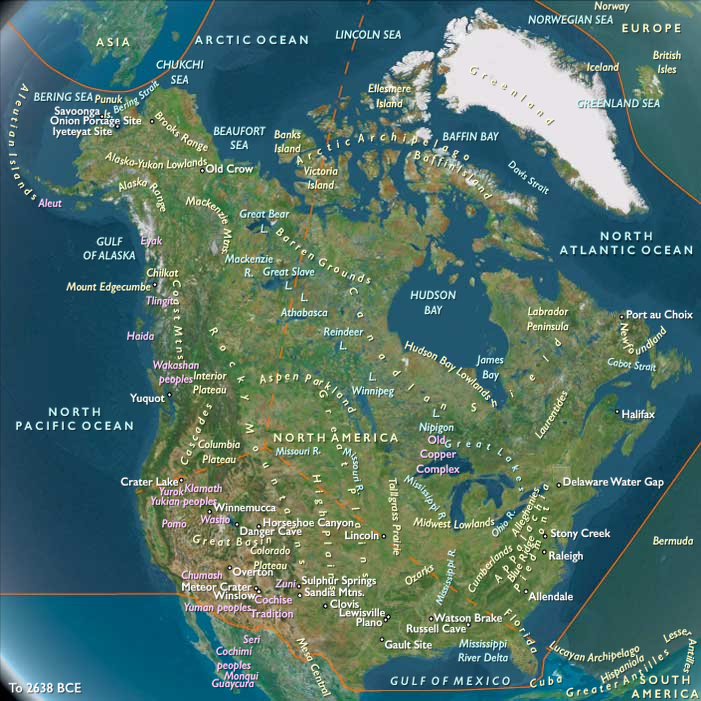
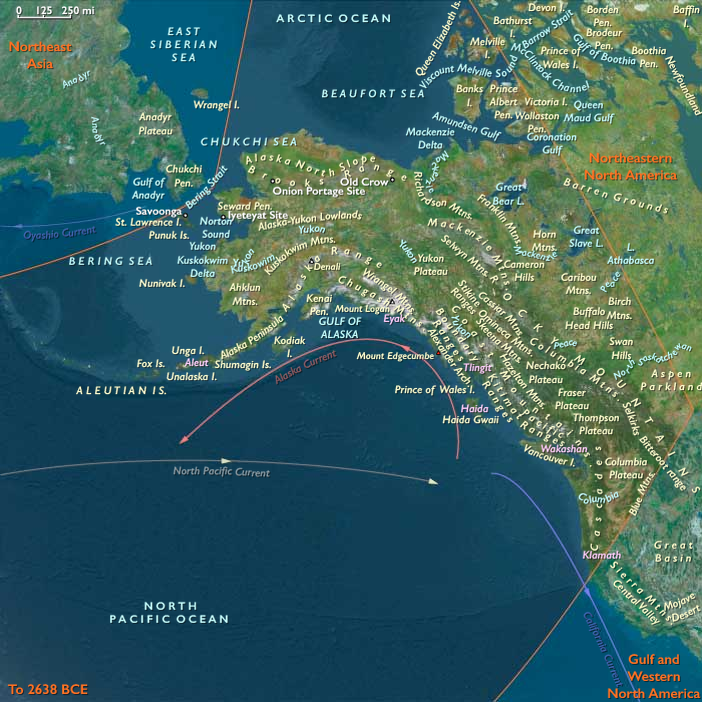
During the Late Holocene, Northern North America spanned an immense and varied terrain—from the Pacific fjords and archipelagos of Alaska and British Columbia, across the continental forests, lakes, and river plains of the interior, to the Atlantic and Arctic seaboards reaching Greenland and Labrador.
This northern tier was defined not by uniformity but by connectivity: salmon-rich coasts, bison and deer grasslands, and the inland waterways that bound them together. Stable shorelines and post-glacial soils fostered thriving ecosystems—kelp forests, eelgrass meadows, boreal wetlands, and oak–hickory groves—each supporting complex human economies tuned to season and place.
Climate & Environmental Shifts
By 4365 BCE, the post-glacial stabilization of sea levels and rivers had created predictable coastal and riparian ecologies. The long thermal optimum gradually waned, bringing cooler, moister conditions to the interior and slightly drier episodes along the west-coast margins.
Glaciers persisted only in the far north, while permafrost retreated across the Yukon and Arctic lowlands. Estuaries and deltas—Columbia, St. Lawrence, Hudson, Mackenzie—reached near-modern outlines, providing long-term stability for settlement and travel.
Subsistence & Settlement
Across this vast region, diverse yet complementary economies took root:
-
Northwest Coasts: shell-midden towns, plank-house villages, and salmon-weir estates dominated. Sea-lion rookeries and herring runs were organized under lineage tenure, signaling emerging hereditary management.
-
Interior Forests and Lakes: pit-house villages and river hamlets intensified fishing and small-game hunting while cultivating early plant-tending traditions that foreshadowed horticulture in the east.
-
Eastern Lowlands and Great Lakes: the Eastern Agricultural Complex began with chenopod, knotweed, and sumpweed tending; riverine villages practiced intensive foraging with seed storage.
-
Arctic and Sub-Arctic margins: seasonal hunting and fishing camps exploited caribou and seal migrations while maintaining trade ties southward for stone, wood, and oil.
Throughout, settlement was semi-permanent and seasonally rotational, balancing predictability with mobility.
Technology & Material Culture
Innovation and refinement characterized the epoch.
Plank-built canoes on the Pacific and dugouts and skin boats inland and east ensured efficient river and coastal transport. Ground-stone adzes, antler harpoons, and net technology advanced woodworking and marine harvests.
Ceramics appeared earliest in the southeast fringe of the region—fiber-tempered and grit-tempered pottery—while bone and shell ornaments flourished as exchange symbols.
Copper was hammered into beads and awls around the western Great Lakes, marking one of the world’s earliest metal traditions. Textile and cordage crafts spread from the Gulf–Appalachian zone northward, complementing fur and hide industries.
Movement & Interaction Corridors
Northern North America was a continent of waterborne corridors.
-
Along the Inside Passage, canoe routes connected Alaska, Haida Gwaii, and the Columbia–Fraser systems.
-
The Fraser–Columbia–Missouri–Mississippi chain linked Pacific and continental basins, moving furs, oils, shells, and copper.
-
The Great Lakes–St. Lawrence complex became the spine of interior trade, while the Atlantic estuaries and bays tied coastal shellfishers and early horticulturalists together.
-
Across the north, the Mackenzie–Hudson–Ungava–Labrador waterways carried Arctic materials—slate, soapstone, seal oil—south in exchange for timber and beads.
These arterial systems formed a continent-scale lattice of communication and reciprocity.
Belief & Symbolism
Ritual expression drew upon both ancestral place and seasonal renewal.
In the northwest, first-salmon and first-seal rites sacralized harvests and reaffirmed lineage rights. Farther east, mound and earth-oven complexes served as ceremonial foci linking the living with the dead.
Rock art and petroglyph panels—boats, animals, solar signs—appeared from Puget Sound to the Canadian Shield. Shell-heap feasting and burial goods reveal ancestor veneration and emerging social ranking, grounded in generosity and redistribution.
Environmental Adaptation & Resilience
Resilience came through redundancy, storage, and alliance.
West-coast societies developed estate tenure over fisheries; interior and eastern groups stored seeds, nuts, and dried fish for lean years. Seasonal scheduling matched migration and plant cycles, while exchange among ecological zones—coast ↔ plateau ↔ forest—ensured food and material security.
Socially, kin alliances and ritualized exchange buffered households against environmental shocks, embedding cooperation in cosmology.
Long-Term Significance
By 2,638 BCE, Northern North America was a landscape of entrenched complexity without cities—maritime and lacustrine polities, inland villages, and trading confederacies bound by river and sea. Copper metallurgy, early ceramics, horticultural experimentation, and enduring coastal longhouses marked the continent’s steady drift toward regional specialization.
The foundations of later Northwest Coast, Great Lakes, and Woodland civilizations—lineage governance, surplus management, and ceremonial redistribution—were already in place, rooted in the ecological intelligence of a people who treated water as both road and memory.
Groups
- Paleo-Indians, or Paleoamericans
- Paleo-Arctic Tradition
- Athabaskans, or Dene, peoples
- Klamath (Amerind tribe)
Topics
- Neolithic Revolution
- Archaic Stage (Americas)
- Neolithic Subpluvial, or Holocene climatic optimum, or Holocene Wet Phase
- Atlantic Period during the Neolithic Subpluvial
- 8.2 kiloyear event during the Neolithic Subpluvial
- Chalcolithic Epoch, or Copper Ages
- Older Peron Transgression during the Neolithic Subpluvial
Commodoties
Subjects
Regions
Subregions
Years: 4365BCE - 2638BCE
Groups
- Paleo-Indians, or Paleoamericans
- Paleo-Arctic Tradition
- Athabaskans, or Dene, peoples
- Klamath (Amerind tribe)
Topics
- Neolithic Revolution
- Archaic Stage (Americas)
- Neolithic Subpluvial, or Holocene climatic optimum, or Holocene Wet Phase
- Atlantic Period during the Neolithic Subpluvial
- 8.2 kiloyear event during the Neolithic Subpluvial
- Chalcolithic Epoch, or Copper Ages
- Older Peron Transgression during the Neolithic Subpluvial
Commodoties
Subjects
Regions
Subregions