Laconia, a strong kingdom ruled by Menelaus,…
1197 BCE to 1054 BCE
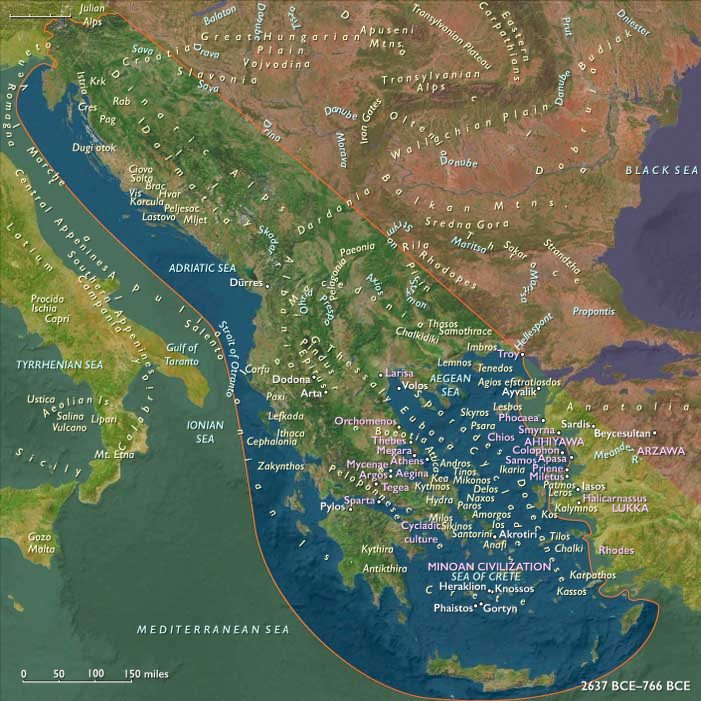
Laconia, a strong kingdom ruled by Menelaus, according to Homer, had seen the founding of numerous settlements in the Late Mycenaean period (1400-1100 BCE).
The southwestern Peloponnesus is governed during Mycenaean times, according to Homeric legend, by the family of Neleides, originating in Iolcos, near modern Vólos, in Thessaly.
The Dorian Invasion (about 1100 BCE) brings widespread destruction to the Peloponnesus (and several centuries will pass before Laconia begins to reemerge).
The second invasion of Greece by the Dorians, much larger than the minor influx that occurred after 1400, takes place (according to Greek tradition) about eighty years after the end of the Trojan War, which would place the invasion around 1104.
The Dorians are a major division of the ancient Greek people, distinguished by a well-marked dialect and by their subdivision, within all their communities, into the “tribes” (phylai) of Hylleis, Pamphyloi, and Dymanes. (These three tribes are apparently quite separate in origin from the four tribes found among the Ionian Greeks.)
As Heracles's son Hyllus traditionally ruled the first of these, Greek legend calls this invasion “the return of the Heraclids.” In Greek tradition, the Dorians were thought to have gained their name from Doris, a small district in central Greece.
According to this tradition, Eurystheus of Mycenae drove the sons of Heracles, the Heraclidae, from their homeland in the Peloponnesus.
The Heraclidae took refuge with Aegimius, the king of Doris.
Several generations later, the Heraclid brothers Temenus, Aristodemus, and Cresphontes lead the “Dorians” back in a successful invasion of the Peloponnesus (in the period 1100-1000 BCE) and thus recover their heritage.
The factual origins of the Dorians are necessarily obscure, but it appears they originated in northern and northwestern Greece, i.e., Macedonia and Epirus.
From there, they apparently sweep southward into central Greece and then into the southern Aegean area in successive migrations beginning about 1100 BCE, at the end of the Bronze Age.
The invading Dorians have a relatively low cultural level, and their only major technological innovation is the iron slashing sword.
The Dorians sweep away the last of the declining Mycenaean and Minoan civilizations of southern Greece (although Athens's Acropolis and Thebes's Cadmeia escape destruction) and plunge the region into a dark age out of which the Greek city-states will begin to emerge almost three centuries later.
The Dorian invaders gain control of many areas, acquiring land and enslaved people, then force many surviving inhabitants east to the Aegean islands and Asia Minor.
Locations
Commodities
Subjects
Regions
Southeast Europe
View →Subregions