
Objects used for a game similar to…
5229 BCE to 5086 BCE
Objects used for a game similar to bowling are placed in the tomb of a young Egyptian boy around 5200.
Topics
Regions
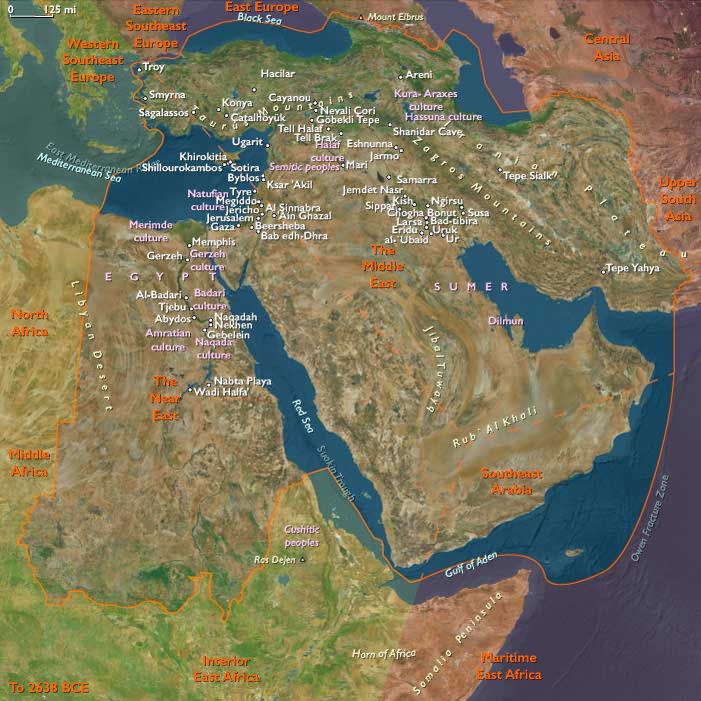
The Near and Middle East
View →Subregions
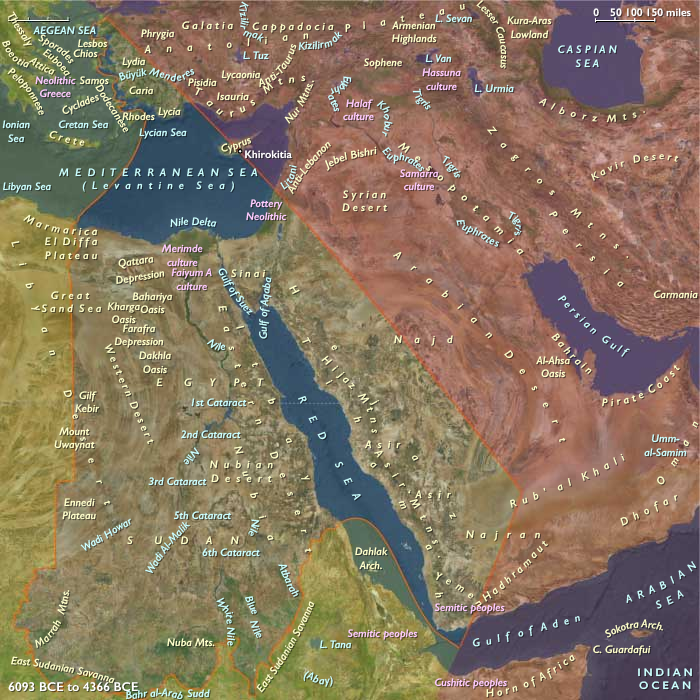
Near East
View →Related Events
No active filters.
Showing 10 events out of 69017 total
China’s Xinle culture, found primarily around the lower Liao River on the Liaodong Peninsula in Liaoning, begins around 5200.
The culture shows evidence of millet cultivation and pig domestication.
Recovered artifacts include deep-bellied pots with impressed rope patterns, microliths, polished stone tools, chipped stone tools, carbonized particles, and wooden carved items.
The Middle East (5229–5086 BCE): Continued Development and Cultural Expansion
Strengthening of Ubaid Culture
Between 5229 and 5086 BCE, the Ubaid culture continued to strengthen and expand throughout southern Mesopotamia. Settlements became increasingly well-established and organized, reflecting improved social cohesion and community planning. These developments contributed significantly to the consolidation of cultural traditions and practices.
Expansion of Agricultural Techniques
During this period, agricultural techniques became more refined and sophisticated, further enabling communities to thrive despite the region’s harsh environmental conditions. Enhanced irrigation methods supported larger-scale farming, allowing the expansion of grain production and improved yields, crucial for sustaining growing populations.
Pottery and Technological Refinements
Pottery manufacture continued to evolve, with artisans producing increasingly refined and functional ceramic vessels. These pottery items, crafted from clays rich in aluminum, not only served daily domestic needs but also became important trade commodities, facilitating broader economic interactions and cultural exchanges.
Societal Complexity and Urbanization
Communities during this era demonstrated greater societal complexity and increasing urbanization. Improved infrastructure, including more organized dwellings and communal structures, reflected advancements in urban planning and social stratification. These developments set the groundwork for subsequent complex urban societies and city-states.
This age highlights continued cultural consolidation, agricultural advancements, technological refinement, and growing social complexity, establishing crucial foundations for future civilizations in the ancient Middle East.
Ghar Dalam (Maltese: "Cave of Darkness") is a prehistorical cul de sac located on the outskirts of Birzebbuga, Malta containing the bone remains of animals that were stranded and subsequently became extinct on Malta at the end of the Ice age.
It has lent its name to the Ghar Dalam phase in Maltese prehistory.
Dwarf elephant, hippopotamus, deer, and bear bone deposits found there are of a different age; the hippopotamuses became extinct about one hundred and eighty thousand years ago, while the deer species became extinct much later, about eighteen thousand years ago.
It is also here that the earliest evidence of human settlement on Malta, some seven thousand four hundred years ago, was discovered.
Human inhabitation and settlements in Malta begin in 5200 BCE.
These first Neolithic people probably arrived from the Agrigento region of Sicily (about one hundred kilometers/sixty miles north), and are mainly farming and fishing communities, with some evidence of hunting activities.
They apparently live in caves and open dwellings.
Maize begins to become a staple for Mesoamerican civilizations from 5200 BCE, beginning with that of the Tehuacán Valley in Mexico.
(Although primitive, this maize is unquestionably domesticated, as no wild forms of maize have been found).
The Daxi culture centered in the Three Gorges region, around the middle Yangtze River, ranges from western Hubei to eastern Sichuan and the Pearl River Delta.
Nels C. Nelson discovered the site at Daxi, located in the Qutang Gorge around Wushan, Chongqing, in the 1920s.
Many key archaeological sites from the Daxi culture, including the site at Daxi, will be inundated or destroyed after the completion of the Three Gorges Dam in 2012.
Daxi sites are typified by the presence of dou (cylindrical bottles), white pan (plates), and red pottery.
The Daxi people cultivated rice extensively.
Daxi sites are some of the earliest in China to show evidence of moats and walled settlements.
The Daxi culture shows evidence of cultural interactions with the Yangtze River Delta region.
The white pan artifacts from the culture were discovered at several Yangtze River Delta sites, including the type-site at Majiabang.
Conversely, jade artifacts at Daxi sites show possible influence from the Yangtze River Delta region.
The Majiabang culture at the mouth of the Yangtze River, primarily around the Taihu area and north of Hangzhou Bay in China, spreads throughout southern Jiangsu and northern Zhejiang from around 5000 BCE.
Initially, archaeologists had considered the Majiabang sites and sites in northern Jiangsu to be part of the same culture, naming it the Qingliangang culture.
Archaeologists later realized that the northern Jiangsu sites were of the later Dawenkou culture and renamed the southern Jiangsu sites as the Majiabang culture.
The Majiabang culture is to coexist with the Hemudu culture for over a thousand years as two separate and distinct cultures, with cultural transmissions between the two cultures.
Majiabang people cultivate rice.
At Caoxieshan, a site of the Majiabang culture, archaeologists excavated paddy fields.
However, faunal remains excavated from Majiabang archaeological sites indicated that people had domesticated pigs.
In addition, the remains of sika and roe deer have been found, showing that people were not completely reliant on agricultural production.
Archaeological sites also bear evidence that Majiabang people produced jade ornaments.
The Yangshao people of the cool and temperate Huang He valley grow millet as their principal grain.
Yangshao farmers employ primitive techniques of cultivation, moving their villages as the soils become exhausted.
Banpo (Pan-p'o) near present Xi'an (Sian) in central China, the type site associated with the Yangshao Culture, is located about five hundred and seventy-two miles (nine hundred and twenty kilometers) southwest of present Beijing (Peking) in a fertile, alluvial lowland at the foot of the Qing Ling Shan (Tsinling Shan) along the Wei, a tributary of the Huang He (Hwang Ho, or Yellow River).
Archaeological sites with similarities to the first phase at Banpo are considered part of the Banpo phase (5000 BCE to 4000 BCE) of the Yangshao culture.
Banpo was excavated from 1954 to 1957 and covers an area of around 50,000 square meters.
It contains the remains of several well-organized Neolithic settlements dating from approximately 4500 BCE.
It is a large area of five to six hectares and surrounded by a ditch, probably a defensive moat, five or six meters wide.
The houses were circular, built of mud and wood, supported by timber poles and and roofed with overhanging steeply pitched thatch.
They sat on low foundations; many of the houses were semisubterranean with the floor typically a meter below the ground surface.
There appears to be communal burial areas, with the graves and pottery kilns located outside of the moat perimeter.
China’s Hemudu culture flourishes in Jiangnan, in modern Yuyao, Zhejiang, just south of the Hangzhou Bay.
The site at Hemudu, twenty-two kilometers northwest of Ningbo, was discovered in 1973.
Hemudu sites were also discovered on the islands of Zhoushan.
The Hemudu culture coexisted with the Majiabang culture as two separate and distinct cultures, with cultural transmissions between the two.
Two major floods caused the nearby Yaojiang River to change its course and inundated the soil with salt, forcing the people of Hemudu to abandon its settlements.
The Hemudu people lived in long, stilt houses.
The Hemudu culture is one of the earliest cultures to cultivate rice.
Most of the artifacts discovered at Hemudu consist of animal bones, exemplified by hoes made of shoulder bones used for cultivating rice.
The culture also produced lacquer wood.
The remains of various plants, including water caltrop, Nelumbo nucifera, acorns, beans, Gorgon euryale and bottle gourd, were found at Hemudu.
The Hemudu people likely domesticated pigs, water buffalo, and dogs.
The people at Hemudu also fished and hunted, as evidence by the remains of bone harpoons and bows and arrowheads.
Music instruments, such as bone whistles and wooden drums, were also found at Hemudu.
The culture produced a thick, porous pottery.
The distinct pottery was typically black and made with charcoal powder.
Plant and geometric designs were commonly painted onto the pottery; the pottery was sometimes also cord-marked.
The culture also produced carved jade ornaments, carved ivory artifacts and small, clay figurines.
Fossilized amoeboids and pollen suggests Hemudu culture emerged and developed in the middle of the Holocene Climatic Optimum.
A study of a sea-level highstand in the Ningshao Plain from 7000 – 5000 BP shows that there may have been stabilized lower sea levels at this time followed by frequent flooding, from 5000 to 3900 BP.
Proto-Austronesian culture is based on the south coast of China in about 5000 BCE, combining extensive maritime technology, fishing with hooks and nets, and gardening.
The protohistory of the Austronesian people can be traced farther back through time than can that of the Proto-Austronesian language.
From the standpoint of historical linguistics, the home (in linguistic terminology, Urheimat) of the Austronesian languages is the main island of Taiwan, also known as Formosa; on this island the deepest divisions in Austronesian are found, among the families of the native Formosan languages.
According to Robert Blust, the Formosan languages form nine of the ten primary branches of the Austronesian language family Blust (1999).
At least since Sapir (1968), linguists have generally accepted that the chronology of the dispersal of languages within a given language family can be traced from the area of greatest linguistic variety to that of the least.
While some scholars suspect that the number of principal branches among the Formosan languages may be somewhat less than Blust's estimate of nine (e.g., Li 2006), there is little contention among linguists with this analysis and the resulting view of the origin and direction of the migration.
For a recent dissenting analysis, see (Peiros 2004).
To get an idea of the original homeland of the Austronesian people, scholars can probe evidence from archaeology and genetics.
Studies from the science of genetics have produced conflicting outcomes.
Some researchers find evidence for a proto-Austronesian homeland on the Asian mainland (e.g., Melton et al. 1998), while others mirror the linguistic research, rejecting an East Asian origin in favor of Taiwan (e.g., Trejaut et al. 2005).
Archaeological evidence (e.g., Bellwood 1997) is more consistent, suggesting that the ancestors of the Austronesians spread from the South Chinese mainland to Taiwan at some time around eight thousand years ago.
Farming reaches central and northern Europe by 5000 BCE.