
Arnaut Daniel: The Master of Trobar Ric…
1210 CE
Arnaut Daniel: The Master of Trobar Ric and Inventor of the Sestina (1180–1210 CE)
Arnaut Daniel, an Occitan troubadour poet active between 1180 and 1210, was the leading exponent of trobar ric, a poetic style characterized by intricate verse forms and concise, highly refined language. His legacy as a poet is defined by technical mastery, linguistic innovation, and influence on later literary giants.
Life and Reputation
-
Biographical uncertainty:
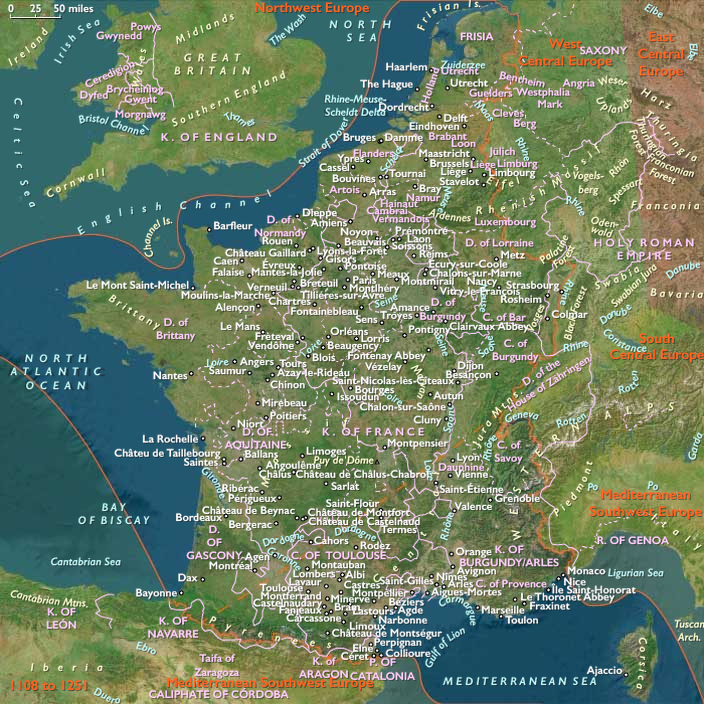
- One biography claims he was born to a noble family at the castle of Ribérac in Périgord.
- However, contemporary sources suggest he was a jester struggling with financial hardship.
- Raimon de Durfort described him as "a student, ruined by dice and shut-the-box," indicating he may have squandered his wealth through gambling.
-
Despite his hardships, Arnaut’s poetic skill gained him legendary status in later literary traditions.
Innovation: The Invention of the Sestina
Arnaut Daniel is credited with creating the sestina, an elaborate and mathematically structured form of poetry consisting of:
- Six stanzas of six lines each, with the same six end-words recurring in every stanza, arranged in a precise, intricate order.
- A concluding three-line stanza (envoi), in which all six end-words appear again.
The sestina would go on to influence Dante, Petrarch, and later poets like Ezra Pound and T.S. Eliot, securing Arnaut’s place in the evolution of European poetry.
Praise and Enduring Influence
- Dante Alighieri refers to Arnaut in Purgatorio (Canto XXVI) of the Divine Comedy, calling him:
"il miglior fabbro del parlar materno"
("the better craftsman of the mother tongue") - Petrarch calls him the "Grand Master of Love", admiring his lyrical elegance.
- Ezra Pound, in The Spirit of Romance (1910), considers him "the greatest poet to have ever lived," continuing his influence into the 20th century.
Legacy
Arnaut Daniel’s work represents the pinnacle of troubadour complexity, merging highly structured poetic forms with emotional depth. His invention of the sestina not only influenced medieval poets but also reverberated through Renaissance and modern literature, securing his place as one of the greatest poetic innovators of the medieval period.
Locations
Subjects
Regions
West Europe
View →Subregions
