Forces under the command of British General…
August 1779 CE
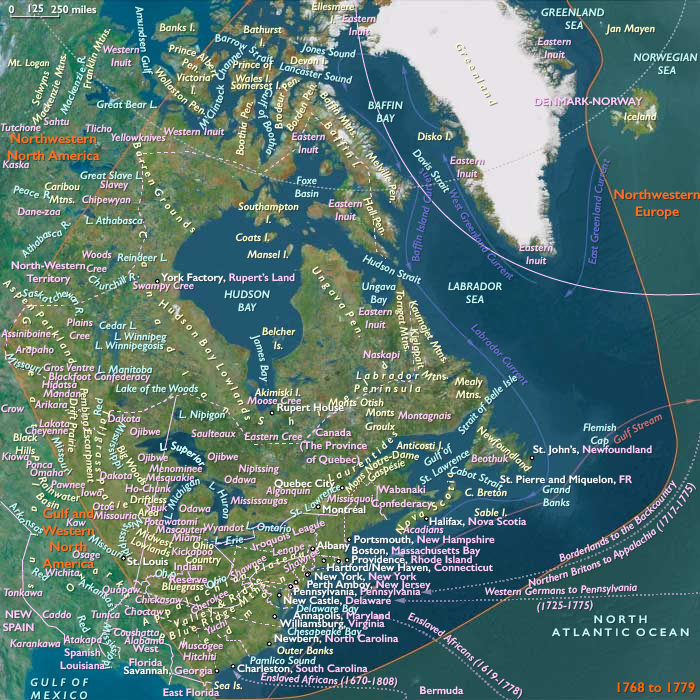
Forces under the command of British General Francis McLean had landed on June 17th, 1779, at what is at this time called Majabigwaduce (Castine), on Penobscot Bay at the mouth of the Penobscot River, on the east coast of Maine, at this time a part of Massachusetts.
The goal of the approximately seven hundred soldiers under General McLean's command, composed of detachments of the 74th and 82nd regiments, is to establish an outpost for traders from Nova Scotia, to create a New Ireland colony for Irish settlers and to use the area as a base for further raids into New England.
The British had begun to build a fortification near present-day Castine.
When news of this reached the rebel authorities in Boston, they hurriedly made plans to drive the British from the area.
The Penobscot River is the gateway to lands controlled by the Penobscot people, who generally favor the British.
Congress fears that if a fort were successfully constructed at the mouth of the river, all chance of enlisting the Penobscots as allies would be lost.
Massachusetts is also motivated by the fear of losing their claim over the territory to rival states in any postwar settlement.
Massachusetts had petitioned Congress for the use of three warships—the twelve-gun sloop Providence, fourteen-gun brig Diligent, and thirty-two-gun frigate Warren—while the rest of over forty ships comprise ships of the Massachusetts State Navy and private vessels under the command of Commodore Dudley Saltonstall.
The Massachusetts authorities have mobilized more than a thousand militia, acquired six small field cannons, and placed Brigadier General Solomon Lovell in command of the land forces.
The expedition had departed from Boston on July 24 and arrived off Penobscot Bay that same day.
The British fort is located on Bagaduce Peninsula (now called Castine) which juts into the bay and commands the principal passage into the inner harbor.
The Americans had landed around seven hundred and fifty men under Lovell on July 26, but instead of attacking the British fortified camp, they had begun construction of siege works under constant and accurate fire.
That same day, the Americans had landed a small group on nearby Nautilus Island and overrun a British artillery battery.
Lovell and Saltonstall had hesitated over the next two weeks to attack the British fortified positions and argued over who is in command of the forces on the land or the sea.
Eventually, at another meeting-of-war on August 6, Lovell and Saltonstall had agreed to try to lure the British out of their fortifications to engage them in the open.
About two hundred and fifty American rebel militia advance from their fortified camp on August 11 and occupy a recently abandoned battery about a quarter mile (four hundred meters) from the British fort.
As expected, a sortie of about fifty-five British troops advances from the fort to engage, but the poorly trained American troops fire only one volley at the attacking British troops and flee back to their fort, leaving behind all their arms and equipment.
Saltonstall finally decides the next day, to launch a naval attack against the British fort, but a British relief fleet arrives under Commodore Sir George Collier and attacks.
The American fleet flees upstream on the Penobscot River over the next two days, pursued by the British fleet.
Several vessels are scuttled or burned along the way with the rest destroyed at Bangor.
The surviving crews then flee overland back to Boston with virtually no food or ammunition.
The American forces have lost all their ships as well as four hundred and seventy-four men killed, wounded or captured.
The British losses are reported at only thirteen killed and wounded, all of whom fell in the August 11 land engagement.
The Penobscot Expedition will remain the worst naval defeat in U.S. history until Pearl Harbor.
Groups
Topics
Regions
Northern North America
View →Subregions