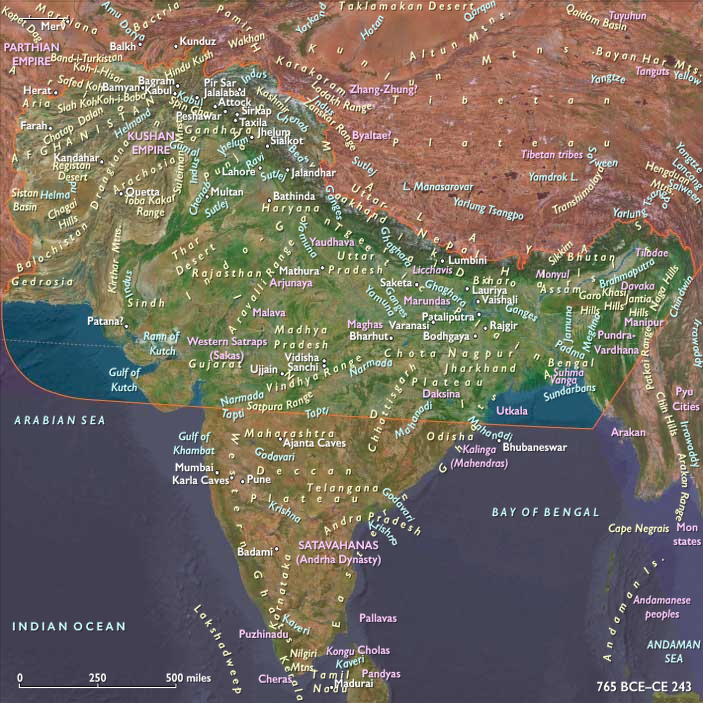
The political struggles and urbanization of north…
333 BCE to 190 BCE
The political struggles and urbanization of north India culminate in the great Mauryan Empire, which at its height under Ashoka (reigned 268-31 BCE) covers almost all of South Asia and stretches into Afghanistan in the west.
Records of Ashoka are located at Lumbini, the Buddha's birthplace, in the Tarai, but there is no proof that Nepal was ever included in the empire, although the empire had important cultural and political consequences for Nepal.
First, Ashoka himself embraces Buddhism, and during his time the religion must have become established in the Kathmandu Valley and throughout much of Nepal.
Ashoka is known as a great builder of stupas, and his archaic style is preserved in four mounds on the outskirts of Patan (now often referred to as Lalitpur), which are locally called Ashok stupas, and possibly in the Svayam-bhunath (or Swayambhunath) stupa.
Second, along with religion comes an entire cultural style centered on the king as the upholder of dharma, or the cosmic law of the universe.
This political concept of the king as the righteous center of the political system has a powerful impact on all later South Asian governments and will continue to play a major role in modern Nepal.
Locations
People
Groups
Subjects
Regions
South Asia
View →Subregions