
The earliest surviving türbe, a form of…
1000 CE to 1011 CE
The earliest surviving türbe, a form of mausoleum architecture that will be developed by and popular among the Seljuq Turks in Iran (mid-eleventh to thirteenth century) and later carried by them into Iraq and Anatolia, is the Gonbad-e Qabus, in the Gorgan region of northeastern Iran: its conical roof creates a type, but its ten-pointed, star-shaped ground plan remains unique.
Groups
Regions
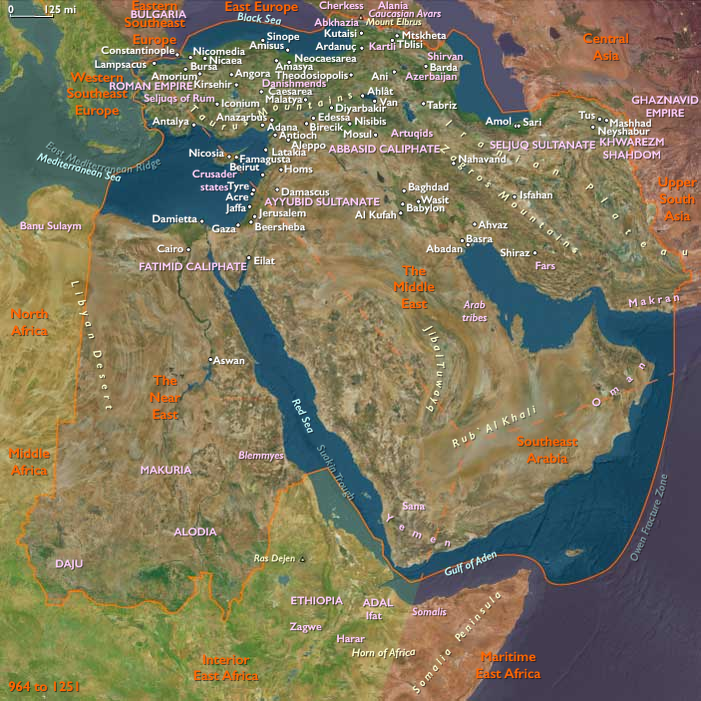
The Near and Middle East
View →Subregions

Middle East
View →Related Events
Showing 10 events out of 11 total
Many of the Portuguese there are veterans of India, where abuse of the natives is routine.
The Tupinambá finally tire of the mistreatment, and many of the Portuguese at Bahia, including the donatário, are captured and ceremonially killed and eaten.
A Dutch fleet under the command of Admiral Jacob Willekens and Vice Admiral Pieter Heyn consisting of thirty-five ships, of which thirteen are owned by the United Provinces, while the rest belong to the WIC, had sailed on December 22, 1623, from Texel carrying sixty-five hundred men en route to Cape Verde, where they had arrived after being scattered by a storm.
There Willekens had revealed that his objective is the capture of the city of Salvador da Bahia on the coast of Brazil.
The Dutch intentions to invade Brazil are soon reported by the Spanish spies in the Netherlands to the court of Madrid, but the Count-Duke of Olivares does not credit the reports.
The Dutch fleet on May 8 appears off Salvador.
The main objective of the expedition is the capture of the port to use it as a commercial base to ensure the Dutch trade with the East Indies.
In addition they would control much of the sugar production in the region, as Salvador is a major center of sugar production in the area.
The Portuguese governor of Salvador, Diogo de Mendonça Furtado, tries to organized the defense of the town with three thousand men hastily recruited, mostly Portuguese militia of peasant levees and enslaved black Africans, all of them resentful to Spanish rule.
The port is protected by sea by two forts: Fort Santo António from the east and Fort São Filipe from the west.
Additionally, a six-gun battery is erected on the beach and the streets were barricaded.
The Dutch fleet enters the bay divides into two squadrons.
One sails towards the beach of Santo António and disembarks the soldiers commanded by Colonel Johan van Dorth.
The other anchors off the town and opens fire over the coastal defenses, which are quickly neutralized.
At dawn, the city is surrounded by more than one thousand Dutch soldiers with two pieces of artillery.
The Portuguese militia, intimidated, throw down their weapons and flee, leaving Mendonça with sixty loyal soldiers.
Salvador has been captured at a cost of fifty casualties among the attackers.
Willekens and Heyn install a garrison under the command of Dorth before departing on new missions, according to the orders they had received.
Four ships are sent to Holland carrying booty and news back, also instructions to call for reinforcements to secure Salvador.
The defenses of the city are reinforced and expanded with moats and ramparts and the garrison is soon increased to up twenty-five hundred men men with numerous Portuguese-owned slaves seduced by promises of freedom and land.
Bahia’s Dutch garrison soon begins to be harassed by the local guerrilla organized by Bishop Dom Marcos Teixeira, who has escaped inland.
He has managed to assemble a force of fourteen hundred Portuguese and two hundred and fifty native auxiliaries, who have built fortifications and, acting under woodland cover, have organized ambushes against the Dutch.
Dorth himself is killed in an attempt to drive off the attackers from the outskirts, and morale sags.
He is replaced by Albert Schoutens, who also perishes in another ambush, being replaced by his brother Willem.
The Spanish-Portuguese fleet, after waiting for some Portuguese ships delayed by rough seas and seven caravels under the command of Francisco de Moura, sent from Pernambuco, enters the Bay of Todos os Santos on March 29.
Toledo anchors his fleet to form a huge crescent to prevent the escape of the Dutch ships in the bay.
At dawn of the following day, four thousand soldiers land at Santo António beach with food and supplies for four days.
They join up with the Portuguese guerrilla and occupy the field above Salvador.
The Dutch are forced back within their walls, warping their eighteen ships beneath the protection of their batteries.
Their strength at this time amounts to two thousand Dutch, English, French and German soldiers and about eight hundred black auxiliaries.
The quarters of Carmen and San Benito, located both outside the walls, are occupied by the Tercios, and a new quarter, named Las Palmas, is built.
Siege warfare ensues, with the artillery firing over the Dutch fortifications from these positions and the pioneers driving saplines toward the Dutch ramparts.
The defenders launch several sporadic attacks to obstruct the siege works.
During one of these sallies, maestro de campo Pedro Osorio and seventy-one Spanish officers and soldiers are killed and another sixty-four wounded.
Nevertheless, the siege continues.
Two days later, the Dutch attempt to break the blockade by sending two fire ships against the anchored Hispano-Portuguese fleet, but they cause no damage.
Some mutinies emerge among the defenders following this failure, and Willem Schoutens is deposed and replaced by Hans Kyff.
Kyff is forced to capitulate a few weeks later, when the siege lines finally reach Salvador’s moats.
Nineteen hundred and twelve Dutch, English, French and German soldiers surrender on April 30, and eighteen flags, two hundred and sixty guns, six ships, five hundred enslaved black Africans and a considerable amount of gunpowder, money and merchandise are captured.
A relief fleet of thirty-three ships under Admiral Boudewijn Hendricksz, seconded by Vice Admiral Andries Veron, bears down upon the bay, divided in two columns, several days after the Dutch surrender.
Toledo, who had been warned about its arrival, disposes six galleons to lure them to a murderous crossfire.
Hendricksz, however, seeing the huge Hispano-Portuguese fleet anchored inside, decides to withdraw to open sea.
Spanish warships attempt to pursue him, but a galleon runs aground, and pursuit is abandoned.
Francisco de Moura Rollim, appointed governor of Salvador by Fadrique de Toledo, remains in the town with a garrison of one thousand Portuguese soldiers.
During the journey back to Spain, three Spanish ships and nine Portuguese ships will sink in storms.
Maestro de Campo Juan de Orellana is among the drowned men.
The Dutch prisoners will be returned to the Low Countries aboard five German store ships, the officers being judged on their arrival for the loss of the city.
Hendricksz divides his fleet in three groups.
One of them returns to Holland with the supplies and ammunitions for the garrison of Salvador; the other two attack respectively San Juan de Puerto Rico and the Castle of Elmina, being both decisively defeated.
The Dutch will not return to Brazil until 1630, when they will manage to conquer Pernambuco from the Portuguese.
A century’s worth of importation of industrial British goods to the Portuguese colonies has discouraged industrial development in Brazil, cheating them of the energy unleashed by the Industrial Revolution now beginning in Europe.
A decree by the Portuguese government in 1785 orders that metallurgical factories, textile manufacturing, and gold-working be discontinued in Brazil.
The Bragança Portuguese royal family, fleeing from the French army, had arrived on January 22, 1808, in Brazil.
Dom João VI’s 1808 establishment of the seat of government in Brazil on March 8 makes the colony, de facto, a kingdom, and the new seat of the Portuguese Empire.
Within the Muslim community, the Malês have power and prestige, especially the Muslims that have long standing.
These members try to attract new Malês.
They do not do so passively, but through proselytizing and conversion.
The term Nagos is used to refer to all Brazilian Yoruba, their African descendants, Yoruba myth, ritual, and cosmological patterns.
Over time, the Nagô slaves made up a majority of Muslims in Bahia due to the rise of Islam in Yoruba kingdoms.
By 1835 most of the Malês are Nagôs.
Many of the key figures important in planning the Malê revolt are Nagôs, including Ahuna, Pacífico, and Manoel Calafate.
The Malê Revolt, perhaps the most significant slave rebellion in Brazil, takes place in the city of Salvador da Bahia in 1835.
Scheduled to take place on Sunday, January 25th, due to various incidents, it was forced to start before the planned time.
On Saturday the 24th, slaves began to hear rumors of an upcoming rebellion.
While there are multiple accounts of freed slaves telling their previous masters about the revolts, only one was reported to the proper authorities.
A man named Domingos Fortunato overheard rumors and told his wife, Guilhermina Rosa de Souza, of the rebellion.
Guilhermina then proceeded to tell her white neighbor, Andre Pinto da Silveria.
Several of Pinto de Silveria’s friends were present, including Antonio de Souza Guimares and Francisco Antonio Malheiros, who took it upon themselves to relay the information to the local authorities.
All of these events occurred between the hours of 9:30 and 10:30 PM on Saturday the 24th.
The justice of the peace, José Mendes de Costa Coelho, reinforces the palace guard, alerts the barracks, doubles the night patrol, and orders boats to watch the bay, all by 11:00 PM.
At around 1:00 AM on Sunday, justices of the peace search the home of Domingos Marinho de Sa, who, fearing for his life, had reported that there were Africans meeting in his house.
The justices ask to see for themselves and go down into his basement where they find the ringleaders, discussing last minute details.
However, the Africans are able to turn the officers out into the streets, where several people are injured and at least one killed in the fighting.
After securing the area, the rebels split up to go in different directions throughout the city.
Most of the groups do very little fighting because they are recruiters, calling slaves to war.
However, the largest group travels up the hill toward Palace Square (Praça Municipal today), and continues to fight.
The rebels decide to first attack the city palace of the jail, attempting to free a Muslim leader, Pacifico Licutan, but the prison guards prove too much for the rebels, who perhaps are looking to supplement their weak supply of arms with the jailers’.
Under heavy fire, the slaves withdraw from the prison and retreat to the Largo de Teatro.
Reinforcements arrive on the slaves’ side, and together they attack a nearby post of soldiers in order to take their weapons.
They march toward the officers’ barracks and put up a good fight, but the soldiers are able to pull the gate guarding the barracks shut.
The slaves have failed.
After failing to take several more key positions, the slaves decide to head through the city, toward Cabrito, the designated meeting spot.
In between Cabrito and Salvador da Bahia is the Brazilian cavalry at Água de Meninos, which the rebels reach at about 3:00 AM.
The foot soldiers immediately retreat inside the confines of the barracks while the men on horseback stay outside.
The rebels, who now only number about fifty to sixty, do not attempt to attack the barracks.
Instead, they seek a way around it.
However, they are met with fire from the barracks, followed by a cavalry charge, which proves too powerful for the rebels.
After the rebels are completely devastated, more slaves arrive.
After assessing the situation, the slaves decide that their only hope is to attack and take the barracks.
This desperate attempt proves futile, and the rebels quickly decide to flee.
The cavalry mounts one last charge that finishes them off.
Fearful that the whole state of Bahia will follow the example of Saint-Domingue (Haiti) and rise up and revolt, the authorities quickly sentence four of the rebels to death, sixteen to prison, eight to forced labor, and forty-five to flogging.
The other surviving leaders of the revolt will be deported back to Africa by the authorities; it is believed that such ethnicities as the Tabom People of Ghana are descended from this deportation, although descendants of these Afro-Brazilian repatriates are reputed to be widespread throughout West Africa (such as Sylvanus Olympio, the first president of Togo).
Fearing the example might be followed, the Brazilian authorities begin to watch the malês very carefully and in subsequent years, intensive efforts will be made to force conversions to Catholicism and erase the popular memory and affection towards Islam.
However, the African Muslim community will not be erased overnight, and as late as 1910 it will be estimated there are still some one hundred thousand African Muslims living in Brazil.
Many consider this rebellion to be the turning point of slavery in Brazil.