Cézanne is interested in the simplification of…
December 1874 CE
Cézanne is interested in the simplification of naturally occurring forms to their geometric essentials: he wants to "treat nature by the cylinder, the sphere, the cone" (a tree trunk may be conceived of as a cylinder, an apple or orange a sphere, for example).
Additionally, Cézanne's desire to capture the truth of perception has led him to explore binocular vision graphically, rendering slightly different, yet simultaneous visual perceptions of the same phenomena to provide the viewer with an aesthetic experience of depth different from those of earlier ideals of perspective, in particular single-point perspective.
Cézanne's innovations have prompted critics to suggest such varied explanations as sick retinas, pure vision, and the influence of the steam railway.
Cézanne's paintings had been shown in the first exhibition of the Salon des Refusés in 1863, which had displayed works not accepted by the jury of the official Paris Salon.
The Salon had rejected Cézanne's submissions every year from 1864 to 1869.
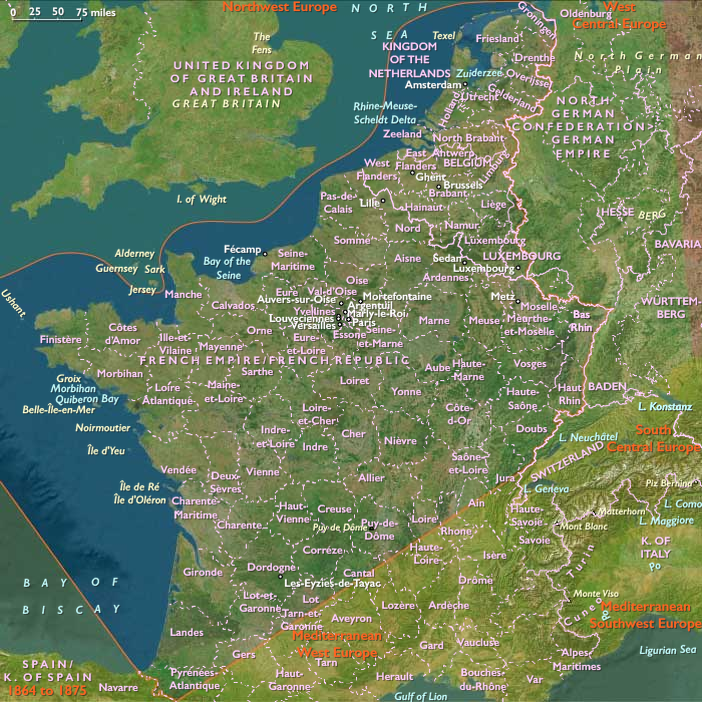
Although the paintings that Cézanne had shown in Paris at the exhibition in April 1874 had been the most severely criticized of any works exhibited, he continues to work diligently, periodically returning to Aix to soak up the light of Provence.
He and Camille Pissarro paint together intermittently through 1874, taking their canvases all over the countryside and painting out-of-doors, a technique that is still considered radical.
Pissarro persuades Cézanne to lighten his colors and shows him the advantages of using the broken bits of color and short brushstrokes that are the trademark of the Impressionists (and that Cézanne will come to use regularly, although with a different effect, in his later work.)
Even while under Pissarro's guidance and employing Impressionist techniques, however, Cézanne paints pictures clearly indicating that his vision is unique and that his purpose is quite different from that of the Impressionists.
His strokes, unlike those of the Impressionists, are not strewn with color; rather, they complement each other in a chromatic unity.
Unconcerned with emphasizing the objective vision presented by the light emanating from an object, Cézanne's explorations instead emphasize the underlying structure of the objects he paints.
Already he is composing with cubic masses and architectonic lines.
Images

Paul Cezanne: The House and the Tree (c.1874) oil on canvas, 66 x 55.5 cm, Private Collection
Locations
Topics
Subjects
Regions
West Europe
View →Subregions