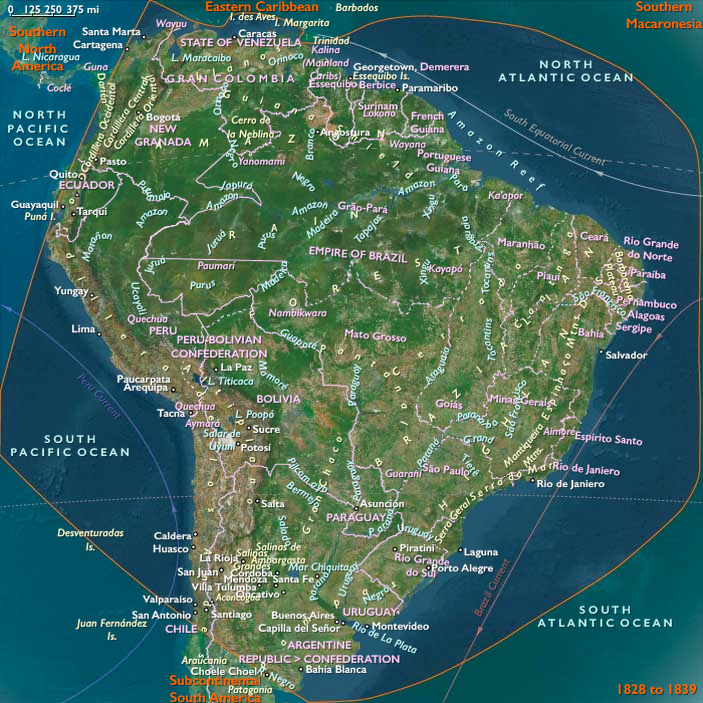
The Brazilian slavocrat agenda after 1826 has…
1828 CE to 1839 CE
The Brazilian slavocrat agenda after 1826 has been to control the court system; to provide harsh punishments for slave rebellion but mild ones for white revolt; to reduce the armed forces, cleansing them of foreigners unsympathetic to slavery; to keep tariffs low and eliminate the Bank of Brazil in order to deny the central government the ability to stimulate a rival, finance-based industrial capitalism; and to shape immigration policy in such a way as to encourage servile labor instead of independent farmers or craftsmen
Led by Bernardo Pereira de Vasconcelos of Minas Gerais in the assembly, slavocrats argue that slavery is not demoralizing, that foreign capital and technology will not help Brazil, and that railroads will only rust.
Others, such as Nicolau de Campos Vergueiro of Sao Paulo, argue in favor of replacing slavery with free European immigrants.
In the end, the Parliament establishes a contract system that is little better than slavery.
There will be no liberal empire.
Laws and decrees unacceptable to the slavocrats simply will not take effect, such as the order in 1829 forbidding slave ships to sail for Africa.
These items of the slavocrat agenda are the roots of the regional rebellions of the nineteenth century.
People
Groups
Commodities
Regions

South America
View →Subregions