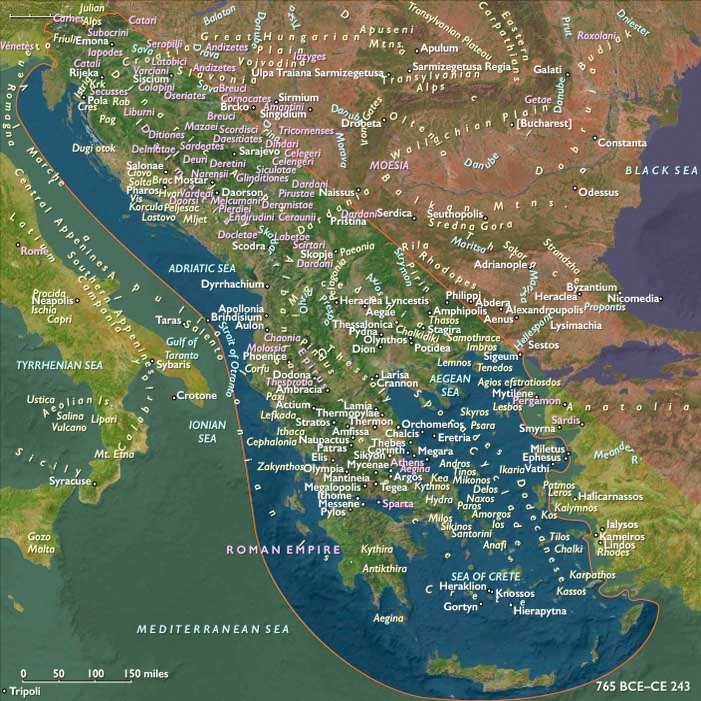
…Peisistratos invades Attica. At Pallene, near Mount…
549 BCE to 538 BCE
…Peisistratos invades Attica.
At Pallene, near Mount Hymettus, he launches a surprise attack on the Athenian army in the heat of midday, while his enemies are gambling or sleeping.
After a complete victory, Peisistratus becomes master of Athens for the third time.
Peisistratos maintains a mercenary bodyguard, composed in part of Scythian archers; possibly, he disarms the citizens; and he certainly places hostages from major families in safekeeping on the island of Naxos.
Yet, he preserves the constitutional forms of government and makes them operate more efficiently.
Some aristocrats cooperate and are permitted to hold the yearly post of archon; others go into exile.
Megacles and his Alcemeonid clan are once more banished; and, though he and, after him, his son Cleisthenes will continue to plot against Peisistratus, they will not succeed during the tyrant's lifetime.
The Athenians have begun to take over the lucrative vase-painting market dominated, until now, by the Etruscans.
Exekias, a Greek vase-painter and potter, works between approximately 550 BCE - 525 BCE at Athens.
Most of his vases, however, are exported to other regions of the Mediterranean, such as Etruria, while some of his other works remained in Athens.
Exekias works mainly with a technique called black-figure.
This technique involves figures and ornaments painted in black silhouette (using clay slip) with details added by linear incisions and the occasional use of red and white paint before firing.
Exekias is considered the most original and most detail-orientated painter and potter using the black-figure technique.
The vase-painter Andokides is thought to be a student of his.
Exekias of Athens paints elegant and sometimes somber scenes on vases and terra cotta plaques.
One of Exekias’ outstanding works, produced between 550 and 540, is an amphora that shows Achilles and Ajax playing at checkers.
Locations
Groups
Topics
Commodities
Subjects
Regions
Southeast Europe
View →Subregions