
The Colorado potato beetle, a major pest…
November 1824 CE
Native to America, it will spread rapidly in potato crops across America, then Europe from 1859 on.
Say, born in Philadelphia into a prominent Quaker family, is the great-grandson of John Bartram, and the great-nephew of William Bartram.
His father, Dr. Benjamin Say, is brother-in-law to another Bartram son, Moses Bartram.
The Say family has a house, "The Cliffs" at Gray's Ferry, adjoining the Bartram family farms in Kingessing township, Philadelphia County.
As a boy, Say often visited the family garden, Bartram's Garden, where he frequently took butterfly and beetle specimens to his great-uncle William.
He became an apothecary.
A self-taught naturalist, Say had helped found the Academy of Natural Sciences of Philadelphia (ANSP) in 1812.
In 1816, he met Charles Alexandre Lesueur, a French naturalist, malacologist, and ichthyologist who soon became a member of the Academy and serves as its curator until 1824.
At the Academy, Say began his work on what he will publish as American Entomology.
To collect insects, he made numerous expeditions to frontier areas, risking native attacks and the hazards of traveling in wild countryside.
In 1818, Say had accompanied his friend William Maclure, then the ANSP president and father of American geology; Gerhard Troost, a geologist; and other members of the Academy on a geological expedition to the off-shore islands of Georgia and Florida, then a Spanish colony.
In 1819–20, Major Stephen Harriman Long led an exploration to the Rocky Mountains and the tributaries of the Missouri River, with Say as zoologist.
Their official account of this expedition included the first descriptions of the coyote, swift fox, western kingbird, band-tailed pigeon, rock wren, Say's phoebe, lesser goldfinch, lark sparrow, lazuli bunting, orange-crowned warbler, checkered whiptail lizard, collared lizard, ground skink, western rat snake, and western ribbon snake.
In 1823, Say had served as chief zoologist in Long's expedition to the headwaters of the Mississippi River.
Subjects
Regions
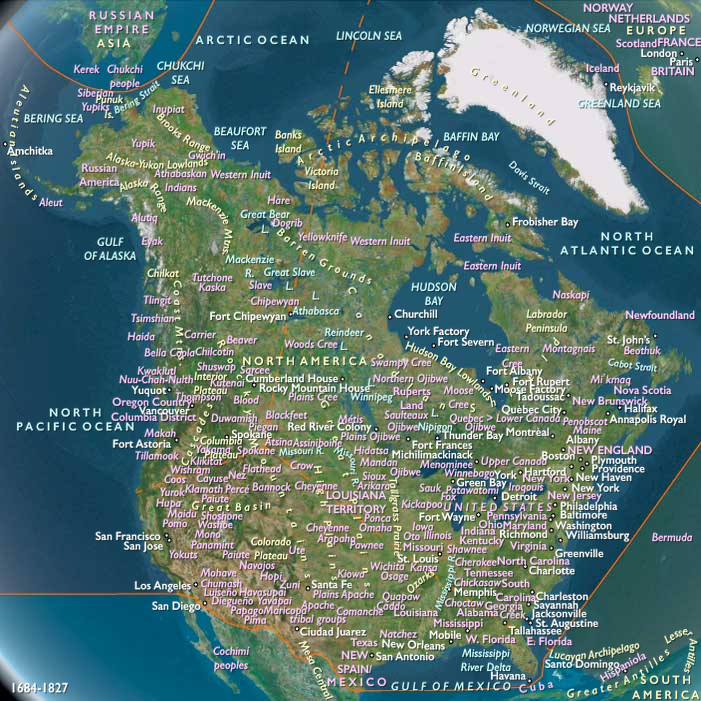
Northern North America
View →Subregions
