
Philip the Bold’s Regency and the Origins …
Years: 1404 - 1404
Philip the Bold’s Regency and the Origins of the Armagnac-Burgundian Feud (1392–1404)
In 1392, Philip the Bold, Duke of Burgundy, took advantage of King Charles VI’s deteriorating mental health to appoint himself regent of France, dismissing the king’s previous advisors. His seizure of power, however, had disastrous consequences for the unity of the House of Valois and for France itself, setting the stage for the long-running Burgundian-Orléanist conflict.
I. Philip the Bold vs. Louis of Orléans: A Rivalry for Power and Wealth
- Philip’s nephew, Louis, Duke of Orléans (the king’s younger brother), deeply resented being sidelined as regent, believing he should have been the natural leader of France in his brother’s absence.
- Their feud grew increasingly personal and political, with both competing for control of royal finances and influence at court:
- Louis of Orléans used royal funds to finance his extravagant lifestyle.
- Philip of Burgundy directed wealth toward his own ambitions in Burgundy and the Low Countries, strengthening his dynastic holdings.
- Despite their rivalry, Philip’s reputation in Paris remained strong, as he appeared a capable and pragmatic ruler in contrast to the reckless and spendthrift Orléans.
II. The Struggle for the Regency (1402–1404)
- In 1402, during a rare moment of lucidity, Charles VI officially named Louis of Orléans as regent.
- However, Louis’ poor governance, financial mismanagement, and growing unpopularity in Paris allowed Philip of Burgundy to regain control of France in 1404.
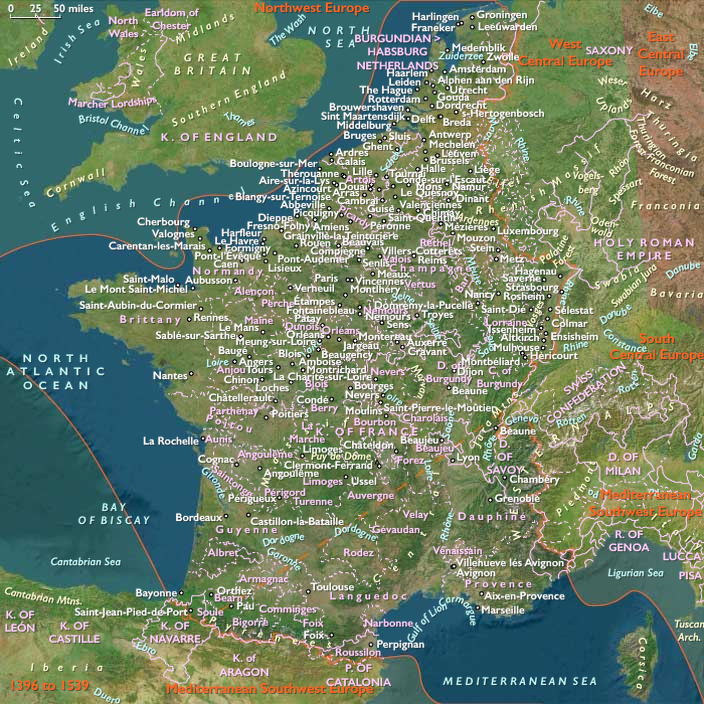
- Shortly after reclaiming the regency, Philip the Bold died on April 27, 1404, in Halle, County of Hainaut (modern Belgium).
III. The Legacy: The Burgundian-Orléanist Conflict Begins
- Philip’s death marked the beginning of a prolonged civil war between the Burgundians and the Orléanists, later known as the Armagnac-Burgundian War (1407–1435).
- His eldest son, John the Fearless, inherited his vast Burgundian territories and political position in France, continuing Philip’s rivalry with Louis of Orléans.
- This feud culminated in the assassination of Louis of Orléans in 1407, a key turning point in French history, leading to decades of internal conflict and English intervention in the Hundred Years’ War.
IV. Impact and Consequences
- Philip’s regency weakened the unity of the Valois dynasty, setting the stage for one of France’s most destructive internal conflicts.
- His political ambitions in Burgundy and the Low Countries laid the foundation for Burgundian expansion, making the duchy a major European power.
- The rivalry between Burgundy and Orléans deepened France’s vulnerability, ultimately facilitating English conquests during the Hundred Years’ War.
Philip the Bold’s rise to power as regent (1392) and subsequent death in 1404 marked the beginning of a bitter civil war within France, as the House of Burgundy and the House of Orléans vied for control of the kingdom, shaping the course of 15th-century French history.
Locations
People
Groups
Topics
Commodoties
Subjects
Regions
Subregions
Related Events
Showing 10 events out of 42616 total
Years: 1404 - 1404
Locations
People
Groups
Topics
Commodoties
Subjects
Regions
Subregions