
Phokas had been killed in 989 and …
Years: 991 - 991
Phokas had been killed in 989 and his followers had surrendered, and Basil II had reached an agreement with Skleros the following year.
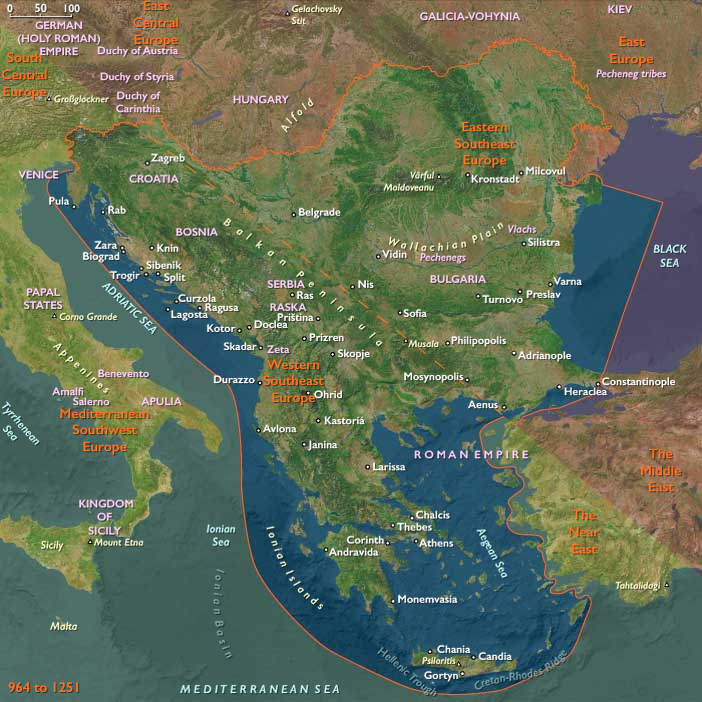
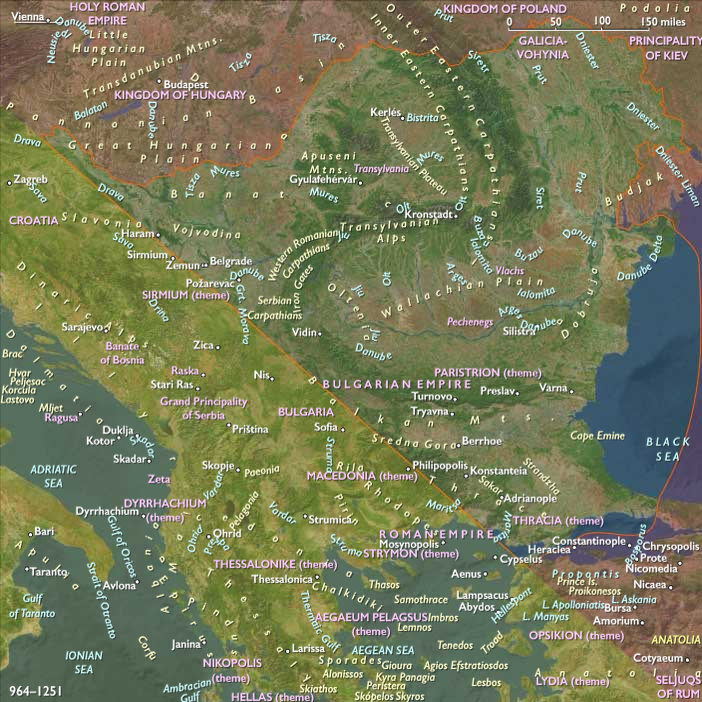
The Greeks focus their attention on Bulgaria, counterattacking in 991.
Although Roman is acknowledged as the official Bulgarian ruler, most of the military matters are left in the hands of Samuil, who is the youngest brother of the Comitopuli dynasty, and Roman devotes to the church deeds similar to his father Peter in his end of life.
During one of his invasions of Bulgaria, the Emperor Basil II succeeds in capturing Roman in 991.
The Bulgarian army is defeated; Samuel manages to escape.
Locations
People
Groups
- Christianity, Chalcedonian
- Greeks, Medieval (Byzantines)
- Bulgarians (South Slavs)
- Tao-Klarjeti (Georgian [Kartvelian] kingdoms and principalities)
- Roman Empire, Eastern: Macedonian dynasty
- Bulgarian Empire, First
Topics
Commodoties
Subjects
Regions
Subregions
Related Events
Filter results
Showing 10 events out of 52215 total
One group of nomadic Ghuzz, or Oguz, Turkmen tribes, led by a chief named Seljuq, had during the tenth-century migrations of the Turkish peoples from Central Asia and southeast Russia split off from the bulk of the Tokuz-Oghuz, a confederacy of nine clans long settled between the Aral and Caspian Sea, and in 985 set up camp on the right bank of the lower Syr Darya (Jaxartes), in the direction of Jend, near Kzyl Orda in present day south-central Kazakhstan.
Here, in 985, Seljuq had converted to Islam.
The biblical names of his four sons—Mikâîl (Michael), Isrâîl (Israel), Mûsâ (Moses), and Yûnus (Jonah)—suggest previous acquaintance with either Khazar Judaism or Nestorian Christianity.
According to some sources, Seljuq had begun his career as an officer in the Khazar army.
The Seljuq clan has played a part in the frontier defense forces of the Iranian Samanid dynasty, which is now on the verge of collapse.
The Lutici federation of West Slavic Polabian tribes had remained quiet during the early years of Otto III's reign, even during Henry II's failed rebellion.
In 983, following Otto II's defeat at the battle of Stilo, the Slavs had revolted against Imperial control, forcing the Empire to abandon its territories east of the Elbe Rivier in the Northern March and the Billung March.
With the process of Christianization halted, the Slavs had left the Empire in peace, and with Henry II's rebellion put down, Theophanu had launched multiple campaigns to reconquer the lost eastern territories, beginning in 985.
Even though he was only six at the time, Otto III had personally participated in these campaigns.
During the expedition of 986 against the Slavs, Otto III had received the homage of Duke Meiszko I of Poland, who had provided the Imperial army with military assistance and had given Otto III a camel.
Although the Lutici were subdued for a time in 987, they have continued to occupy the young king’s attention.
When Otto III is eleven, Slavic raiders capture the city of Brandenburg in September 991.
The three-year-old son of Otto II, the third ruler of the Saxon or Ottonian dynasty of the Holy Roman Empire, had been acclaimed King of Germany in Verona in June 983, and crowned, as Otto III, in Aachen on December 25 the same year.
His father had died four days before the ceremony, but the news did not reach Germany until after the coronation.
Henry the Quarrelsome, who had been deposed as Duke of Bavaria by Otto II, had seized Otto in early 984 and claimed the regency as a member of the reigning house.
To further his object he had made an alliance with Lothair of France.
Willigis, Archbishop of Mainz, the leader of Otto's party, had induced Henry to release the imprisoned king, for which his Duchy of Bavaria was restored.
Otto had thus been returned to his mother, the Imperial Greek princess Theophanu, who then began serving as regent.
Abandoning her husband's imperialistic policy, she had devoted herself entirely to furthering an alliance between Church and Empire.
She had been unable, however, to prevent France from speedily freeing herself from German influence.
The regent has endeavored to watch over the national questions of the Eastern Empire.
One of the greatest achievements of this empress has been her success in maintaining feudal supremacy over Bohemia.
When her husband Otto I died in 973, Adelaide of Italy, also called Adelaide of Burgundy, perhaps the most prominent European woman of the tenth century, had been succeeded by their son Otto II, and Adelaide for some years had exercised a powerful influence at court.
Later, however, her daughter-in-law, Theophanu, had turned her husband Otto II against his mother, and she had been driven from court in 978; she had lived partly in Italy, and partly with her brother Conrad, king of Burgundy, by whose mediation she had ultimately been reconciled to her son; in 983, Otto had appointed her his viceroy in Italy.
However, Otto had died the same year, and although both mother and grandmother had been appointed as co-regents for the child-king, Otto III, Theophanu had forced Adelaide to abdicate and exiled her.
When Theophanu dies in 991, Adelaide is restored to the regency of her grandson.
She is assisted by Willigis, bishop of Mainz.
The Slavic invasion, as well as an incursion of Viking raiders, forces Otto III to lead his army against the invaders in 992; he suffers a crushing defeat in this campaign.
The Fatimids, disregarding the truce with Constantinople, launch a campaign in 991 against the Hamdanid Emirate of Aleppo, an imperial protectorate, perhaps in the belief that Constantinople will not interfere.
Odo I of Blois: A Staunch Carolingian Loyalist in the Capetian Struggle (977–996)
Odo I, Count of Blois, was a powerful noble and a staunch supporter of the Carolingian cause, standing in opposition to Hugh Capet and the newly established Capetian dynasty. His alliances and military campaigns placed him at the center of the struggles for control over France and Brittany in the late 10th century.
Inheritance and Early Conflicts
- Odo inherited his father’s vast holdings in Blois, Chartres, Châteaudun, Tours, and Saumur after Theobald I's death around 977.
- Following his father’s war with Archbishop Odalric of Reims over the Castle of Coucy, Odo received the castle and held it as a fief of the archbishopric.
Expansion into Brittany and Rivalry with Conan I
- During the 970s, Odo extended his influence into Brittany, subjugating the County of Rennes.
- However, in 990, Conan I, newly established as Duke of Brittany, asserted his family’s ancestral rights in the region, challenging Odo’s dominance.
Alliance with Charles of Lorraine (988)
- Odo remained loyal to the Carolingians, aligning himself with Charles of Lorraine, the last legitimate Carolingian heir.
- In 988, he aided Charles in seizing Laon, a key stronghold in the battle against Hugh Capet.
Turning Against the Carolingians and Conflict with Hugh Capet (991–996)
By 991, however, Odo abandoned the Carolingian cause, likely recognizing the waning prospects of Charles of Lorraine.
- At Dreux, he withdrew his support for the Lorrainers, signaling a shift in his ambitions.
- Instead, he besieged Melun, a stronghold belonging to Bouchard the Venerable, a loyal vassal of Hugh Capet.
Hugh, responding to this direct challenge to his authority, assembled a powerful coalition:
- Richard I of Normandy, an early Capetian supporter.
- Fulk Nerra, Count of Anjou, a rival of Odo and a key ally of the Capetians.
Under pressure from this formidable alliance, Odo was forced to lift the siege, dealing a setback to his ambitions.
Legacy and Impact
Despite his initial support for the Carolingians, Odo ultimately acted in his own interests, shifting allegiances as needed. His involvement in Brittany, the wars of succession, and conflicts with the Capetians ensured that the House of Blois remained a major player in France’s feudal landscape. However, his failure to decisively challenge Hugh Capet reinforced the Capetians' consolidation of power, marking the beginning of a new era in French monarchy.
The Anglo-Norman Peace of 991: Papal Mediation and Diplomatic Settlement
During the late 10th century, the Normans, still aware of their Scandinavian origins, maintained a favorable disposition toward their Danish cousins, who continued their raids across the North Sea, particularly targeting England. This relationship led to growing tensions between the English and Norman courts, as English rulers viewed Normandy as a refuge and support base for Viking raiders.
Norman Hospitality Toward the Danes
- Danish raiders, returning from campaigns in England, often sought harbor in Normandy, where they were welcomed as kin by their Norman counterparts.
- The English monarchy, facing increasing Viking incursions, saw this as an act of implicit support for their enemies, heightening hostilities between King Æthelred II of England and Duke Richard I of Normandy.
Papal Intervention: Pope John XV Seeks Reconciliation
- As word of the Anglo-Norman enmity reached Pope John XV, he sought to dissolve the hostility between the two courts.
- The pope took diplomatic steps to mediate the conflict, urging both rulers to seek a peaceful resolution rather than risk prolonged tensions.
The Treaty of Rouen (991)
- The diplomatic efforts culminated in a formal peace agreement, ratified in Rouen in 991, between England and Normandy.
- The treaty eased tensions by ensuring that Normandy would no longer serve as a base for Danish raiders.
- In return, England recognized Normandy’s autonomy, ensuring peaceful relations between the two emerging powers.
Impact and Legacy
The Anglo-Norman peace of 991 helped establish a period of relative stability between England and Normandy. However, Norman-English relations would remain complex, culminating decades later in the Norman Conquest of England (1066), when Duke William of Normandy would claim the English throne, forever altering the course of both realms.
Sigeric, educated at Glastonbury Abbey, where he had taken holy orders, had been elected Abbot of St. Augustine's in about 975 to 990, and in 985 or 986 had been consecrated by Archbishop Dunstan to the See of Ramsbury and Sonning.
He had been transferred in 990 to the see of Canterbury; he may have been a disciple of Dunstan's.
Sigeric had made the pilgrimage to Rome following the Via Francigena to receive his pallium circa 990, and contemporary records of this journey still exist.
he Deposition of Arnulf and the Contested Appointment of Gerbert of Aurillac (991–996)
By 991, Hugh Capet had secured his dynasty’s future by making his son, Robert II, joint sovereign, ensuring a smooth Capetian succession. However, he still faced a lingering Carolingian threat, particularly from Charles of Lorraine and his nephew, Arnulf of Reims, both of whom had sought to restore Carolingian rule.
The Synod of Reims and the Deposition of Arnulf (June 991)
After capturing both Charles of Lorraine and Archbishop Arnulf, Hugh Capet sought to eliminate the Carolingian presence from ecclesiastical and political power.
- In June 991, he convened a synod at Reims, composed of loyal French bishops, to formalize his control over the archbishopric.
- The synod obediently deposed Arnulf, citing his betrayal in supporting Charles of Lorraine against the Capetians.
- To replace him, the bishops elected Gerbert of Aurillac, one of the most brilliant scholars of the age and a staunch supporter of the Capetian cause.
Rome’s Rejection and the Summoning of an Imperial Synod
Despite Hugh’s efforts, Gerbert’s appointment faced strong opposition:
- Pope John XV refused to recognize the legitimacy of the Reims synod, declaring that a French royal council lacked authority to depose an archbishop without papal approval.
- The pope called for a second synod, held outside of Capetian territory, in the imperial city of Aachen, to reconsider Arnulf’s case.
- When the French bishops refused to attend, Pope John XV summoned them to Rome, demanding an independent ruling on Arnulf’s deposition.
French Defiance and the Struggle Over Church Authority
The Capetian-aligned bishops declined to travel to Rome, citing unsettled conditions on the route and political instability in the city. Their refusal underscored the growing tensions between the papacy and the emerging Capetian monarchy, as Hugh Capet sought to assert greater royal control over the French Church, a pattern that would continue throughout the medieval period.
Legacy: The Rise of Gerbert and Capetian-Papal Tensions
- Though Gerbert of Aurillac remained in Reims for a time, his position was not universally accepted, forcing him to later align with the Ottonians in the Holy Roman Empire.
- Arnulf, though deposed, still had support from Rome, reflecting the ongoing struggle between the pope and secular rulers over ecclesiastical appointments.
- This conflict over Reims foreshadowed later investiture struggles, as monarchs sought to secure loyal clergy while the papacy insisted on supremacy in Church matters.
Though Hugh Capet succeeded in neutralizing the Carolingian threat, his defiance of papal authority set an early precedent for Capetian involvement in ecclesiastical affairs, a dynamic that would shape French monarchy-church relations for centuries.
A sizable Danish fleet begins a sustained campaign in the southeast of England, arriving in August of 991 off Folkestone, in Kent, and making its way around the southeast coast and up the river Blackwater, coming eventually to its estuary and occupying Northey Island.
About two kilometers east of Northey lies the coastal town of Maldon, where Byrhtnoth, ealdorman of Essex, is stationed with a company of thegns.
The battle that follows between English and Danes on August 10 is immortalized by the Old English poem The Battle of Maldon, which describes the doomed but heroic attempt of Byrhtnoth to defend the coast of Essex against overwhelming odds.
This is the first of a series of crushing defeats felt by the English at the hands of first Danish raiders, then organized Danish armies.
Years: 991 - 991
Locations
People
Groups
- Christianity, Chalcedonian
- Greeks, Medieval (Byzantines)
- Bulgarians (South Slavs)
- Tao-Klarjeti (Georgian [Kartvelian] kingdoms and principalities)
- Roman Empire, Eastern: Macedonian dynasty
- Bulgarian Empire, First
