Plague breaks out in 740 in Sicily, …
Years: 740 - 740
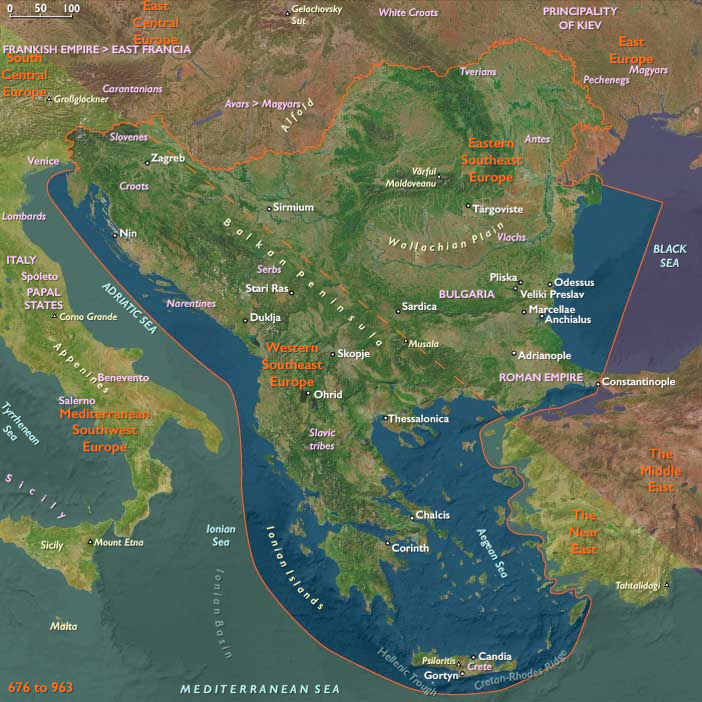
Plague breaks out in 740 in Sicily, Calabria, and Monemvasia.
Related Events
Filter results
Showing 10 events out of 55436 total
The Tang Dynasty government, much to the delight of the citizens of Chang'an, orders fruit trees to be planted along every main avenue of the city, which enriches not only the diets of the people but also the surroundings.
The Khazars, having been compelled to shift the center of their empire northward after 737, establish their capital at Itil (located near the mouth of the Volga River) and accept the Caucasus Mountains as their southern boundary.
During the same period, however, they expand westward.
The most striking characteristic of the Khazars is the apparent adoption of Judaism by the khagan—a secluded supreme ruler of semireligious character—and the greater part of the ruling class in about 740.
The circumstances of the conversion remain obscure, the depth of their adoption of Judaism difficult to assess; but the fact itself is undisputed and unparalleled in central Eurasian history.
A few scholars have asserted that the Judaized Khazars are the remote ancestors of many eastern European and Russian Jews, later known as Ashkenazim.
Whatever the case may be, religious tolerance is practiced in the Khazar empire, and paganism continues to flourish among the population.
Russian archaeologists will announce in 1999 that they had successfully reconstructed a Khazarian vessel from the Don River region, revealing four inscriptions of the word “Israel” in Hebrew lettering.
It is today the accepted opinion among most scholars in the field that the conversion of the Khazars to Judaism was widespread, and not limited merely to the royal house and nobility.
According to tenth-century Khazar King Joseph, in his Reply to Hasdai ibn-Shaprut (c. 955): “After those days there arose from the sons of [khagan] Bulan's sons a king, Obadiah by name.
He was an upright and just man.
He reorganized the kingdom and established the Jewish religion properly and correctly.
He built synagogues and schools, brought in many Israelite sages, honored them with silver and gold, and they explained to him the 24 Books of the Bible, Mishnah, Talmud, and the order of prayers established by the Khazzans.
He was a man who feared God and loved the law and the commandments.”
Leo has secured the Empire's frontiers by inviting Slavic settlers into the depopulated districts and by restoring the army to efficiency.
Akroinon is a major success for the imperial forces, as it is the first large-scale victory they have scored in a pitched battle against the Arabs.
Seeing it as evidence of God's renewed favor, the victory also serves to strengthen Leo's belief in the policy of iconoclasm that he had adopted some years before.
His military efforts are supplemented by his alliances with the Khazars and the Georgians.
Leo's victory has freed Asia Minor from any immediate serious threat of Arab conquest, and it will make possible the forceful counteroffensive and reconquest of some lost territory in the subsequent reign of his son, Constantine V.
The Empire, as the largest, richest and militarily strongest state bordering the expanding Caliphate, has been the Muslims' primary enemy, aince the beginning of the Muslim conquests.
Following the disastrous Battle of Sebastopolis in 692, the imperial armies have largely confined themselves to a defensive strategy, while the Muslim armies regularly launch raids into imperially held Anatolia.
Following their failure to capture the imperial capital, Constantinople, in 717–718, the Umayyads for a time had diverted their attention elsewhere.
From 720/721, however, they had resumed these expeditions in a regular pattern: each summer one or two campaigns have been launched, sometimes accompanied by a naval attack and/or followed by winter expeditions.
These are no longer aimed at permanent conquest but rather large-scale raids, plundering and devastating the countryside and only occasionally attacking forts or major settlements.
The raids of this period are also largely confined to the central Anatolian plateau (chiefly its eastern half, Cappadocia), and only rarely reach the peripheral coastlands.
Under the more aggressive Caliph Hisham ibn Abd al-Malik, these raids have become more important and have been led by some of the Caliphate's most capable generals, including princes of the Umayyad dynasty, like Maslama ibn Abd al-Malik or Hisham's own sons Mu'awiyah, Maslama and Sulayman.
Gradually, however, the Muslim successes have become fewer, especially as their resources are drawn into the mounting conflict with the Khazars.
The raids continue, but the Arab and Byzantine chroniclers mention fewer successful captures of forts or towns.
Nevertheless, after a major victory over the Khazars in 737 had relieved them of pressure in the Caucasus, the Arabs have intensified their campaigns against the Empire: in 738 and 739, Maslama ibn Hisham has achieved a number of successes, including the capture of the town of Ancyra.

Sulayman, son of the caliph Hisham, is first attested as leading the northern summer expedition ("of the right") against imperially held Anatolia in 732, and again in 735, in 736 (this time into Armenia) and in 737, but on neither campaign does he seem to have accomplished anything of note.
In 738 however, he had sacked an imperial fortress called Sideroun ("Iron Fort") taking many prisoners, including its commander, Eustathios.
In 740, he is placed in overall charge of the exceptionally large campaign prepared for that year, which according to the chronicle of Theophanes the Confessor totaled ninety thousand men.
Two task forces are sent first, one of ten thousand lightly armed men under al-Ghamr ibn Yazid, which is to raid the western coast of Anatolia, and twenty thousand under Abdallah al-Battal and al-Malik ibn Su'aib, who follows after towards Akroinon.
The main force of some sixty thousand (the number is certainly much inflated), under Sulayman, raids Cappadocia with Tyana as their target.
Sulayman fails to take the city, and returns home after plundering the countryside.
The second task force, however, suffers a major defeat at the Battle of Akroinon, losing some two thirds of its men, as well as its commanders.
Details of the battle are not known, but the Emperor, Leo III, secures a crushing victory: both Arab commanders fall, as well as the larger part of their army.
About six thousand eight hundred resist, however, and manage to conduct an orderly retreat to …
…Synnada, where they join Sulayman.
The other two forces devastate the countryside unopposed, but fail to take any towns or forts.
In addition, the Arab invasion army suffers from severe hunger and lack of supplies before returning to Syria.
The tenth-century Arab Christian historian Agapius also records that the imperial army took twenty thousand prisoners from the invading forces.
Forced to fall back toward Damascus, the Caliphal forces leave Asia Minor to imperial control.
As-Saffah is the head of one branch of the Banu Hāshim from Arabia, a subclan of the famous Quraysh tribe who trace their lineage to Hāshim, a great-grandfather of the Prophet Muhammad via 'Abbās, an uncle of the Prophet, hence the title "Abbasid" for his descendants' caliphate.
This indirect link to the Prophet's larger clan forms sufficient basis for As-Saffah's claim to the title caliph.
However, the tradition that 'Abbās himself never converted to Islam or only halfheartedly weakens that legitimacy in some eyes.
As narrated in many hadith, many believed that in the end times a great leader or mahdi would appear from the family of the Prophet Muhammad, to which Ali belonged, who would deliver Islam from corrupt leadership.
The halfhearted policies of the later Umayyads to tolerate non-Arab Muslims and Shi'as have failed to quell unrest among these minorities.
During the reign of late Umayyad Caliph Hisham ibn Abd al-Malik, this unrest has led to revolt in Kufa, now a prominent Muslim city in southern Iraq.
Shi'ites had revolted in 736 and hold the city until 740, led by Zayd ibn Ali, a grandson of the famous martyr Husayn and another member of the Banu Hashim.
Zayd's rebellion fails, and is put down by Umayyad armies in 740.
The revolt in Kufa indicates both the strength of the Umayyads and the growing unrest in the Muslim world.
Leo, failing in his efforts to restore imperial authority in the west, places Illyria, Calabria, and Sicily—all currently controlled by the pope—under the jurisdiction of the patriarch of Constantinople, thus permitting a unified program of re-Christianization of much of this region. (The Albanian lands for centuries hereafter will become an arena for the ecclesiastical struggle between Rome and Constantinople.
Most Albanians living in the southern and central regions, the majority, will become Orthodox, while …
…those in the mountainous north will become Roman Catholic.)