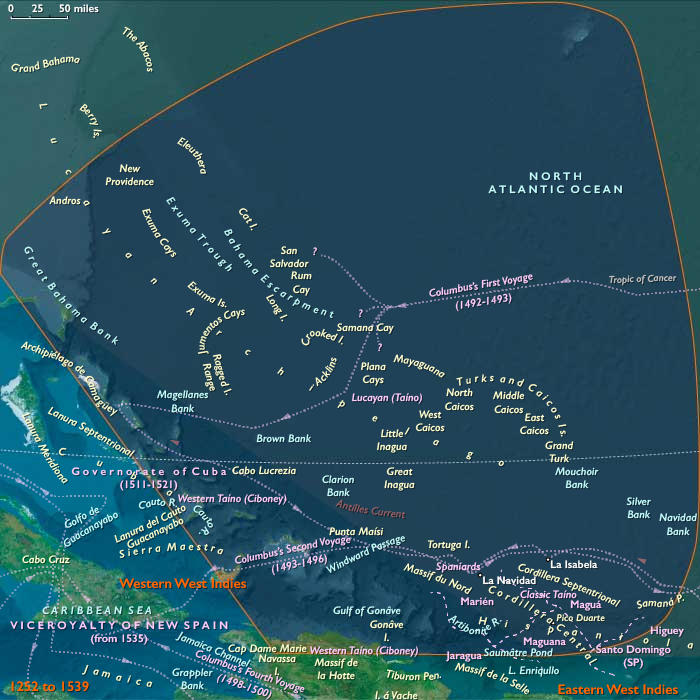
...Plana Cays. The indigenous people he encounters,…
October 1492 CE
...Plana Cays.
The indigenous people he encounters, the Lucayan, Taíno, or Arawak, are peaceful and friendly.
Noting their gold ear ornaments, Columbus takes some of the Arawaks prisoner and insists that they guide him to the source of the gold.
Apparently believing he has reached the Indies, or at least the east coast of Asia, Columbus calls them Indians.
From the entry in his journal of October 12, 1492, in which he writes of them, "Many of the men I have seen have scars on their bodies, and when I made signs to them to find out how this happened, they indicated that people from other nearby islands come to San Salvador to capture them; they defend themselves the best they can.
I believe that people from the mainland come here to take them as slaves.
They ought to make good and skilled servants, for they repeat very quickly whatever we say to them.
I think they can very easily be made Christians, for they seem to have no religion.
If it pleases our Lord, I will take six of them to Your Highnesses when I depart, in order that they may learn our language."
Columbus remarks that their lack of modern weaponry and metal-forged swords or pikes is a tactical vulnerability, writing, "I could conquer the whole of them with 50 men, and govern them as I pleased."
After visiting and naming a few more islands in the Bahamas (inhabited by an estimated forty thousand Lucayans, with a population of about four thousand on Grand Bahama Island alone), the explorers take on board a number of locals, then make their way to Cuba, the largest island in the Antilles archipelago.
Locations
People
Groups
Topics
Commodities
Subjects
Regions
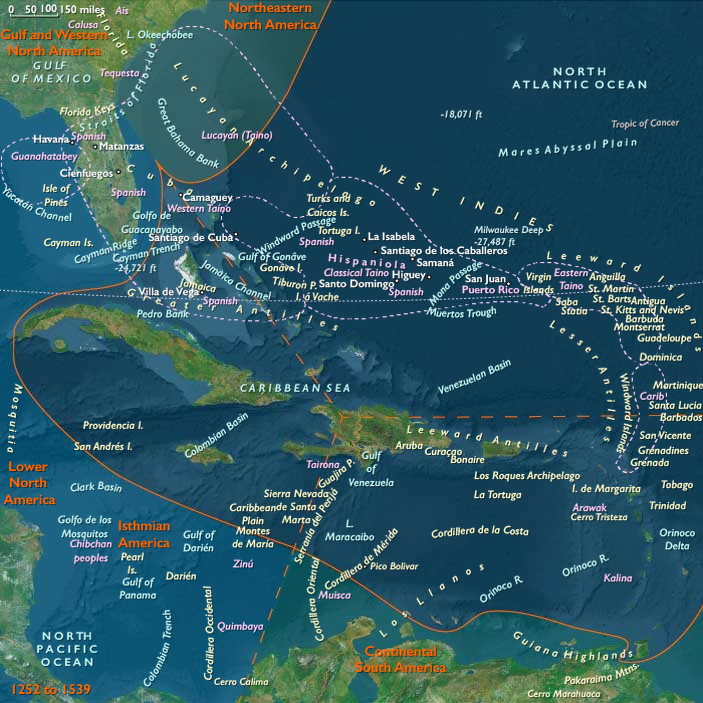
West Indies
View →Subregions