Poland’s energetic ruler, Boleslaw I, had inherited…
1000 CE
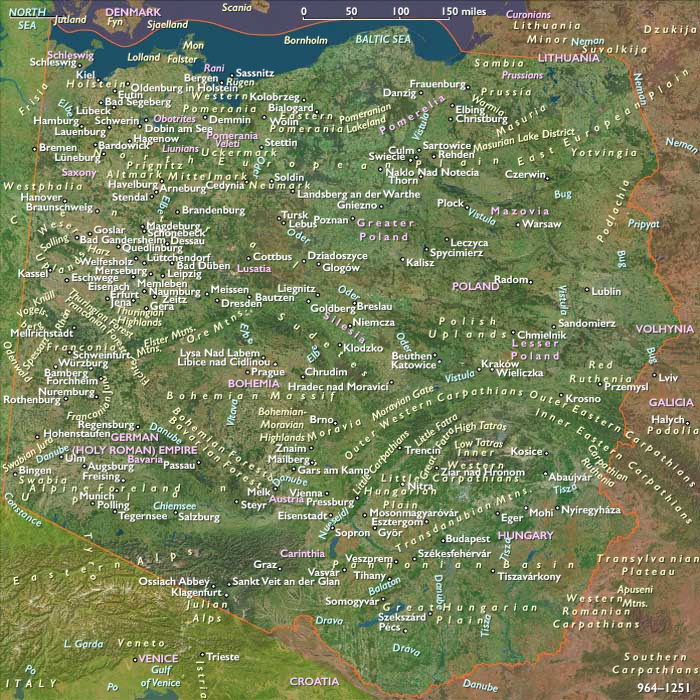
Poland’s energetic ruler, Boleslaw I, had inherited from his father a realm that was close in dimensions to modern-day Poland, centered on the core of Polanian country, the later Greater Poland (Wielkopolska).
Greater Poland encompasses the valley of river Warta, stretches to the north to the Noteć river and to the south it encompasses Kalisz.
Outside of this core, the nascent Poland included the surrounding areas subdued by Boleslaw's father, Mieszko I which included parts of Pomerania to the north, including Kolobrzeg in the west and Gdańsk in the east, Mazovia with its capital at Plock to the east and Silesia to the southwest.
It is disputed whether Lesser Poland, centered around Kraków, was incorporated into the Polish realm by Mieszko I before 992 or whether it was added by Boleslaw in 999.
In either case, Boleslaw is by the year 1000 the lord of a domain larger than contemporary England, Denmark, León or Burgundy.
Not only has he not met any internal opposition, but he has furthermore gained the respect of Otto III, King of Germany and Roman Emperor.
Having consolidated his position as Duke (Dux) of Poland by the year 1000, Boleslaw ransoms from the pagan Prussians the relics of the martyred and recently canonized Bishop Adalbert (Vojtěch), bishop of Prague, and buries the relics at Gniezno in a ceremony held in March.
Otto III, Adalbert's former student and Boleslaw's ally since 992, attends the ceremony, visiting Poland under the pretext of a pilgrimage to the grave of his martyred friend.
In addition to the religious motivation, Otto III's voyage also carries a strong political agenda: he has intentions to renew the Holy Roman Empire based on a federal concept he calls "Renovatio Imperii Romanorum".
Within the federal framework, Polish and Hungarian duchies are to be upgraded to eastern federati of the empire.
The Emperor needs to assess Poland's strength and establish its status within the Holy Roman Empire.
The ensuing Congress of Gniezno, where Boleslaw entertains his distinguished guest, is one of the most famous episodes of medieval Polish history.
During the time the emperor spends in Poland, Boleslaw does not hide the wealth of his country: instead, he shows off its affluence at every step as he tries to dazzle the emperor.
Among other gifts the Polish ruler presents to Otto III are three hundred armored knights, while the Emperor responds with a gift of a copy of the lance of Saint Maurice.
Evidently, Otto III is impressed with what he sees and decides that Poland should be treated as a kingdom on par with Germany and Italy, not merely as a tributary duchy like Bohemia.
Since Otto III has intentions to renew the Empire it is towards this end that the Emperor places his Imperial crown on Boleslaw's brow and invests him with the titles frater et cooperator Imperii ("Brother and Partner of the Empire") and populi Romani amicus et socius.
He also raises Boleslaw to the dignity of patricius or "elder of the Roman nation".
This episode has long been a subject of debate among historians.
Some historians see this as an act of favor between an Emperor and his vassal, others as a gesture of friendship between equals.
Could placing of the Imperial crown on Boleslaw's head mean that the Emperor crowned the Polish Duke?
Most modern historians agree that it could not.
It is undoubtedly a sign of Otto's respect for the Polish ruler, but it cannot truly mean Boleslaw is King as only the Pope has the authority to invest a prince with the crown and elevate his realm to a status of a kingdom.
According to one source, afterwards Boleslaw traveled with the Emperor to Aix-la-Chapelle where Otto III had the tomb of Charlemagne opened.
From there Otto III is reputed to have removed the Imperial throne itself and presented it to the Polish Duke.
Other political talks take place as well.
Otto III decides that Poland will no longer be required to pay tribute to the Empire.
Gniezno is confirmed as an Archbishopric and a Metropolitan See for the Polish area.
Locations
Groups
Commodities
Regions
Central Europe
View →Subregions