
The poet Sebastian Klonowic, a Polish burgher,…
1587 CE
The poet Sebastian Klonowic, a Polish burgher, had settled first in Lwów (now Lviv, Ukraine) and eventually in Lublin, where he has become mayor and a municipal juror.
In the Latin poem “Roxolania” (written 1584) he had given the first complete account of the Ruthenian geography, landscape, and people.
In the satirical and didactic Latin poem Victoria deorum (1587; “The Victory of the Gods”) Klonowic contends that true nobility depends not upon birth but upon character.
Locations
Subjects
Regions
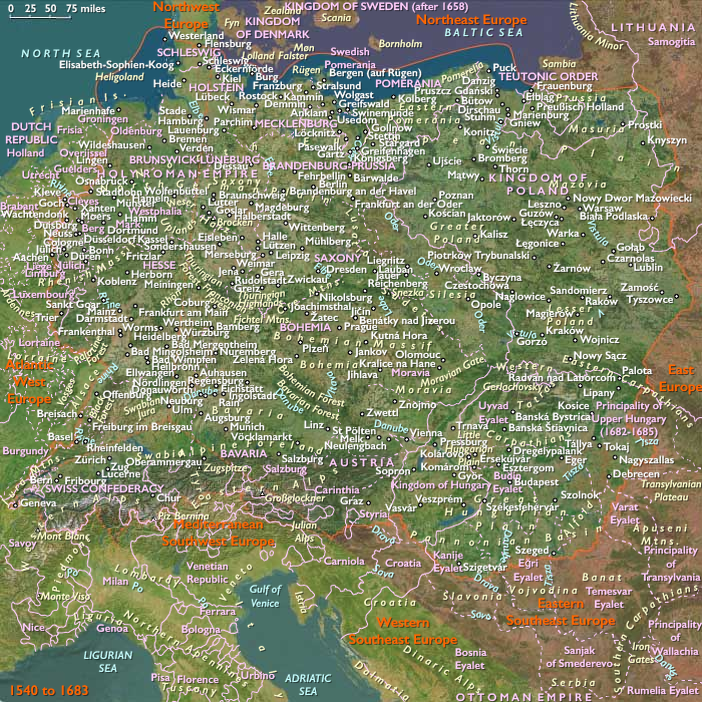
Central Europe
View →Subregions
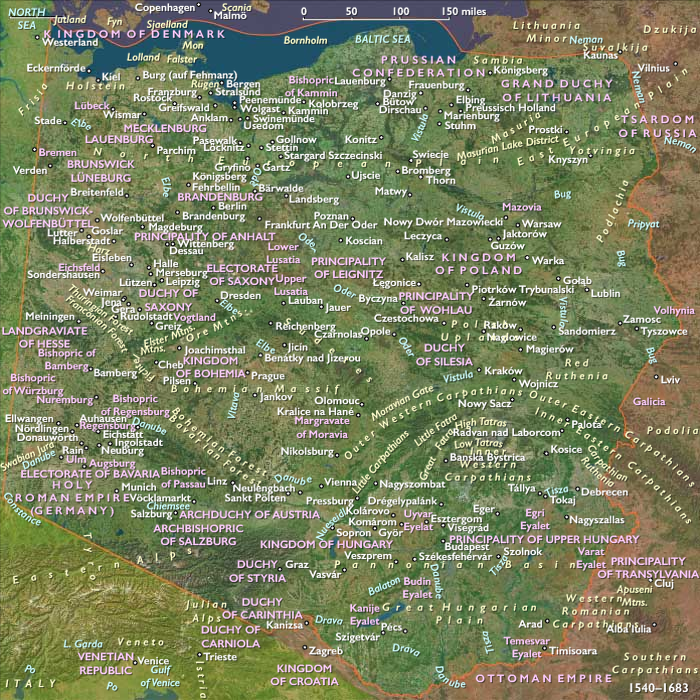
East Central Europe
View →Related Events
No active filters.
Showing 10 events out of 34623 total
Hideyoshi, like Nobunaga, spends great amounts of time and money indulging his cultural proclivities, especially the tea ceremony (chanoyu).
Like Nobunaga, Hideyoshi collects valuable tea bowls, caddies, and other implements associated with the rituals of the ceremony, and Hideyoshi favors enormous social events, such as the massive tea party scheduled to last for several days in Kyoto in 1587.
The Shimazu family, a powerful warrior clan founded in the twelfth century, has prospered by taking advantage of trade with Korea and the Ryukyu Islands and by the sixteenth century had become the major power in southwestern Japan, also controlling most of the island of Kyushu.
The Shimazu are finally defeated by Hideyoshi in 1587 in his efforts to reunify Japan.
Hideyoshi allows them to keep the southern part of their domain, and hereafter they become one of his staunchest allies.
Wawrzyniec Goslicki is the only prelate who, in 1587, signs the Compact of Warsaw granting equal rights to all Poles in matters of religion.
Under his Latin name of Laurentius Grimalus, Goslicki had in 1568 published in Venice his principal work, De optimo senatore, a political tract precursory to Catholic liberalism.
He had in 1569 joined the royal chancery and served two Polish kings, Sigismund II Augustus and Stephen Báthory and had in 1586 been appointed bishop of Kamieniec Podolski.
Opposing absolute monarchy and supremacy of the people, Goslicki recommends that the senate should stand between the sovereign and the people, controlling the sovereign and representing the people.
He is one of the earliest political theorists to advocate the right of revolt against tyranny.
Azerbaijan remains the goal of Ottoman actions in the ongoing war that began in 1578, but Safavid counteroffensives relieve Tabriz from Turkish hands and ...
...overcome (if momentarily) Tiflis and ...
...Erivan.
Safavid court painter Mirza 'Ali, a native of western Iran, was a son of the painter Sultan Muhammad, who was one of his teachers.
A master of line, Muhammadi (so called after his great father) had begun to paint while still young.
The surviving examples of his work were executed between the 1530s and the 1580s, an unusually long period of activity.
He has worked on some of the greatest Safavid manuscripts, including Tahmasp I's Shah-nameh and the Khamseh (1539–43) of Nezami.
His debt to the Herat painters of the school of Behzad is clear, but he is best known for a calligraphic, wiry line and a mannered, almost expressionist, personal style.
This assertion of the individuality of the painter marks Safavid painting hereafter.
Like his contemporaries, Muhammadi signs few of his paintings.
Akbar's efforts to develop a revenue schedule both convenient to the peasants and sufficiently profitable to the state have taken some two decades to implement.
He had in 1580 obtained the previous ten years' local revenue statistics, detailing productivity and price fluctuations, and averaged the produce of different crops and their prices.
He also has evolved a permanent schedule circle by grouping together the districts having homogeneous agricultural conditions.
For measuring land area, he has abandoned the use of hemp rope in favor of a more definitive method using lengths of bamboo joined with iron rings.
Developed largely under the supervision of his famed Hindu minister Todar Mal., Akbar’s administration fixes the revenue according to the continuity of cultivation and quality of soil, which ranges from one-third to one-half of production value and is payable in copper coin (dams).
The peasants thus have to enter the market and sell their produce in order to meet the assessment.
This system, called zabt, applies in North India and ...
...in Malwa and ...
...parts of Gujarat.
The earlier practices (e.g., crop sharing), however, also are in vogue in the empire.
The new system encourages a rapid nexus of cash and economic expansion.
Moneylenders and grain dealers become increasingly active in the countryside.