
Gregory, who Pelagius had in 579 made …
Years: 590 - 590
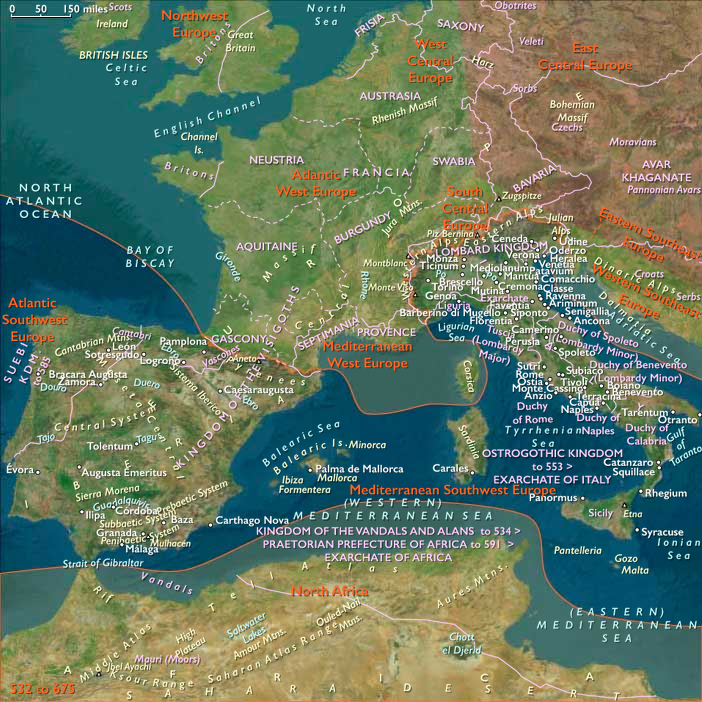
Gregory, who Pelagius had in 579 made permanent papal ambassador at the court of Emperor Tiberius in Constantinople, had returned to his monastery from a five-year stint in Constantinople, and had been elected abbot.
As bishop, he has organized and increases the revenues from the Roman ecclesiastical estates, which he uses largely to ameliorate the social misery of the day.
Pelagius has appealed for help against the Lombards from Emperor Maurice, the Roman Senate having made him a gift of thousands of pounds of gold for this purpose, but Constantinople has been of little help.
Pelagius had been forced to buy a truce and turn to the Franks, who had invaded Italy but departed after being bribed by the Lombards.
Locations
People
Groups
- Lombards (West Germanic tribe)
- East, or Oriens, Praetorian prefecture of
- Christianity, Chalcedonian
- Roman Empire, Eastern: Justinian dynasty
- Rome, Duchy of
- Lombards (Italy), Kingdom of the
Subjects
Regions
Subregions

Related Events
Filter results
Showing 10 events out of 167 total
The Tay Son have in the meantime overcome the crumbling Trinh dynasty by 1786 and seized all of the north, thus uniting the country for the first time in two hundred years.
The Tay Son make good their promise to restore the Le dynasty, at least for ceremonial purposes.
The three Nguyen brothers install themselves as kings of the north, central, and southern sections of the country, respectively, while continuing to acknowledge the Le emperor in Thang Long.
In 1788, however, the reigning Le emperor flees north to seek Chinese assistance in defeating the Tay Son.
Eager to comply, a Chinese army of the Qing dynasty (1644-1911) invades Vietnam, seizes Thang Long, and invests the Le ruler as "King of Annam."
This same year, the second eldest Tay Son brother, Nguyen Hue, proclaims himself Emperor Quang Trung.
Marching north with one hundred thousand men and one hundred elephants, Quang Trung attacks Thang Long at night and routs the Chinese army of two hundred thousand, which retreats in disarray.
Immediately following his victory, the Tay Son leader seeks to reestablish friendly relations with China, requesting recognition of his rule and sending the usual tributary mission.
Nguyen Nhac seizes Qui Nhon, which becomes the Tay Son capital, in 1773.
By 1778 the Tay Son have effective control over the southern part of the country, including Gia Dinh (later Saigon).
The ruling Nguyen family are all killed by the Tay Son rebels, with the exception of Nguyen Anh, the sixteen-year-old nephew of the last Nguyen lord, who escapes to the Mekong Delta.
There he is able to gather a body of supporters and retake Gia Dinh.
The city changes hands several times until 1783, when the Tay Son brothers destroy Nguyen Anh's fleet and drive him to take refuge on Phu Quoc Island.
Soon thereafter, he meets with French missionary bishop Pigneau de Behaine and asks him to be his emissary in obtaining French support to defeat the Tay Son.
Pigneau de Behaine takes Nguyen Anh's five-year-old son, Prince Canh, and departsfor Pondichery in French India to plead for support for the restoration of the Nguyen.
Finding none there, he goes to Paris in 1786 to lobby on Nguyen Anh's behalf.
Louis XVI ostensibly agrees to provide four ships, sixteen hundred and fifty men, and supplies in exchange for Nguyen Anh's promise to cede to France the port of Tourane (Da Nang) and the island of Poulo Condore.
However, the local French authorities in India, under secret orders from the king, refuse to supply the promised ships and men.
Determined to see French military intervention in Vietnam, Pigneau de Behaine himself raises funds for two ships and supplies from among the French merchant community in India, hires deserters from the French navy to man them, and sails back to Vietnam in 1789.
The Austrians, however, retake Prague, and Maria Theresa is crowned queen of Bohemia in the spring of 1743.
Aided by a British diplomatic campaign, Austria also makes important military gains in Central Europe.
Thus, when Charles Albert unexpectedly dies in January 1745, his son makes peace with Austria and agreed to support the Habsburg candidate for emperor.
This enables Maria Theresa's husband, Franz (r. 1745-65), to be elected Holy Roman emperor in October 1745.
In the west, the war with France and Spain gradually settles into a military stalemate, and negotiations finally lead to the Peace of Aix-la-Chapelle in 1748.
Although Maria Theresa emerges with most of her empire intact owing largely to the early support she receives from Hungarian nobles—Austria is obliged to permanently cede Silesia, its most economically advanced territory, to Prussia.
Recognizing that the costly war with France has done more to promote British colonial interests in North America than its own interests in Central Europe, Austria abandons its partnership with Britain in favor of closer ties with France.
This reversal of alliances is sealed by the marriage of Maria Theresa's youngest daughter, Marie Antoinette, to the future Louis XVI of France.
Atlantic West Europe (1684–1827 CE): Ports, Polders, and Revolutions on an Ocean Rim
Geography & Environmental Context
Atlantic West Europe includes the Atlantic and English Channel coasts of France, the Loire Valley, Burgundy, northern France (including Paris), and the Low Countries: Belgium, the Netherlands, and Luxembourg. Anchors include the Seine, Loire, Somme, Scheldt (Escaut), Meuse (Maas), and Rhine–Meuse–Scheldt delta, the Brittany and Cotentin peninsulas, and the Flemish and Dutch polders. The mix of estuaries, dunes, chalk cliffs, river basins, and reclaimed lowlands made an intensely maritime and fluvial landscape.
Climate & Environmental Shifts
In the tail of the Little Ice Age, the Great Frost (1709) and later 1816–1817 dearths (“Year Without a Summer”) hammered grain and wine. North Sea gales and storm surges tested dikes in the Low Countries; Channel tempests menaced fishing fleets and convoys. Yet temperate rains and silt-laden rivers regenerated soils, while coastal upwelling sustained rich fisheries.
Subsistence & Settlement
-
Grain & dairying: Wheat and rye dominated Paris’s provisioning basins; Flanders and Holland balanced grain with dairy, butter, and cheese.
-
Vine & orchard belts: Loire and Burgundy vineyards (Sancerre, Touraine, Côte d’Or) specialized in high-value wines; cider zones dotted Normandy and Brittany.
-
Maritime economies: Herring and cod fisheries (Channel/North Sea); salt works and oyster beds along the French Atlantic; river and coastal shipping sustained small ports and market towns.
-
Urban network: Paris concentrated administration, crafts, print, and finance; Amsterdam, Rotterdam, Antwerp, Ostend, and French ports—Le Havre, Rouen, Saint-Malo, Nantes, La Rochelle, Bordeaux, Brest, Dunkirk—linked hinterlands to Atlantic circuits.
Technology & Material Culture
Wind- and water-power drove mills, sawyers, and paper works; polder engineering (dikes, sluices, windpumps) extended arable land. Canalization—Briare, Centre, Loire–Bretagne, Saint-Quentin, Ourcq, and Dutch canal grids—knit river basins to seaports. Shipyards on the Seine, Loire, Gironde, and Dutch estuaries turned out warships and merchantmen. Textiles flourished: Flemish linens and lace; northern French woolens and printed cottons; Dutch and French faience and porcelain; urban book trades and scientific instruments fed Enlightenment cultures.
Movement & Interaction Corridors
-
Sea lanes & estuaries: Convoys moved colonial staples and manufactures through the Channel, Bay of Biscay, and Dutch delta; river barges provisioned Paris, Rouen, Nantes, Bordeaux, and the Low Countries’ ports.
-
Atlantic empires: Dutch carrying trade persisted though eclipsed by Britain; the Ostend Company briefly challenged monopolies (1720s). French ports (Nantes, Bordeaux, La Rochelle, Saint-Malo) prospered on Caribbean sugar and the triangular trade, then reeled under wartime blockades.
-
War regimes: The War of the Spanish Succession, Seven Years’ War, and Napoleonic Wars re-routed commerce; the Continental System and British blockades choked Atlantic exports, while smuggling through the North Sea and Brittany coasts proliferated.
-
Roads & canals: Turnpikes and towpaths, Dutch trekvaart passenger boats, and French royal canals shortened time–distance to market.
Cultural & Symbolic Expressions
Parisian salons, academies, and presses circulated Enlightenment ideas; the French Revolution (1789) unleashed sans-culottes politics, civic festivals, and new symbols. The Code civil (Code Napoléon) recast property and family law across annexed territories. In the Low Countries, Catholic processions and guild traditions coexisted with a vigorous print and mercantile culture; Antwerp and Amsterdam remained art and publishing hubs. Coastal ritual calendars—fishermen’s blessings, harvest fairs—endured beside neoclassical boulevards in rebuilt Le Havre and Bordeaux quays.
Environmental Adaptation & Resilience
-
Risk spreading: Mixed farming (grain–dairy–flax) and vineyard diversification buffered climate shocks; cider and beer substituted when wine failed.
-
Water management: Continuous dike raising, dune fixation, canal dredging, and bank revetments defended land and kept arteries open.
-
Provisioning systems: Parisian grain police, port granaries, and charitable confraternities cushioned bad years; Dutch urban poor relief and fish protein mitigated famine pulses.
-
Wartime elasticity: Neutral flags (at times), coastal cabotage, and river relays sustained minimal flows when ocean routes were interdicted.
Transition
Between 1684 and 1827, Atlantic West Europe moved from Dutch-led carrying trade toward a Paris-centered, French revolutionary–Napoleonic epoch and a rebalanced Low Countries. Port cities rose and fell with war and blockade; canals and polders bound sea to field; vineyards and dairying financed dense towns. By the 1820s, despite scars from blockades and dearth, the region had the infrastructure, market linkages, and legal reforms to launch nineteenth-century industrial and commercial expansion—its estuaries and capitals poised once more to meet the Atlantic winds.
It is designed by Ange-Jacques Gabriel by the order of Louis XV for his long-term mistress, Madame de Pompadour, and is constructed between 1762 and 1768.
Madame de Pompadour dies four years before its completion, and the Petit Trianon will subsequently be occupied by her successor, Madame du Barry.
The château of the Petit Trianon is a celebrated example of the transition from the Rococo style of the earlier part of the eighteenth century, to the more sober and refined Neoclassical style of the 1760s and onward.
Essentially an exercise on a cube, the Petit Trianon attracts interest by virtue of its four facades, each thoughtfully designed according to that part of the estate it would face.
The Corinthian order predominates, with two detached and two semi-detached pillars on the side of the formal French garden, and pilasters facing both the courtyard and the area once occupied by Louis XV's greenhouses.
Overlooking the former botanical garden of the king, the remaining facade is left bare.
The subtle use of steps compensates for the differences in level of the château's inclined location.
Atlantic West Europe (1768–1779): Enlightenment Reforms, Economic Revival, and Rising Revolutionary Sentiment
From 1768 to 1779, Atlantic West Europe—spanning northern France, the Low Countries (Belgium, Netherlands, Luxembourg), and regions along the Atlantic and English Channel coasts—experienced a crucial period of intellectual vibrancy, economic recovery, administrative reform, and escalating revolutionary ideas. This era set important foundations for the profound social and political transformations that would soon follow.
Political and Administrative Developments
Bourbon Reforms and Administrative Centralization
-
Under King Louis XV (r.1715–1774) and then Louis XVI (r.1774–1792), France pursued administrative reforms inspired by Enlightenment rationalism, attempting to streamline government efficiency, reduce corruption, and stabilize the economy.
-
Ministers such as Anne Robert Jacques Turgot (Controller-General from 1774–1776) enacted policies aimed at fiscal restructuring, reducing noble privileges, and rationalizing trade and agriculture, although conservative opposition severely limited their effectiveness.
The Low Countries under Habsburg Rule: Reforms of Maria Theresa
-
Austrian-controlled Belgium and Luxembourg experienced significant administrative and economic reforms under Empress Maria Theresa (r.1740–1780). Efforts to modernize infrastructure, education, and fiscal policy enhanced efficiency and prosperity, particularly in cities like Brussels, Antwerp, and Ghent.
-
Joseph II, Maria Theresa’s co-regent from 1765, began introducing Enlightenment-inspired reforms—religious toleration, judicial modernization, and reduced censorship—paving the way for tensions between progressive ideals and conservative institutions.
Dutch Republic: Political Stagnation and Economic Revival
-
The Dutch Republic entered a period of relative political stagnation, marked by tensions between Orangists (supporters of the House of Orange) and Republican factions. Yet economic recovery began to stabilize following earlier setbacks from Anglo-Dutch rivalries, aided by renewed international trade and finance in cities such as Amsterdam and Rotterdam.
Economic Developments: Recovery and Innovation
Maritime Trade Revival and Colonial Commerce
-
Post-war economic recovery gained momentum, particularly in northern French ports like Bordeaux and Nantes, which revitalized trade networks, notably in wine, textiles, sugar, and Atlantic fisheries. Bordeaux emerged as a premier wine-exporting hub, particularly to Britain, significantly enhancing regional prosperity.
-
Antwerp and Amsterdam regained importance as international trade and financial centers, benefiting from colonial commerce and innovative financial institutions, such as enhanced banking and insurance systems, reinforcing their global economic influence.
Agricultural and Industrial Innovations
-
Enlightenment-era agricultural reforms in northern France and the Low Countries aimed at increasing productivity, introducing crop rotation, land reclamation, and improved cultivation techniques. These developments significantly enhanced food production and rural prosperity.
-
Proto-industrialization advanced markedly, especially in the textile industries of Flanders, northern France, and Brabant. Cities like Ghent, Lille, and Bruges saw significant growth in linen and wool manufacturing, employing rural labor and fueling urban economic expansion.
Intellectual and Cultural Developments
Enlightenment Expansion: Philosophy and Critique
-
Enlightenment ideas flourished through philosophers like Voltaire, Rousseau, Condorcet, and Beaumarchais, whose works openly criticized aristocratic privilege, religious intolerance, and absolutist governance.
-
Rousseau's writings—particularly his influential novel Émile (1762) and Confessions (1770–1778)—inspired profound introspection about education, individual liberty, and social justice, shaping public consciousness in France and beyond.
Scientific and Educational Advances
-
Significant progress in sciences continued with figures like Antoine Lavoisier revolutionizing chemistry and fostering empirical methods. Universities in Paris, Leiden, and Louvain reinforced scientific rationalism, disseminating Enlightenment principles widely.
-
Educational reforms broadened public access to learning, supported by initiatives to establish schools, academies, and scientific societies, significantly raising literacy and critical inquiry across the region.
Religious and Social Developments
Religious Toleration and Secular Trends
-
Toleration advanced markedly in the Low Countries, especially in urban centers such as Amsterdam and Brussels, enabling diverse religious and intellectual communities—Catholic, Calvinist, Jewish, and freethinking—to coexist productively, fostering cosmopolitan cultural vitality.
-
In France, despite state-supported Catholic orthodoxy, Enlightenment critiques increasingly challenged church authority, fueling secular tendencies and religious skepticism among urban intellectual elites.
Social Criticism and Emerging Revolutionary Sentiment
-
Social inequalities, excessive taxation, and political abuses provoked escalating criticism. Urban intellectuals, merchants, and the emerging bourgeoisie openly challenged feudal privileges, advocating principles of meritocracy, civil equality, and representative governance.
-
Salons, cafés, and reading societies proliferated in Paris, Brussels, and Amsterdam, becoming vibrant forums for revolutionary debate and civic participation, profoundly influencing public opinion and social consciousness.
Cultural and Artistic Flourishing
Transition from Rococo to Neoclassicism
-
Artistic expression in this period shifted decisively toward Neoclassicism, reflecting Enlightenment ideals of reason, symmetry, and classical harmony. Prominent artists like Jacques-Louis David emerged in Paris, while influential architects and sculptors transformed the urban landscape in Brussels, Amsterdam, and Antwerp with elegant, classically inspired designs.
-
Decorative arts flourished, notably French porcelain production at Sèvres, setting European tastes through sophisticated craftsmanship and refined aesthetics.
Literary and Musical Innovations
-
Literary culture thrived with socially critical writers like Voltaire and playwright Pierre Beaumarchais (Le Barbier de Séville, 1775), whose satirical works sharply critiqued societal injustices and aristocratic corruption.
-
Musical culture saw continued growth, with burgeoning concert life in Paris, Brussels, and Amsterdam. Composers and performers introduced new styles bridging late Baroque and early Classical forms, enriching urban cultural life.
Urban and Social Transformations
Urban Growth and Merchant Prosperity
-
Economic recovery facilitated substantial urban expansion. Northern French ports such as Bordeaux, Nantes, and Rouen expanded trade infrastructure, growing economically prosperous merchant and artisan communities.
-
Amsterdam and Antwerp regained economic vitality, reinforcing their global trade prominence, contributing significantly to urban modernization, enhanced civic institutions, and improved public infrastructure.
Social Dynamics and Reformist Movements
-
Increasing urban social mobility allowed merchant and bourgeois classes greater political influence, intensifying demands for representation, administrative efficiency, and reduced privileges for traditional aristocratic elites.
-
Heightened social awareness, driven by Enlightenment ideals, fostered civic engagement, municipal reforms, and strengthened communal identities, particularly evident in urban centers across Atlantic West Europe.
Legacy and Historical Significance
The period 1768–1779 critically influenced Atlantic West Europe's historical trajectory:
-
Politically, Bourbon and Habsburg administrative reforms, though limited, demonstrated early attempts at modern governance, highlighting tensions between Enlightenment ideals and entrenched conservative resistance.
-
Economically, significant recovery, maritime expansion, and industrial innovation positioned the region favorably for future industrialization and global economic integration.
-
Intellectually and culturally, the era deepened Enlightenment influences, promoting revolutionary ideas that would profoundly shape subsequent political transformations.
-
Socially, urban growth, merchant prosperity, and rising civic activism fostered demands for reform and greater political participation, establishing conditions ripe for revolutionary upheaval.
Ultimately, the era significantly set the stage for the Atlantic revolutions and profound changes that would redefine the region’s social and political landscape in the decades ahead.
Marie Antoinette of Austria, fourteen years old, arrives at the French court , and on May 16 marries Crown Prince Louis-Auguste, the future Louis XVI, King of France.
Fireworks lit at the wedding in Paris cause a fire, killing one hundred and thirty-two people.
Louis XVI succeeds his grandfather Louis XV to become king of France on May 10, 1774.
Maupeou and Terray had been replaced on August 24, 1774, by Miromesnil, then by Malesherbes, recalled from his exile in 1775 to be Secretary of State of the Maison du Roi, and by the economist Turgot.
Dagoty’s portrait of Marie Antoinette in 1775 features the distinctive pouf style coiffure: her own natural blonde hair is extended on the top with an artificial hairpiece of great height and complexity.
The queen's situation becomes more precarious when, on August 6, 1775, her sister-in-law, the comtesse d'Artois, gives birth to a son, the duc d'Angoulême (who will later become the presumptive heir to the French throne when his father, the comte d'Artois, becomes King Charles X of France in 1824).
There follows a release of a plethora of graphic satirical pamphlets, which mainly center on the king's impotence and the queen's searching for sexual relief elsewhere, with men and women alike.
Among her rumored lovers are her close friend, the princesse de Lamballe, and her handsome brother-in-law, the comte d'Artois, with whom the queen has a good rapport.
Years: 590 - 590
Locations
People
Groups
- Lombards (West Germanic tribe)
- East, or Oriens, Praetorian prefecture of
- Christianity, Chalcedonian
- Roman Empire, Eastern: Justinian dynasty
- Rome, Duchy of
- Lombards (Italy), Kingdom of the
Subjects
Regions
Subregions