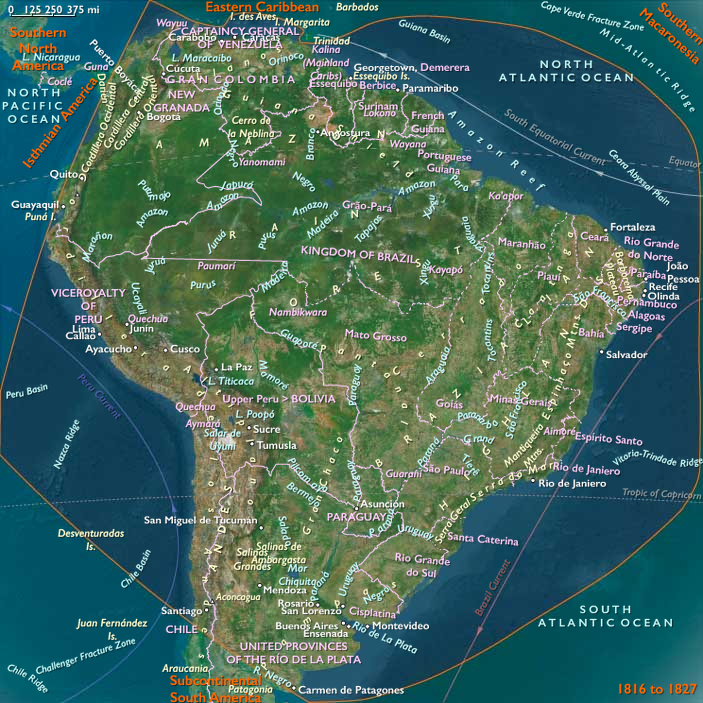
Portuguese businessmen who invest locally in Brazil,…
1816 CE to 1827 CE
Portuguese businessmen who invest locally in Brazil, nobles and government officials who build expensive homes here, and those who marry into provincial wealth share a common interest in remaining.
Indeed, what takes shape is a new concept of a dual monarchy of Brazil and Portugal, which even under the best of circumstances will be difficult to make work.
It is an expedient idea that will founder because of resistance by those in Portugal who see their status and that of the kingdom endangered; by the British, who want the king back in Lisbon, where he is more vulnerable; and by the unwillingness of Brazilians to suffer the indignity of being returned to colonial rank.
The centralization of power in Rio de Janeiro meets with violent resistance in the Northeast.
When Pernambuco raises the banner of republican rebellion in 1817, it is followed by Paraíba do Norte, Rio Grande do Norte, and the south of Ceara, each of which act to defend local interests without thought of federating.
They resent their loss of autonomy to Rio de Janeiro and the Portuguese who have settled in the Northeast since 1808.
Significantly, although they send envoys to secure recognition from Britain and the United States and to spread the revolt to Bahia, they do not send agents to central or southern Brazil.
The revolt is crushed brutally.
Although unsuccessful, the 1817 "Pernambuccan revolution" shakes the monarchy's foundations because it has pushed aside authority and tarnished the crown's aura of invincibility.
In desperation, the monarchy responds by banning all secret societies and by garrisoning Rio de Janeiro, Salvador, and Recife with fresh troops from Portugal.
Meanwhile, the monarchy is waging war in the Rio de la Plata.
King João regarda the East Bank of the Rio de la Plata (present-day Uruguay) as the proper and true boundary of Brazil.
Over British objections, he brings veteran troops from Portugal to seize Montevideo and to wage a wearing campaign (1816-20) against the forces of independence-minded Jose Gervasio Artigas, the father of Uruguay.
The region is incorporated into the United Kingdom as the Cisplatine Province in 1821.
Nonetheless, even as it is expanding, the United Kingdom, as the Rio de Janeiro royalists term it, is suffering from pressures in Portugal itself.
The Pernambuccan revolution in 1817 encourages army officers in Portugal to conspire against the regency of British Marshal William Carr Beresford.
Twelve of the conspirators, including a general officer, are tried secretly and hanged.
Anti-British sentiment deepens.
In 1820, when a military revolt in Spain forces the revived absolutist regime of Fernando VII (1784-1833) to restore the liberal constitution of 1812, the Portuguese military follows suit by expelling the British officers and forming revolutionary juntas.
The military petitions the king's return and summons a Cortes (the Por tuguese Parliament), the first since 1697 when the crown had dispensed with such bodies.
Unable to do more, João pardons the juntas' usurpation of his prerogative to summon a Cortes and acknowledges that a Cortes could be useful in making proposals to him on how best to govern the United Kingdom.
Then, in January 1821, Portuguese officers and troops, as well as Brazilian liberals, take over provincial governments in Bahia and Belem, and in late February, troops in Rio de Janeiro throw in with the movement and force the king to take an oath to accept any constitution the Cortes might write.
In effect, Brazil is again being ruled from Portugal.
A few days later, a royal decree announces that the king will return to Lisbon, leaving his twenty-four-year-old son Dom Pedro as regent in Brazil.
On April 25, 1821, twelve ships carrying the king and queen, four thousand officials, diplomats, and families, as well as purloined funds and jewels from the Bank of Brazil, set course for Lisbon.
The city and country that they leave behind no longer constitutes the closed colony of thirteen years before.
Thanks to the surveys, expeditions, and studies that Joao has encouraged, resources will be exploited at a steadily increasing pace, but in a fashion that ties the country more closely to the rapidly expanding industrial capitalism of the North Atlantic.
Nonetheless, Joao VI and Queen Carlota exemplify the fading absolutist regime; their son Pedro will seek to be more modern by embracing the new ideas of liberal constitutionalism.
People
Groups
Commodities
Regions
South America
View →Subregions