
Portugal’s Colonial Focus in Africa and Early…
1852 CE to 1863 CE
Portugal’s Colonial Focus in Africa and Early Explorations (Mid-19th Century)
With the advent of rotativismo and the resulting political stability, Portugal shifted its attention toward consolidating and expanding its African colonial holdings. By the mid-19th century, Portuguese influence in Africa remained largely coastal, with limited control over the vast inland territories.
-
East Africa: The chief Portuguese settlement was Mozambique Island, serving as the administrative and commercial hub. However, Portuguese authority on the mainland was weak, with much of the interior controlled by Portuguese-African elites of mixed ancestry, who ruled their estates as semi-feudal potentates.
-
West Africa: The most significant Portuguese settlements were Luanda and Benguela, located on the Angolan coast. These ports were deeply intertwined with Brazil through the transatlantic slave trade, facilitated by São Tomé, a crucial hub for human trafficking.
During this period, Portugal sought to expand its reach beyond the coast, launching exploratory expeditions into the African interior. In 1852, António da Silva Porto embarked on an exploration of Angola’s interior, marking the beginning of a more concerted effort to establish deeper territorial claims. These early forays set the stage for Portugal’s later attempts at colonial expansion and consolidation, particularly as European powers intensified their imperial ambitions in Africa.
Locations
People
Groups
Commodities
Subjects
Regions
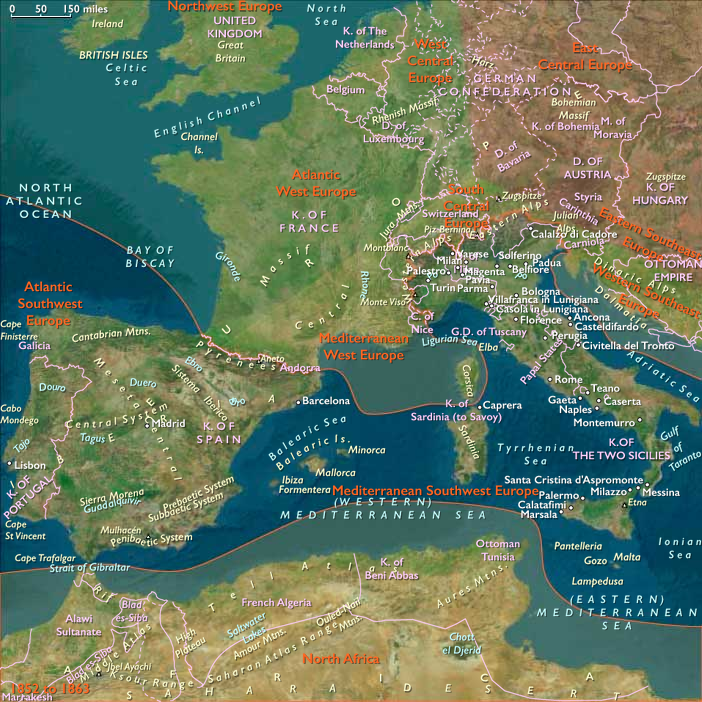
Southwest Europe
View →Subregions
