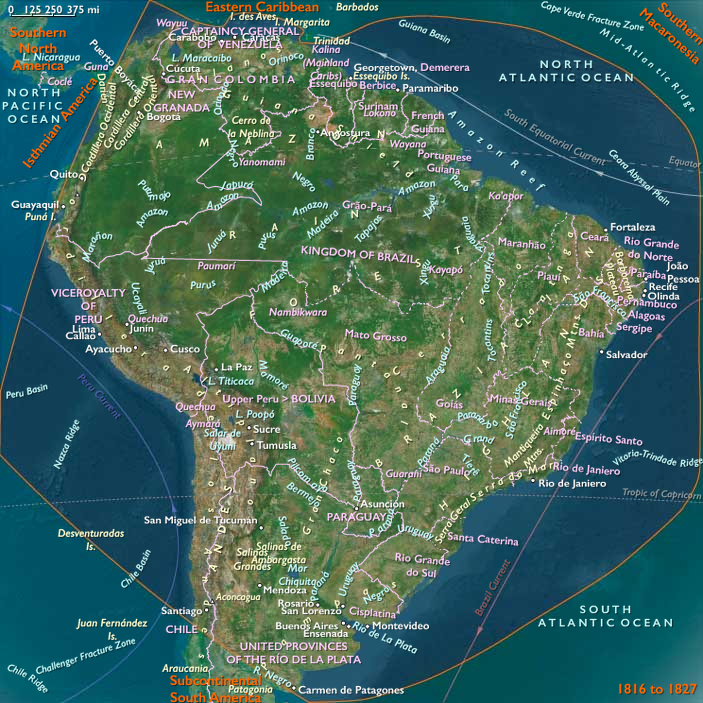
International trade expands during the thirteen years…
1816 CE to 1827 CE
Rio de Janeiro by 1820 has more than three thousand foreigners among its one hundred and thirteen thousand inhabitants; the city also has coffee houses serving the product that will become the backbone of the economy.
Expanding from seedlings nurtured in the Jardim Botanico, coffee cultivation spreads from the Rio de Janeiro area over the Serra do Mar into the fertile upland valley, through which the Rio Paraíba flows from Sao Paulo easterly to the sea, dividing the provinces of Minas Gerais and Rio de Janeiro.
On both sides of the river, the tropical forests are cut to make way for the coffee groves.
Mule trains that once brought gold from Minas Gerais to Rio de Janeiro now carry coffee in quantities that swell from two thousand three hundred and four kilos in 1792 to seven million seven hundred and sixty-one thousand kilos in 1820, and will reach eighty-two million, one hundred and seventy-eight thousand three hundred and ninety-five kilos in 1850.
Sao Paulo's entry into the coffee age lies in the future, but in 1821 it is providing herds of mules and horses for the coffee pack trains.
The Cisplatine and Rio Grande do Sul are ship- ping abroad hides, tallow, and dried meat.
In contrast, the Northeast and North are in decline because an 1815 treaty between Brazil and Britain forbids the African slave trade north of the equator, thereby reducing the demand for Bahian molasses-soaked rolled tobacco, and because Cuban competition slashes deeply into the Northeast's sugar market in the United States and Europe.
Even cotton, which a few years before seemed a secure export for Maranhao, is overwhelmed by the post-War of 1812 expansion in the southern United States.
The world demand for Amazonian nuts, cocoa, skins, herbs, spices, and rubber is still weak in 1821.
Finally, in the Brazilian west (Mato Grosso and Goias) gold mining has all but ended, and subsistence farming and livestock raising are predominant.
Throughout the country, but more so from Bahia through Minas Gerais to Rio de Janeiro and São Paulo, the labor force is made up of African or locally born black slaves.
The native heritage lives on in the substantial number of Tupi-speaking races and mixtures that live in the tropical forest region.
People
Groups
Brazil, Indigenous people in
View →
Portuguese people
View →
Portuguese Empire
View →
São Vicente, Captaincy General of
View →
Pernambuco, Captaincy of
View →
Brazil, Colonial
View →
Portugal, Bragança Kingdom of
View →
Britain (United Kingdom of Great Britain and Ireland)
View →
France, (first) Empire of
View →
Spain, Bourbon Kingdom (first restoration) of
View →
Commodities
Regions
South America
View →Subregions