
Ptolemy VI, a young man of pious…
175 BCE
Ptolemy VI, a young man of pious and magnanimous character, marries his sister, Cleopatra II, the daughter of Ptolemy V and likely Cleopatra I, in 175.
Under his advisers' guidance, preparations are made to invade Coele Syria, Palestine, and Phoenicia, which Antiochus III, the late king of the Seleucid realms, had conquered in the Fifth Syrian War at the turn of the century, and leaving the Seleucid king in possession of Coele-Syria, while marrying off his daughter Cleopatra I to Ptolemy V.
Commodities
Subjects
Regions
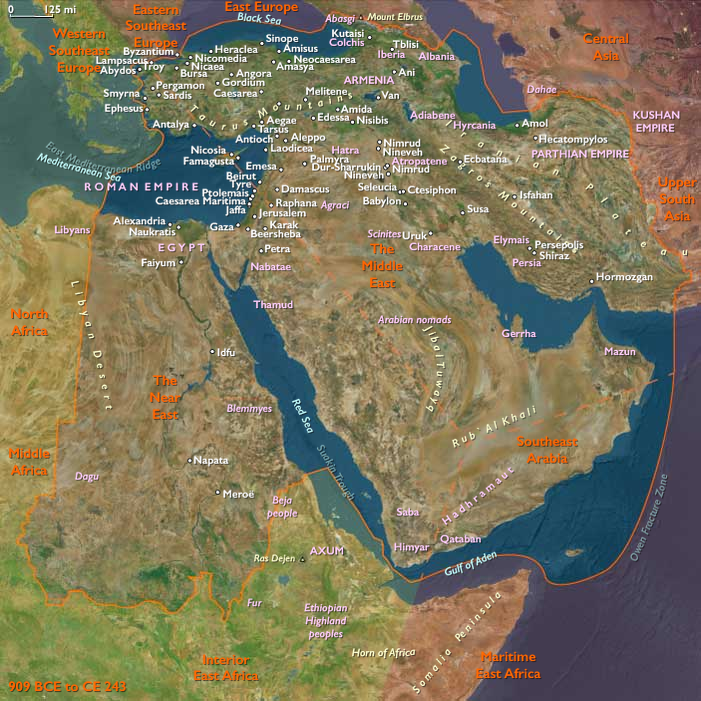
The Near and Middle East
View →Subregions

Near East
View →Related Events
No active filters.
Showing 10 events out of 63289 total
Financial difficulties, created in part by the heavy war indemnity exacted by Rome, have compelled Seleucus IV to pursue a policy devoid of expensive adventures.
His unambitious policy and care are also dictated by the fact that his son and heir, Demetrius, has been sent to Rome as a hostage for his father in exchange for Antiochus, the third son of Antiochus III, who has learned to admire Roman institutions and policies.
Seleucus, having heard that the temple treasury in Jerusalem is wealthy, wonders why some of the tribute is being withheld.
He sends one his chief ministers, Heliodorus, to investigate.
Heliodorus, having possibly found enough wealth to bribe elements in the Seleucid army, returns, assassinates Seleucus, and seizes the throne in 175.
As Seleucus' legitimate heir, Demetrius, is still a hostage in Rome, Antiochus, with the help of King Eumenes II of Pergamon, seizes the throne for himself, proclaiming himself co-regent for another son of Seleucus, an infant named Antiochus (whom he will murder a few years later).
He takes the throne as Antiochus IV Epiphanes (”God Manifest”).
Both economically and socially, Antiochus, a passionate philhellene who pays lip service to the political traditions of both Athens and Rome, makes efforts to strengthen his kingdom—inhabited in the main by Orientals (non-Greeks of Asia Minor and Persia)—by founding and fostering Greek cities.
Even before he had begun his reign, he had contributed to the building of the temple of Zeus in Athens and to the adornment of the theater.
He enlarges Antioch on the Orontes by adding a section to the city (named Epiphania after him).
Here he builds an aqueduct, a council hall, a marketplace, and a temple to Jupiter Capitolinus.
Demetrius, king of the Greco-Bactrian state, may have been as far as the imperial capital Pataliputra in eastern India (today Patna).
However, these campaigns are typically attributed to Menander.
The invasion is completed by 175 BCE.
This establishes in northern India what is called the Indo-Greek Kingdom, which is to last for almost two centuries until around CE 10.
The Buddhist faith flourishes under the Indo-Greek kings, foremost among them Menander I.
It is also a period of great cultural syncretism, exemplified by the development of Greco-Buddhism.
The Hellenizing policies of Antiochus IV Epiphanus, the son and successor of Antiochus III, have brought him into conflict with the prosperous Oriental temple organizations, and particularly with Jerusalem's Jews.
Antiochus apparently aims at a wholesale restoration of the Seleucid empire in the east, including an occupation of Egypt, as a counter to the loss of the western province occasioned by the Peace of Apamea.
Since the reign of Antiochus III, the Jews have enjoyed extensive autonomy under their high priest.
They now divide into two parties, the orthodox Hasideans (”Pious Ones”) and a reform party that favors Hellenism.
The Hasideans trace their origins to the so-called Hasidim ha-Rishonim (”early pious men”) of the fourth century BCE, members of Judaean agricultural communities who had followed the teachings of simple piety and brotherly love.
Rebelling against Hellenistic influences, the Hasideans emphasize a meticulous observance of their own traditions.
The quarrels are factional ones, the issue being whether the old and popular government of the Ptolemies should continue, or whether the Jews should deliver themselves over to the Syrian kings and their Hellenization.
In an ongoing dispute between the current High Priest, Onias III, and Simon the Benjamite, the philhellene Jason, brother to Onias, offers to pay Antiochus in order to be confirmed as the new High Priest in Jerusalem.
For financial reasons, Antiochus supports the reform party and accepts the offer.
Perseus arouses widespread alarm in Greece by visiting Delphi with his army after subduing a revolt in Dolopia (the region in Greece between Thessaly to the northeast and Aetolia to the southwest),
Renewing former connections with some southern Greek city-states (poleis), the king announces that he can carry out reforms in Greece and restore its previous strength and prosperity.
Perseus’s activism initiates a stream of complaints to the Roman Senate from neighboring Greek powers from 175 BCE onward. (The king's real intentions are unclear; perhaps Polybius was right that he wished to make the Romans “more cautious about delivering harsh and unjust orders to Macedonians.”)
Babylon, which reveres Antiochus as Soter (Liberator, or Savior) of Asia, is given a Greek colony that is granted freedom of the city.
Another Epiphania is founded in Armenia.
Ecbatana (in Persia) is also named Epiphania and becomes a Greek city.
Many of these Seleucid cities are granted the right to coin their own municipal currency.
Construction had begun on the colossal Temple of Olympian Zeus in the sixth century BCE during the rule of the Athenian tyrants, who had envisaged building the greatest temple in the ancient world.
The temple is located about five hundred meters (sixteen hundred and forty feet feet) southeast of the Acropolis, and about seven hundred meters (twenty-three hundred feet) south of the center of Athens, Syntagma Square.
Its foundations were laid on the site of an ancient outdoor sanctuary dedicated to Zeus.
An earlier temple had stood there, constructed around 550 BCE by the tyrant Pisistratus.
The building was demolished after the death of Peisistratos and the construction of a colossal new Temple of Olympian Zeus was begun around 520 BCE by his sons, Hippias and Hipparchos.
They sought to surpass two famous contemporary temples, the Heraion of Samos and the Temple of Artemis at Ephesus, which was one of the Seven Wonders of the Ancient World.
Designed by the architects Antistates, Callaeschrus, Antimachides and Porinus, the Temple of Olympian Zeus was intended to be built of local limestone in the Doric style on a colossal platform measuring forty-one meters (one hundred and thirty-four and a half feet) by one hundred and eight meters (three hundred and fifty three and a hapf feet).
It was to be flanked by a double colonnade of eight columns across the front and back and twenty-one on the flanks, surrounding the cella.
The work was abandoned when the tyranny was overthrown and Hippias expelled in 510 BCE, by which point only the platform and some elements of the columns had been completed.
The temple has remained in this state for the past three hundred and thirty-six years, left unfinished during the years of Athenian democracy, apparently because the Greeks thought it hubristic to build on such a scale.
In the treatise Politics, Aristotle cited the temple as an example of how tyrannies engaged the populace in great works for the state and left them no time, energy or means to rebel.
The Seleucid king Antiochus IV Epiphanes, who presents himself as the earthly embodiment of Zeus, revives the project in 174 BCE and places the Roman architect Decimus Cossutius in charge.
The design is changed to feature three rows of eight columns across the front and back of the temple and a double row of twenty on the flanks, for a total of one hundred and four columns.
The columns are to stand seventeen meters (fifty-five and a half feet) high and two meters (six and a half feet) in diameter.
The building material is changed to the expensive but high-quality Pentelic marble and the order is changed from Doric to Corinthian, marking the first use of this order on the exterior of a major temple.
Abrupolis, a king of the Thracian Sapaei, and ally of the Romans, had attacked the dominions of Perseus around 179 BCE, and laid them waste as far as Amphipolis, as well as overrunning the gold mines of Mount Pangaeus.
He is eventually driven out of his holdings by Perseus, the conflict of which helps ignite the Third Macedonian War, since Rome takes issue with the ousting of an ally from his territories.
Flamininus, throughout his stewardship of Greece, has attempted to preserve Greek local autonomy, but Rome abandons this policy soon after his death in 174.
While some ancient (and modern) writers considered Abrupolis's routing by Perseus a primary cause of the Third Macedonian War, other, later Roman writers, and modern scholars, tended to look upon it as an act of self-defense, with Rome merely using it as one pretext for a quarrel with Perseus.
Both the Syrian and Egyptian parties appeal to Rome for help, but the Senate refuses to take sides.
Jason, as High Priest, scorning the traditional Jewish monotheism of the Pharisaic party, promotes Greek culture and religion throughout Judaea.
In return for a considerable sum, Antiochus has permitted Jason to build a gymnasium in Jerusalem and to introduce the Greek mode of educating young people.
Jason has reestablished Jerusalem as a Greek-style polis named after the king, Antioch-at-Jerusalem.
With the creation of Antioch, Jason has abandoned the ordinances given under Antiochus III, which defined the polity of the Judeans according to the Torah.
Jason's time as High Priest is brought to an abrupt end in 172 BCE when he sends Menelaus, the brother of Simon the Benjamite, to deliver the annual tribute money to Antiochus.
Although during the three years of his pontificate Jason has given many proofs of his attachment to the Hellenistic party, the zealous Hellenists of the stamp of the Tobiads, a Jewish or Ammonite faction, plot his overthrow, suspecting him of partiality to traditional Judaism.
Menelaus takes the opportunity to "outbid" Jason for the priesthood, resulting in Antiochus confirming Menelaus as the High Priest.
Jason flees Jerusalem and finds refuge in the land of the Ammonites, by which is probably meant the Nabataeans.
An officer named Sostrates is sent by Antiochus with a troop of Cyprian soldiers to subdue any opposition that might be attempted by the followers of the deposed Jason and to collect at the same time the sum Menelaus had promised.
Menelaus' first act is to seize the sacred vessels in the Temple stores in order to meet the obligations he has incurred.
This act comes to the ears of the deposed high priest Onias III, who publicly accuses Menelaus of robbing the Temple.
The latter, afraid of the consequences of this accusation, induces the king's lieutenant Andronicus, who had had his share of the plunder, to get rid of Onias before a formal complaint had been lodged with the king.
Accordingly, Onias is decoyed from the sanctuary at Daphne, in which he has sought refuge, and murdered.
Menelaus continues to plunder the treasures of the Temple until violence ensues, in which his brother Lysimachus meets his death.
He then brings before the king an accusation against the people of Jerusalem, that they are partisans of the Egyptians and persecute him only because he is opposed to their party intrigues.
This accusation causes the execution of several Jews who, although they had proved beyond any doubt that Menelaus and Lysimachus had desecrated the Temple, were sentenced to death.