
Nguyen Anh adopts the reign name Gia …
Years: 1684 - 1827
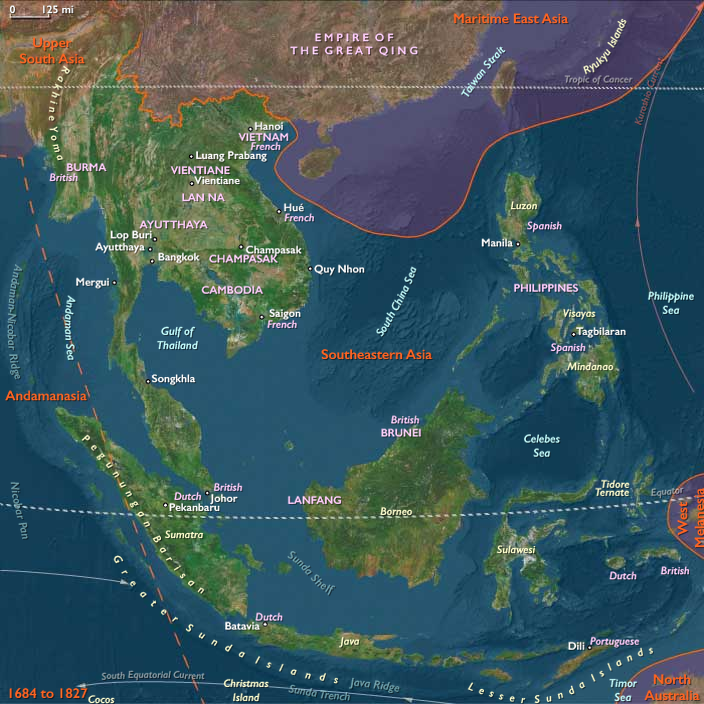
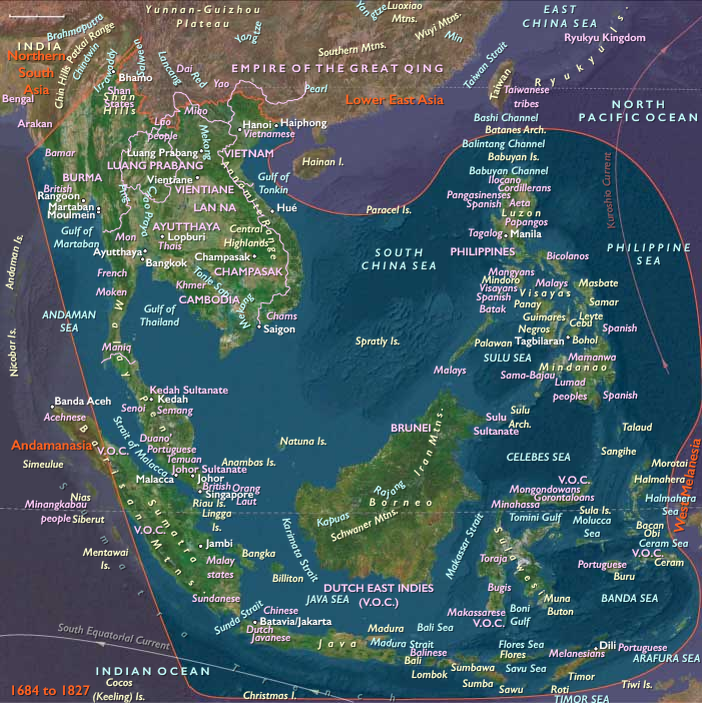
Nguyen Anh adopts the reign name Gia Long in June 1802 to express the unifying of the country—Gia from Gia Dinh (Saigon) and Long from Thang Long (Hanoi).
As a symbol of this unity, Gia Long changes the name of the country from Dai Viet to Nam Viet.
For the Chinese, however, this is too reminiscent of the wayward General Trieu Da.
In conferring investiture on the new government, the Chinese invert the name to Viet Nam, the first use of this name for the country.
Acting as a typical counterrevolutionary government, the Gia Long regime harshly suppresses any forces opposing it or the interests of the bureaucracy and the landowners.
In his drive for control and order, Gia Long adopts the Chinese bureaucratic model to a greater degree than any previous Vietnamese ruler.
The new capital at Hue, two kilometers northeast of Phu Xuan, is patterned after the Chinese model in Beijing, complete with a Forbidden City, an Imperial City, and a Capital City.
Vietnamese bureaucrats are required to wear Chinese-style gowns and even adopt Chinese-style houses and sedan chairs.
Vietnamese women, in turn, are compelled to wear Chinese-style trousers.
Gia Long institutes a law code, which follows very closely the Chinese Qing dynasty (1644-1911) model.
Under the Gia Long code, severe punishment is meted out for any form of resistance to the absolute power of the government.
Buddhism, Taoism, and indigenous religions are forbidden under the Confucianist administration.
Traditional Vietnamese laws and customs, such as the provisions of the Hong Due law code protecting the rights and status of women, are swept away by the new code.
Taxes that had been reduced or abolished under the Tay Son are levied again under the restored Nguyen dynasty.
These include taxes on mining, forestry, fisheries, crafts, and on various domestic products, such as salt, honey, and incense.
Another heavy burden on the peasantry is the increased use of corvée labor to build not only roads, bridges, ports, and irrigation works but also palaces, fortresses, shipyards, and arsenals.
All but the privileged classes are required to work on such projects at least sixty days a year, with no pay but a rice ration.
The great Mandarin Road, used by couriers and scholar-officials as a link between Gia Dinh, Hue, and Thang Long, is started during this period in order to strengthen the control of the central government.
Military service is another burden on the peasantry; in some areas one out of every three men is required to serve in the Vietnamese Imperial Army.
Land reforms instituted under the Tay Son Are soon lost under the restored Nguyen dynasty, and the proportion of communal lands dwindles to less than twenty percent of the total.
Although chu nom is retained as the national script by Gia Long, his son and successor Minh Mang, who gains the throne upon his father's death in 1820, orders a return to the use of Chinese ideographs.
Locations
People
Groups
- Vietnamese people
- Buddhism
- Confucianists
- Taoism
- Chinese (Han) people
- French people (Latins)
- France, (Bourbon) Kingdom of
- Chinese Empire, Qing (Manchu) Dynasty
- India, French
- Dai Viet, Kingdom of
- Vietnam, Kingdom of
Topics
Subjects
Regions
Subregions
Related Events
Showing 10 events out of 30218 total
Years: 1684 - 1827
Locations
People
Groups
- Vietnamese people
- Buddhism
- Confucianists
- Taoism
- Chinese (Han) people
- French people (Latins)
- France, (Bourbon) Kingdom of
- Chinese Empire, Qing (Manchu) Dynasty
- India, French
- Dai Viet, Kingdom of
- Vietnam, Kingdom of
Topics
Subjects
Regions
Subregions