Northeast Asia (1684–1827 CE): Imperial Frontiers, Pacific…
1684 CE to 1827 CE
Northeast Asia (1684–1827 CE): Imperial Frontiers, Pacific Exploration, and the Northern Resource World
Geographic Parameters
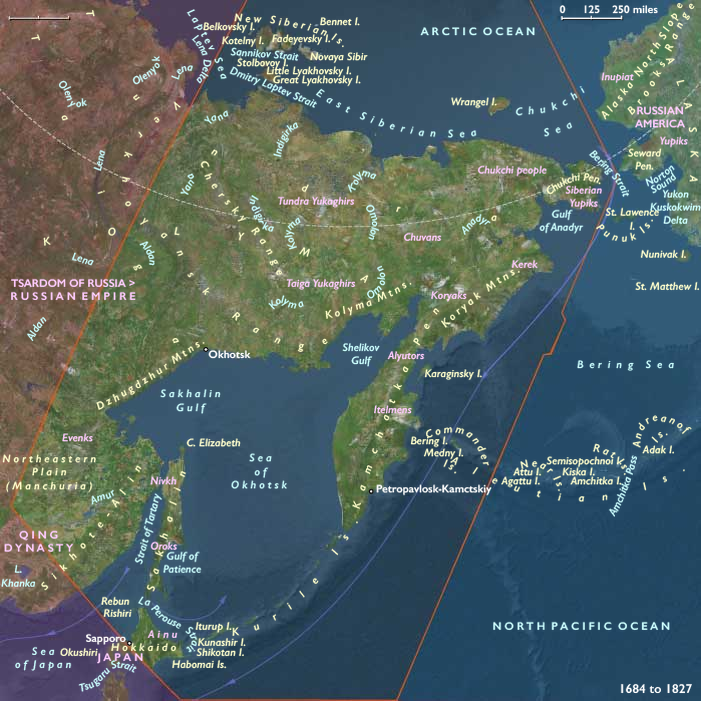
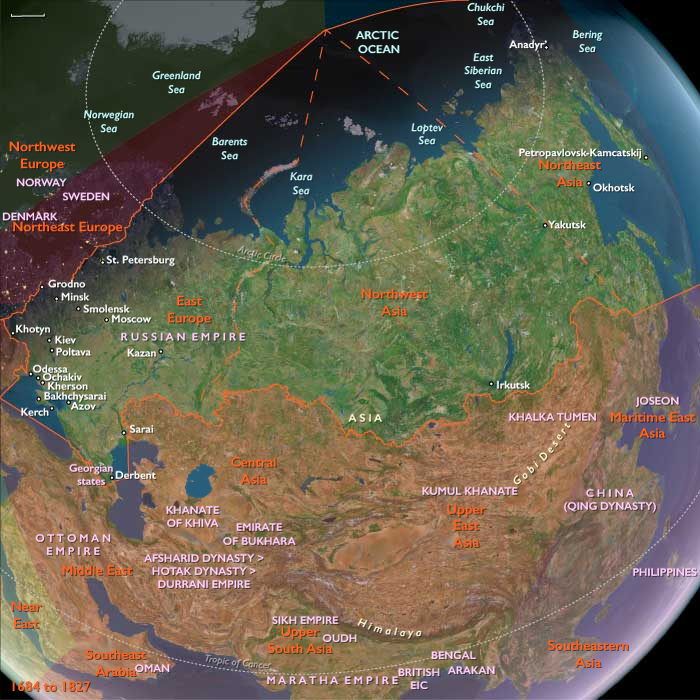
Northeast Asia encompasses eastern Siberia east of the Lena River basin to the Pacific Ocean, the Russian Far East north of southern Primorye, the Amur and lower Ussuri river systems, Sakhalin, Kamchatka, the Chukchi Peninsula, Wrangel Island, the Sea of Okhotsk littoral, the Kuril Islands, and Hokkaidō north of its southwestern peninsula. Immense taiga forests, Arctic tundra, volcanic mountain ranges, broad river valleys, and seasonally frozen seas continued to dominate the physical landscape. Rivers remained the principal transportation corridors, while the Sea of Okhotsk and the northern Pacific increasingly connected the region to wider imperial maritime networks.
Climate and Environmental Conditions
The Little Ice Age continued to shape the northern environment through long winters, heavy snowfall, extensive permafrost, and prolonged seasonal sea ice. Frozen rivers provided dependable winter transportation, while productive salmon rivers, rich marine ecosystems, boreal forests, and tundra continued to sustain abundant biological resources. Although local climatic fluctuations affected fisheries and reindeer pastures, the ecological structure of the region remained remarkably stable.
Human Adaptation
Indigenous societies continued to organize life around complementary seasonal resource systems that had developed over many centuries.
Amur communities, including the ancestors of the Nanai, Nivkh, Ulch, and Udege, combined salmon fishing, sturgeon harvesting, hunting, trapping, gathering, and limited agriculture within stable riverine villages.
Across the interior, Evenki, Even, Yukaghir, and related peoples maintained highly mobile seasonal rounds centered upon hunting, trapping, fishing, and reindeer husbandry.
Koryak, Chukchi, Itelmen, and Siberian Yupik communities continued to integrate marine hunting, river fisheries, terrestrial game, and reindeer economies across Kamchatka, Chukotka, and the Bering coast.
On Hokkaidō, Ainu communities remained organized around salmon rivers and coastal fisheries while expanding commercial production for exchange with Japanese merchants. Hunting, gathering, and modest cultivation continued to complement maritime resources throughout the island.
Economic Organization
The principal historical development of the age was the consolidation of imperial frontier economies that increasingly integrated Northeast Asia into wider Eurasian and Pacific systems.
Russian administration expanded steadily across eastern Siberia after the Treaty of Nerchinsk (1689) stabilized relations with the Qing Dynasty along the Amur frontier. Fur tribute gradually gave way to broader commercial exchange centered upon fisheries, timber, transport, and regional trade. Okhotsk developed into Russia's principal Pacific port, supporting exploration, supply, and communication across the northern Pacific.
The expeditions of Vitus Bering and subsequent Russian voyages established enduring maritime connections between Northeast Asia, Alaska, and the North Pacific, transforming the region into the eastern gateway of the Russian Empire.
Along the Amur frontier, Qing administration regulated trade and diplomacy while indigenous communities continued to mediate exchange between forest, river, and agricultural worlds.
On Hokkaidō, the Matsumae domain strengthened its commercial monopoly over Ainu trade. Dried salmon, herring, kelp, sea mammal products, furs, hawks, and eagle feathers moved southward in growing quantities, while iron tools, textiles, ceramics, lacquerware, rice, tobacco, and manufactured goods became increasingly common in Ainu settlements.
Despite expanding imperial commerce, fisheries, hunting, trapping, forestry, and seasonal harvesting continued to provide the primary productive base throughout most of the subregion.
Technology and Material Culture
Traditional ecological technologies remained fundamental to daily life. Fish weirs, basket traps, nets, smokehouses, drying racks, oil-rendering facilities, sledges, skis, snowshoes, birch-bark canoes, skin boats, and reindeer transport continued to dominate subsistence activities.
Imported iron became widespread, while firearms, metal traps, iron cooking vessels, saws, axes, and woodworking tools became increasingly common through Russian and Japanese trade. These innovations generally enhanced existing indigenous technologies rather than replacing them outright.
Permanent log buildings, Orthodox chapels, Russian administrative posts, and expanded trading stations gradually appeared within portions of Siberia and the Sea of Okhotsk coast, while indigenous architecture remained dominant across most of the region.
Movement and Interaction Corridors
The Lena, Aldan, Indigirka, Kolyma, and other great Siberian rivers served as the principal arteries of Russian settlement, administration, and commerce.
The Sea of Okhotsk became Russia's primary maritime corridor linking Siberia with Kamchatka and the North Pacific, while Amur waterways continued to connect interior forests with Qing frontier markets.
Hokkaidō's coastal routes became increasingly integrated into Japanese commercial systems through the Matsumae domain. The Kuril Islands formed stepping stones linking Hokkaidō and Kamchatka, while Bering Strait waters connected northeastern Asia with Alaska through indigenous exchange and Russian exploration.
For the first time, Northeast Asia occupied a significant position within trans-Pacific navigation while retaining its traditional regional transportation networks.
Institutions and Political Authority
Imperial administration became substantially more visible during this period, although unevenly distributed across the immense landscape.
Russian forts, towns, customs stations, Orthodox missions, and administrative offices expanded throughout eastern Siberia and the Okhotsk coast, while the Qing government maintained military outposts, frontier supervision, and regulated diplomatic relations along the Amur.
On Hokkaidō, Matsumae authority increasingly structured commercial exchange, though most Ainu communities continued to govern their internal affairs through traditional leadership.
Across much of Kamchatka, Chukotka, Sakhalin, and the northern taiga, indigenous political organization based upon kinship, customary law, and ceremonial authority remained the dominant framework of local governance.
Belief and Cultural Life
Indigenous spiritual traditions remained central throughout Northeast Asia despite expanding imperial presence.
Ainu iomante, Amur salmon ceremonies, Chukchi and Koryak whale rituals, Evenki shamanism, and numerous local ceremonial traditions continued to express reciprocal relationships between people and the northern environment.
Russian Orthodoxy spread gradually through colonial settlements and missionary activity, while Qing frontier administration introduced additional Confucian and Buddhist influences near the southern margins. Nevertheless, traditional cosmologies remained the primary religious framework across most of the subregion.
Adaptation and Resilience
Communities continued to demonstrate remarkable resilience by combining fisheries, hunting, trapping, gathering, reindeer husbandry, and limited agriculture within flexible seasonal economies.
Imported technologies, commercial opportunities, and imperial institutions were generally incorporated selectively into long-established ecological systems. Extensive food preservation, seasonal mobility, and kinship-based exchange networks continued to buffer environmental variability and political change.
Although imperial authority expanded considerably during this age, indigenous knowledge remained indispensable for transportation, survival, and resource management across the northern landscape.
Legacy of the Age
Between 1684 and 1827, Northeast Asia became an established frontier of the Russian, Qing, and Japanese worlds while retaining its identity as one of Earth's great northern ecological regions. Russian expansion reached the Pacific, the Qing stabilized the Amur frontier, Matsumae commercial influence deepened across Hokkaidō, and Pacific exploration connected the region to Alaska and the wider oceanic world.
Yet the transformation remained fundamentally layered upon enduring environmental systems. Salmon rivers, taiga forests, Arctic tundra, volcanic coasts, and seasonally frozen seas continued to organize settlement, economy, and culture more powerfully than imperial boundaries. By 1827, Northeast Asia had become a strategically important imperial frontier, but one whose ecological foundations still shaped both indigenous societies and the expanding states that sought to govern them.
Images

Northeast Asia in the High Modern age
People
Groups
Commodities
Regions
Northeastern Eurasia
View →Subregions