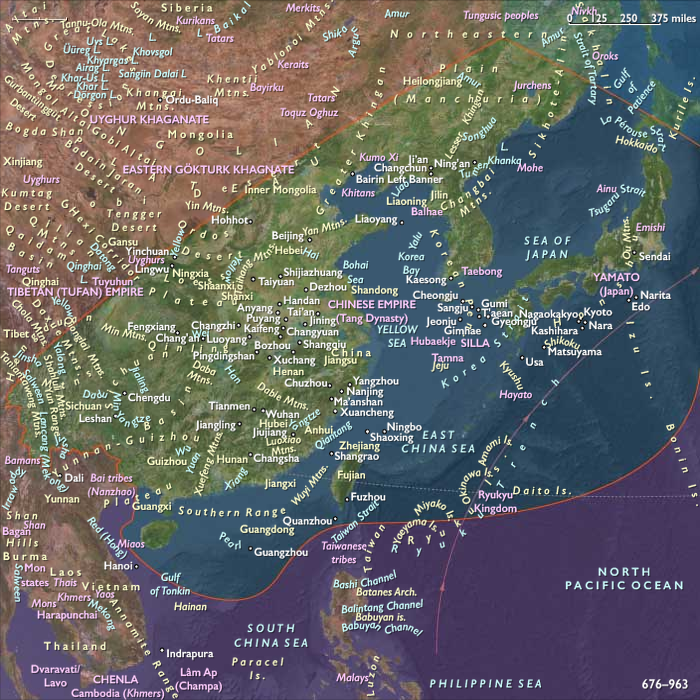
The Japanese capital was customarily moved after…
676 CE to 819 CE
The Japanese capital was customarily moved after the death of an emperor, before the Taiho Code was established, because of the ancient belief that a place of death was polluted.
Reforms and bureaucratization of government led to the establishment of a permanent imperial capital at Heijokyo, or Nara, in 710. (Previously the capital had been about twenty-five kilometers south of Nara, in and around Asuka, the name given by some historians to the pre-Nara period [538-710] and art style.)
The capital at Nara, which gives its name to the new period (710-94), is styled after the grand Chinese Tang Dynasty (618-907) capital at Chang' an and is the first truly urban center in Japan.
It soon has a population of two hundred thousand, representing nearly our percent of the country's population, and some ten thousand people work in government jobs.
Locations
Groups
Regions

East Asia
View →Subregions