
Religious antagonism has played an important part …
Years: 1604 - 1604
Religious antagonism has played an important part in the current long war between the German empire and the Turks.
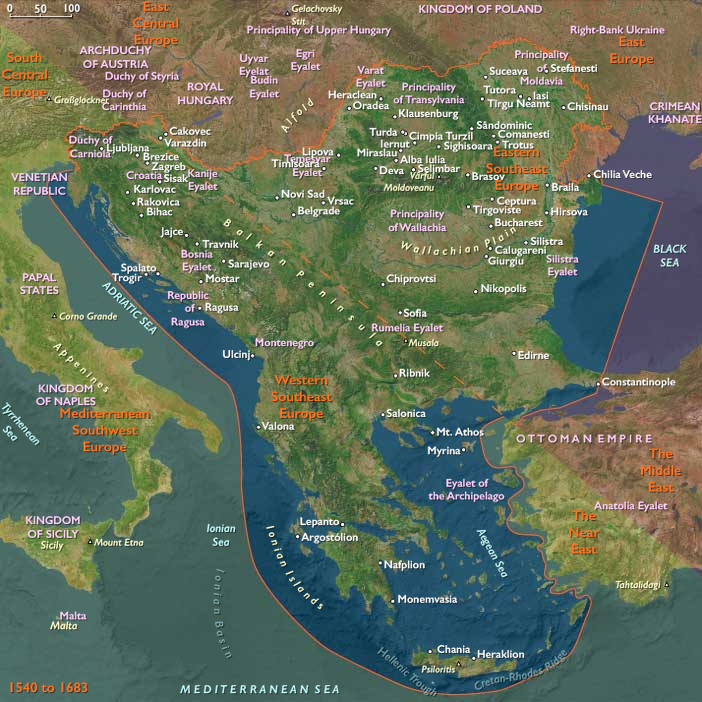
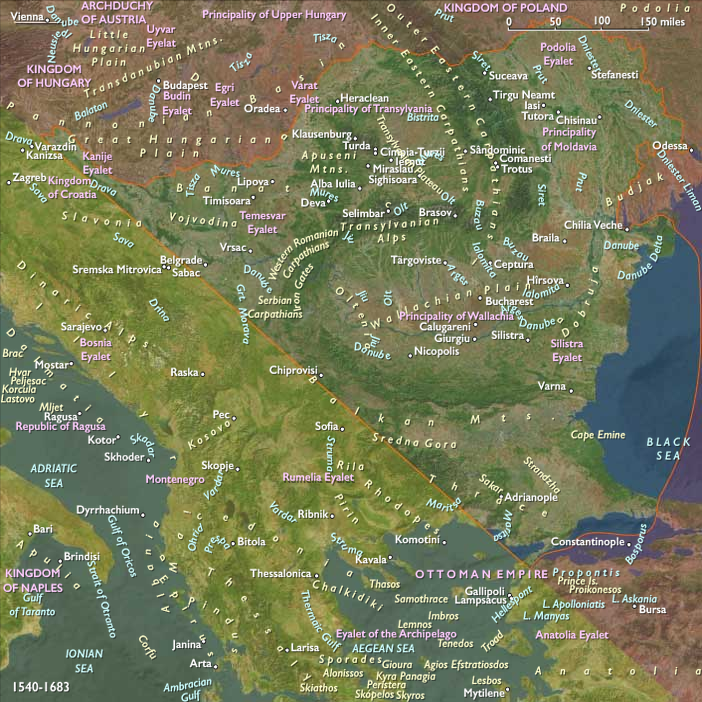
Imperial troops have entered Transylvania, and their commander, Giörgio Basta, has behaved there (and in northern Hungary) with such insane cruelty toward the Hungarian Protestants, also illegally expropriating their estates, that the Transylvanian general Stephen Bocskay, formerly a Habsburg supporter, revolts.
Locations
People
Groups
- Austria, Archduchy of
- Wallachia, Principality of
- Ottoman Empire
- Hungary, Royal
- Moldavia (Ottoman vassal), Principality of
- Transylvania (Ottoman vassal), Principality of
- Habsburg Monarchy, or Empire
Topics
- Ottoman-Habsburg Wars
- Protestant Reformation
- Counter-Reformation (also Catholic Reformation or Catholic Revival)
- Long War or Thirteen Years' War
Commodoties
Subjects
Regions
Subregions
Related Events
Filter results
Showing 10 events out of 12 total
Captain John Smith is constantly seeking a supply of food for the colonists, and, using the Discovery, the smallest of the three ships which had been left behind for their use, he successfully trades for food with the Nansemonds, who are located along the Nansemond River in the modern-day City of Suffolk, and several other groups.
With the coming arrival of the new supply fleet, Captain Smith feels the colony is sufficiently reinforced to engage the Powhatan directly with a diplomatic initiative aimed at securing at least a temporary respite from native sniping, kidnapping, and assaulting.
Taking a small escort, they make their way through a attacks to the capital of the Powhatan Confederacy.
While leading the expedition in December 1607 up the Chickahominy River west of Jamestown, his men are set upon by Powhatans.
As his party is being slaughtered around him, Smith straps his native guide in front of him as a shield and escapes with his life but is captured by Opechancanough, the Powhatan chief's half-brother.
Smith gives him a compass which pleases the warrior and makes him decide to let Smith live.
Smith is taken before Wahunsunacock, who is commonly referred to as Chief Powhatan, at the Powhatan Confederacy's seat of government at Werowocomoco on the York River.
However, seventeen years later, in 1624, Smith will first relate that when the chief decided to execute him, this course of action had been stopped by the pleas of Chief Powhatan's young daughter, Pocahontas, who was originally named Matoaka but whose nickname meant "Playful One."
Many historians today find this account dubious, especially as it was omitted in all his previous versions.
The life of Chief Powhatan's young daughter, Pocahontas, will be largely tied to the English after legend credits her with saving John Smith's life after his capture by Opechancanough, but her contacts with Smith himself are minimal.
Records indicate that she has become something of an emissary to the colonists at Jamestown Island.
During their first winter, Pocahontas brings food and clothing to the colonists.
She later negotiates with Smith for the release of Virginia natives who had been captured by the colonists during a raid to gain English weaponry.
The trade soon proves to Chief Powhatan the weakness of the English colony.
Jamestown's colonists had never planned to grow all of their own food.
Instead, their plans depend upon trade with the Powhatan Confederacy to supply them with food between the arrival of periodic supply ships from England.
The efforts by anti-English leaders among the Powhatan Confederacy have however succeeded in isolating the tenuous English colony.
Additionally, lack of access to water and a relatively dry rain season has crippled the agricultural production of the colonists.
A drought earlier in 1609 during the normal growing season has left the fields of the colonists of Virginia barren.
With Smith gone, Chief Powhatan feels clear to end the truce and he begins a campaign to starve the English out of Virginia.
The Powhatans stop trading with the colonists for food.
John Ratcliffe, captain of the Discovery, has became colony president and tries to improve the colony's situation by obtaining food.
Hoping to emulate Captain Smith, John Ratcliffe attempts a trade mission shortly after being elected, but is captured by Chief Powhatan and tortured to death, along with fourteen of his men, leaving the colony without strong leadership.
The Powhatans carry out additional attacks on other colonists who come in search of trade.
Hunting also becomes very dangerous, as they kill any Englishmen they find outside the fort.
The Powhatans place the colony completely under siege and attempt to end the English settlement through starvation.
Between the lack of trade with the natives, and the failure of the Third Supply to arrive with expected supplies, the colony finds itself with far too little food for the winter.
With the new arrivals, there are many more mouths to feed.
The relationship between the Virginia natives and the colonists will become more strained during the next several years, but never more so than during the period of poor crops for both the natives and colonists which becomes known as the Starving Time in late 1609 and early 1610.
Faced with impending disaster, the colony has attempted numerous attempts to break the Powhatan siege with armed foraging expeditions, diplomatic expeditions, and trading expeditions.
All attempts have been beaten back by the Powhatans, with most of the expedition personnel captured or killed.
The Powhatans' campaign kills all but sixty of the two hundred colonists during the winter of 1609–1610.
There are few records of the hardships the colonists experience in Virginia during this winter.
Arms and valuable work tools are traded to the Powhatans for a pittance in food.
Houses are used as firewood.
Archaeologists have found evidence that the colonists ate cats, dogs, horses, and rats.
At least three respected authorities in early 2007 concluded, based on some credible evidence, that the starvation conditions were so severe that corpses were dug up, and human flesh was eaten.
A scientist has suggested another sinister possibility: arsenic poisoning.
Chief Powhatan meanwhile has relocated his principal capital from Werowocomoco, which is relatively close to Jamestown along the north shore of the York River, to a point more inland and secure along the upper reaches of the Chickahominy River.
John Rolfe, who has left a wife and child buried in Bermuda, is among the survivors of the Sea Venture, who finally arrive to Jamestown on May 23, 1610.
Here, Rolfe will marry Chief Powhatan’s daughter Pocahontas.
The new arrivals, led by Gates (the new governor) and George Somers, had assumed they would find a thriving colony in Virginia.
Instead, they find the colony in ruins and practically abandoned.
Of the five hundred colonists living in Jamestown in the autumn, they find less than one hundred survivors with many of these sick or dying.
Worse yet, many supplies intended for Jamestown had been lost in the shipwreck at Bermuda, and Gates and Somers have brought along with them only a small food supply.
Lord De la Warr proves harsher and more warlike toward the Powhatans and their associated tribes than any of his predecessors.
He first sends Gates to drive off the Kecoughtan from their village on July 9, then gives Chief Powhatan the ultimatum of either returning all English subjects and property, or facing war.
Powhatan insists that the English either stay in their fort or leave Virginia.
Enraged, De la Warr had the hand of a Paspahegh captive cut off and sent him to the paramount chief with another ultimatum: Return all English subjects and property, or the neighboring villages will be burned.
Powhatan does not respond.
The arrival of Lord De la Warr with a substantial armed force of pilgrims filled with patriotic fervor, spreading Protestantism and the English, results in a counteroffensive against the Powhatan Confederacy.
As a veteran of English campaigns against the Irish, De La Warr employs "Irish tactics" against the natives: troops raid villages, burn houses, torch cornfields, and steal provisions; these tactics, identical to those practiced by the Powhatan themselves, prove effective.
On August 9, just nine weeks after De La Warr had taken command of the colony, seventy English under Percy launch a major attack on the Paspahegh capital, killing sixty-five to seventy-five, burning houses, cutting down the cornfields, and capturing one of the weorance Wowinchopunk's wives and her children.
Returning downstream, the English throw the children overboard, and, in Percy's own words, shoot out "their Braynes in the water".
They stab the queen to death in Jamestown, burning houses and chopping down the corn fields.
The Paspahegh abandon their town; they will never recover from this attack.
The English attack, and their murder of elite native women and children, ignites the First Anglo-Powhatan War.
Wowinchopunk is mortally wounded in a skirmish near the Jamestown fort, in February 1611.
His followers soon thereafter avenge his death by luring several colonists out of the fort and killing them.
The bulk of the broken tribe appear to have merged with the other chiefdoms, owever, and they disappear from the historical record at this point.
Subsequent use of the word Paspahegh in documents is mainly in reference to their former territory.
Bermuda, discovered in 1503 by Spanish explorer Juan de Bermúdez, is mentioned in Legatio Babylonica, published in 1511 by Peter Martyr d'Anghiera, and had also been included on Spanish charts of that year.
Both Spanish and Portuguese ships have used the islands as a replenishment spot for fresh meat and water, but legends of spirits and devils, now thought to have stemmed only from the callings of raucous birds (most likely the Bermuda Petrel, or Cahow), and of perpetual, storm-wracked conditions (most early visitors arrived under such conditions), have kept them from attempting any permanent settlement on the Isle of Devils.
Bermúdez and Gonzalo Fernández de Oviedo had ventured to Bermuda in 1515 with the intention of leaving a breeding stock of hogs on the island as a future stock of fresh meat for passing ships.
However, the inclement weather had prevented them from landing.
Some years later, a Portuguese ship on the way home from San Domingo had wedged itself between two rocks on the reef.
The crew had tried to salvage as much as they could and spent the next four months building a new hull from Bermuda cedar to return to their initial departure point.
One of these stranded sailors is most likely the person who carved the initials "R" and "P", "1543" into Spanish Rock which still sits at "Spittal Pond".
The initials probably stood for "Rex Portugalia" and later were incorrectly attributed to the Spanish, leading to the misnaming of this rocky outcrop of Bermuda.
For the next several decades, the island is believed to have been visited frequently but not permanently settled.
The first two British colonies in Virginia having failed, a more determined effort is initiated by King James I of England, who grants a Royal Charter to The Virginia Company.
A flotilla of ships had left England in 1609 under the Company's Admiral, Sir George Somers, to relieve the colony of Jamestown, settled two years before.
Somers had had previous experience sailing with both Sir Francis Drake and Sir Walter Raleigh.
The flotilla had been broken up by a storm, and the flagship, the Sea Venture, wrecked off Bermuda (as depicted on the territory's coat of arms), leaving the survivors in possession of a new territory.
(William Shakespeare's play The Tempest is thought to have been inspired by William Strachey's account of this shipwreck.)
The island had been claimed for the English Crown, and the charter of the Virginia Company was extended to include it.
Most of the survivors of the Sea Venture had carried on to Jamestown in 1610 aboard two Bermuda-built ships.
Among them was John Rolfe, who left a wife and child buried in Bermuda, but in Jamestown would marry Pocahontas, a daughter of Chief Powhatan.
Intentional settlement of Bermuda begins with the arrival of the Plough, in 1612.
St. George's, settled in this year and made Bermuda's first capital, is today the oldest continually inhabited English town in the Western Hemisphere.
Years: 1604 - 1604
Locations
People
Groups
- Austria, Archduchy of
- Wallachia, Principality of
- Ottoman Empire
- Hungary, Royal
- Moldavia (Ottoman vassal), Principality of
- Transylvania (Ottoman vassal), Principality of
- Habsburg Monarchy, or Empire
Topics
- Ottoman-Habsburg Wars
- Protestant Reformation
- Counter-Reformation (also Catholic Reformation or Catholic Revival)
- Long War or Thirteen Years' War
