
René Descartes was born in La Haye …
Years: 1637 - 1637
René Descartes was born in La Haye en Touraine (now Descartes), Indre-et-Loire, France, where his mother had died of tuberculosis when he was one year old; his father Joachim was a member in the provincial parliament.
He had entered the Jesuit Collège Royal Henry-Le-Grand at La Flèche at around the age of eleven, and had studied after graduation at the University of Poitiers, earning a Baccalauréat and Licence in law in 1616, in accordance with his father's wishes that he should become a lawyer.
He had joined the army of Maurice of Nassau in the Dutch Republic in the summer of 1618.
While walking through Breda on November 10, 1618, Descartes had met Isaac Beeckman, who had sparked his interest in mathematics and the new physics, particularly the problem of the fall of heavy bodies.
Descartes had been present in November 1620 at the Battle of the White Mountain outside Prague, while in the service of the Duke Maximilian of Bavaria.
He had returned to France in 1622, and during the next few years had spent time in Paris and other parts of Europe.
He had arrived in La Haye in 1623, selling all of his property, investing this remuneration in bonds which are to provide Descartes with a comfortable income for the rest of his life.
Descartes had been present at the siege of La Rochelle by Cardinal Richelieu in 1627.
He had returned in 1628 to the Dutch Republic, where he will spend most of his adult life.
He had joined the University of Franeker in April 1629 and the next year, under the name "Poitevin", had enrolled at the Leiden University to study mathematics with Jacob Golius and astronomy with Martin Hortensius.
He had in October 1630 had a falling out with Beeckman, whom he accused of plagiarizing some of his ideas.
He had had a relationship in Amsterdam with a servant girl, Helène Jans, with whom he had a daughter, Francine, who was born in 1635 in Deventer, at which time Descartes taught at the Utrecht University.
Descartes has changed his address frequently while in the Netherlands, living, among other places, in Dordrecht (1628), Franeker (1629), Amsterdam (1629–30), Leiden (1630), Amsterdam (1630–2), Deventer (1632–4), Amsterdam (1634-5), Utrecht (1635-6), Leiden (1636), Egmond (from 1636).
Galileo had bin 1633 been condemned by the Roman Catholic Church, and Descartes had abandoned plans to publish Treatise on the World, his work of the previous four years.
"Discourse on the Method", an introduction to the Essais, which includes the Dioptrique, the Météores and the Géométrie, is published in 1637.
In it, Descartes lays out four rules of thought, meant to ensure that our knowledge rests upon a firm foundation.
He also publishes La Géométrie (Geometry), Descartes' major work in mathematics.
There is an English translation by Michael Mahoney (New York: Dover, 1979).
Locations
People
Groups
Topics
- Protestant Reformation
- Counter-Reformation (also Catholic Reformation or Catholic Revival)
- Scientific Revolution
- Eighty Years War (Netherlands, or Dutch, War of Independence)
Commodoties
Subjects
- Commerce
- Labor and Service
- Conflict
- Faith
- Theory
- Government
- Technology
- Movements
- Mathematics
- Physics and Mechanics
Regions
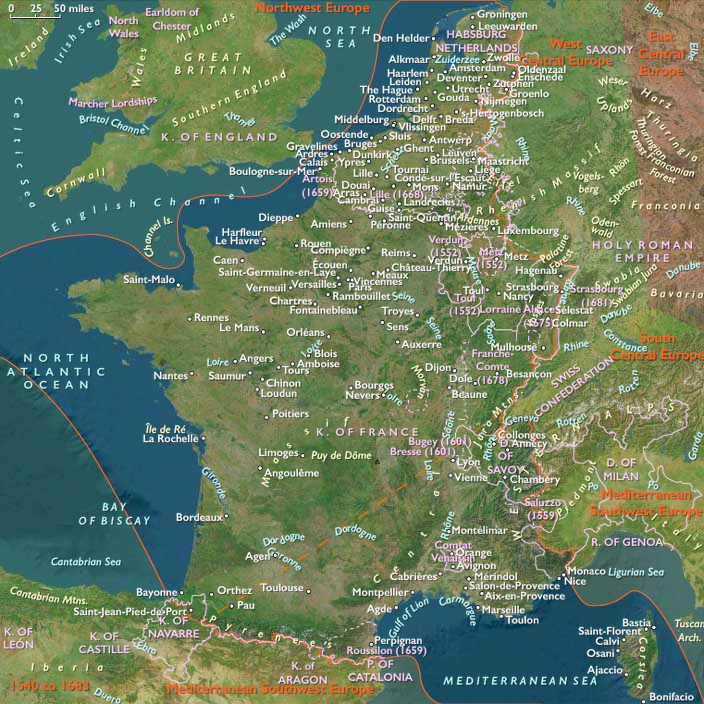
Subregions
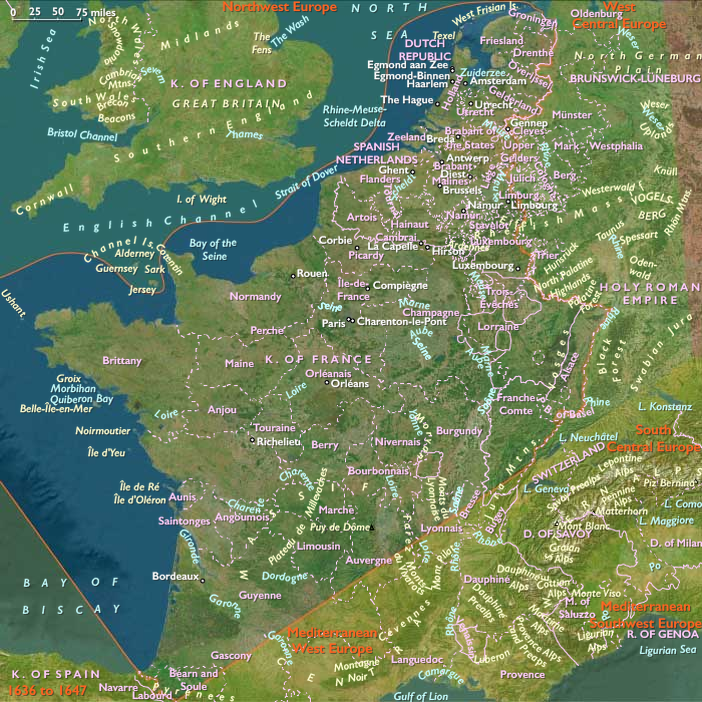
Related Events
Showing 10 events out of 32318 total
Years: 1637 - 1637
Locations
People
Groups
Topics
- Protestant Reformation
- Counter-Reformation (also Catholic Reformation or Catholic Revival)
- Scientific Revolution
- Eighty Years War (Netherlands, or Dutch, War of Independence)
Commodoties
Subjects
- Commerce
- Labor and Service
- Conflict
- Faith
- Theory
- Government
- Technology
- Movements
- Mathematics
- Physics and Mechanics
Regions
Subregions