
The citizens of Rhodes erect the famous…
285 BCE to 274 BCE
The citizens of Rhodes erect the famous Colossus, a bronze statue dedicated to the sun god Helios.
Many stories exaggerate the size of the statue, but it must be approximately one hundred and twenty feet (thirty-six meters) high on a base of white marble twenty to twenty-five feet (six to seven-and-a-half meters) high and thus larger than any other statue.
Commodities
Subjects
Regions
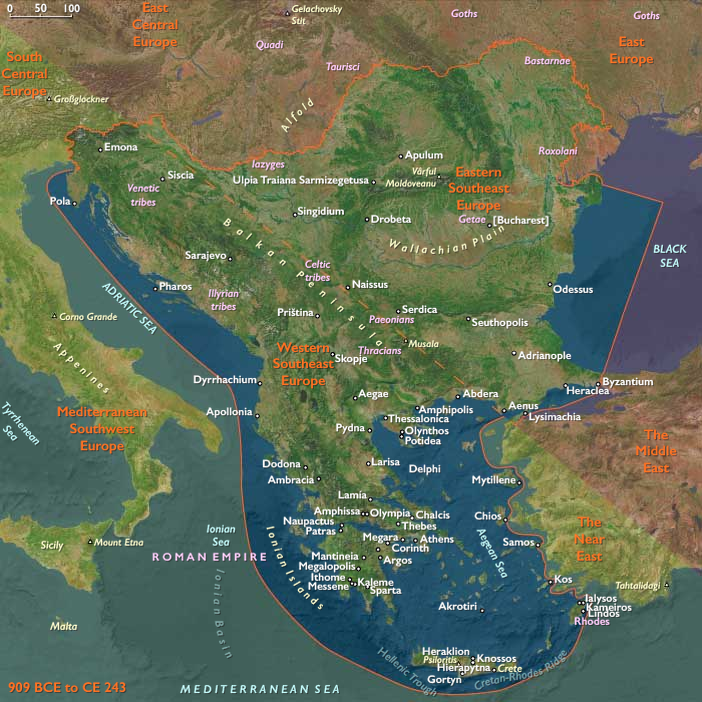
Southeast Europe
View →Subregions

Western Southeast Europe
View →Related Events
No active filters.
Showing 10 events out of 64066 total
Qu Yuan (Ch'u Yuan), a diplomat of Xu, falls from the king's favor due to his opposition to the prevalent policy of compromise to the powerful state of Qin (Ch'in).
Banished, he writes an imaginative long poem, Encountering Sorrow (Lisao), which also shows the depth of his loyalty to the state.
The distinguished poet drowns himself in despair in 278.
Gallic groups, originating from the various La Tène chiefdoms, had begun a southeastern movement into the Balkan peninsula from the fourth century BCE.
Celtic settlements are concentrated in the western half of the Carpathian basin, but there are notable incursions, and settlements, within the Balkan peninsula itself.
The Gallic invasions, originating from their new bases in northern Illyria and Pannonia, climax in the early third century BCE, with the invasion of Greece.
The 279 BCE invasion of Greece proper had been preceded by a series of other military campaigns waged toward the southern Balkans and against the kingdom of Macedon, favored by the state of confusion ensuing from the intricate succession to Alexander.
A part of the invasion crosses over to Anatolia and eventually settles in the area that comes to be named after them, Galatia.
Three Macedonian dynasties have established themselves in the natural units of Alexander’s empire by 275.
The successors of Antigonus I (the Antigonids) rule Macedonia and its Greek dependencies; those of Seleucus I (the Seleucids), the Asian provinces; and those of Ptolemy I (the Ptolemies), Egypt.
Anatolia itself is divided, as Lycia and Caria are governed by Ptolemaic Egypt while the Seleucids govern most of the other parts of the peninsula.
The new Hellenistic monarchies, whose leaders rule by force and lack Alexander's organizational ability, continue to fight each other and suffer internal struggles as well.
The Scordisci, a Celtic tribe that invades Greece during the first part of the third century BCE, finally settles east of Sirmium at the junction of the Savus and the Danube rivers. (Some Roman authorities consider them a Thracian stock, because of their admixture with an older Thraco-Illyrian population.)
The Middle East: 285–274 BCE
Hellenistic Rivalries and Regional Dynamics
Antiochus I and Ptolemaic Expansion
From 285 to 274 BCE, the Middle East continues to experience intense rivalry among Hellenistic dynasties. Antiochus I, the Seleucid king, attempts to consolidate and expand his holdings in Syria and Anatolia but faces significant setbacks. In 280 BCE, Antiochus is decisively defeated by Ptolemy II of Egypt in the Damascene War, curtailing Seleucid influence in the region.
First Syrian War and Ptolemaic Dominance
Tensions between Seleucid and Ptolemaic forces escalate once again with the onset of the First Syrian War in 274 BCE. Ptolemy II, strengthened by his recent marriage to his politically adept sister Arsinoe II, stabilizes the previously volatile Egyptian court, allowing him to conduct a vigorous and effective military campaign against Antiochus, further asserting Egypt's dominance in the eastern Mediterranean.
Consolidation of Hellenistic Dynasties
By 275 BCE, three major Macedonian dynasties have solidified their dominance over the territories of Alexander's fragmented empire. The Antigonids control Macedonia and its Greek dependencies, the Seleucids rule over Asia, and the Ptolemies dominate Egypt. Anatolia is notably divided, with Lycia and Caria under Ptolemaic control, while the Seleucids manage much of the remaining Anatolian regions.
Gallic Incursions and Settlement
The period is also marked by the significant movement of Gallic tribes from various La Tène chiefdoms, pushing southeastward into the Balkan Peninsula. These Celtic groups launch invasions into Greece proper around 279 BCE, capitalizing on the chaotic conditions following Alexander's death. Some of these groups cross into Anatolia and establish a presence in the region soon known as Galatia.
Persian Autonomy under Bagadates I
In the southern Iranian plateau, the region known today as Fars province begins to assert its independence from Seleucid authority. Bagadates I, bearing the title frataraka ("Keeper of the Fire"), becomes the first indigenous Persian satrap tolerated by the Seleucids. His rule around 280 BCE marks a notable resurgence of Persian administrative and cultural autonomy, as depicted on his coinage, which prominently features Zoroastrian symbolism.
This era, therefore, captures a dynamic and turbulent period in Middle Eastern history, marked by significant military conflicts, the solidification of dynastic realms, and notable shifts toward local autonomy amidst broader Hellenistic influences.
Antiochus I, the Seleucid king who is trying to expand his empire's holdings in Syria and Anatolia, is defeated in 280 BCE by Egypt's Ptolemy II in the Damascene War.
Ptolemy again faces Antiochus, a decade into his rule, in the First Syrian War, which begins in 274 BCE.
Ptolemy proves to be a forceful ruler and skilled general.
In addition, his recent marriage to his court-wise sister Arsinoe II of Egypt has stabilized the volatile Egyptian court, allowing Ptolemy to successfully carry out the campaign.
The southern portion of the Iranian plateau, present Fars province, is ruled independently of the Seleucids by a local dynasty with the title frataraka or or "Keeper of the Fire".
Bagadates I is the first indigenous Persian satrap to be appointed —or at least tolerated—by the Seleucids, who hold the higher administrative posts tightly within the Greco-Macedonian circle that was headed by the "Companions" and their heirs.
On the reverse of his coins, Bagadates is depicted standing in front of a Zoroastrian fire-altar, or seated in majesty holding a staff of authority and possibly a pomegranate in his left hand.
Bagadates seems to have asserted his independence about 280 BCE, exploiting the turmoil after the death of Seleucus I.
Near East (285–274 BCE): Emergence of the Hellenistic Monarchies and Cultural Flourishing
By 275 BCE, three distinct Macedonian dynasties solidify control over major segments of Alexander the Great’s fractured empire. In Macedonia and its Greek dependencies, the Antigonids, successors of Antigonus I Monophthalmus, rule securely. To the east, the vast Asian provinces are dominated by the Seleucids, descendants of Seleucus I Nicator. Meanwhile, Ptolemy I Soter and his successors—the Ptolemies—govern Egypt, with additional territories including Lycia and Caria in Anatolia. Most other parts of Anatolia, however, remain under Seleucid authority.
These emerging Hellenistic monarchies, characterized by centralized military rule yet lacking Alexander’s organizational genius, continuously clash with each other and face internal instability. A notable instance is the conflict between Antiochus I, the Seleucid king striving to extend his control in Syria and Anatolia, and Egypt’s Ptolemy II Philadelphus. Antiochus suffers defeat in 280 BCE during the Damascene War, and in 274 BCE, hostilities renew with the onset of the First Syrian War. Ptolemy II, benefiting from his strategic acumen and recent marriage to his influential sister, Arsinoe II, maintains a stable court and emerges as a capable military leader.
Culturally, the influence of Greek art and scholarship proliferates across the Near East, reflecting broader trends of Hellenization. Ptolemy II enhances Alexandria’s prestige as a center of learning and innovation by founding the Museum (Mouseion)—a renowned institution housing scholars and artists—and the great Library of Alexandria. Additionally, the construction of the towering Pharos of Alexandria, designed by Sostratus of Cnidus, marks a significant technological and architectural achievement. Standing more than 350 feet (approximately 110 meters) high, this lighthouse—counted among the Seven Wonders of the Ancient World—employs a sophisticated system of mirrors to project constant fires of resinous wood or oil, visible up to thirty miles away. It remains the archetype for lighthouses for centuries to follow.
Greek art forms become prevalent in the Near East.
The Pharos of Alexandria, built by Sostratus of Cnidus, perhaps for Ptolemy I, is said to have been more than three hundred and fifty feet (one hundred and ten meters) high; the only taller manmade structures at this time are the ancient pyramids of Giza.
One of the Seven Wonders of the World and the most famous lighthouse in antiquity, its tiered stone tower shields constant fires of resinous wood or oil, reflected by metal mirrors, thus rendering them visible for possibly thirty miles (about fifty kilometers).
A technological triumph, it is to remain the archetype of all lighthouses since.