Richard Dadd had worked on the painting…
1864 CE
Richard Dadd had worked on the painting titled The Fairy Fellers' Master Stroke for nine years, paying microscopic attention to detail and using a layering technique to produce 3D-like results.
Although it is generally regarded as his most important work, Dadd himself considers the painting to be unfinished (the background of the lower left corner is only sketched in), and as such adds the suffix of "Quasi" to its title.
In order to give context to his work, Dadd subsequently writes a strange poem by the name of Elimination of a Picture & its Subject—called The Fellers' Master Stroke in which each of the characters appearing in the picture is given a name and purpose—including myriad references to old English folklore and Shakespeare—in an apparent attempt to show that the painting's unique composition had not merely been a product of random, wild inspiration.
The Queen song "The Fairy Feller's Master-Stroke" from the band's second album will be born of Freddie Mercury's appreciation of the work; it makes direct reference to the painting's characters as detailed in Dadd's poem.
Dadd was born at Chatham, Kent, England, the son of a chemist.
His aptitude for drawing had been evident at an early age, leading to his admission to the Royal Academy of Arts at the age of twenty.
He had been awarded the medal for life drawing in 1840.
With William Powell Frith, Augustus Egg, Henry O'Neil and others, he had founded The Clique, of which he was generally considered the leading talent.
He had also been trained at William Dadson's Academy of Art.
Among his best-known early works are the illustrations he produced for The Book of British Ballads (1842), and a frontispiece he designed for The Kentish Coronal (1840).
In July 1842, Sir Thomas Phillips, the former mayor of Newport, had chosen Dadd to accompany him as his draftsman on an expedition through Europe to Greece, Turkey, Southern Syria and finally Egypt.
In November of that year, they had spent a gruellng two weeks in Southern Syria, passing from Jerusalem to Jordan and returning across the Engaddi wilderness.
Toward the end of December, while traveling up the Nile by boat, Dadd had undergone a dramatic personality change, becoming delusional and increasingly violent, and believing himself to be under the influence of the Egyptian god Osiris.
His condition was initially thought to be sunstroke.
On his return in the spring of 1843, he had been diagnosed to be of unsound mind and was taken by his family to recuperate in the countryside village of Cobham, Kent.
In August of that year, having become convinced that his father was the Devil in disguise, Dadd had killed him with a knife and fled for France.
En route to Paris, Dadd had attempted to kill another tourist with a razor, but had been overpowered.
Arrested by the police, Dadd had confessed to the killing of his father and was returned to England, where he had been committed to the criminal department of Bethlem psychiatric hospital (also known as Bedlam).
Here and subsequently at the newly created Broadmoor Hospital, Dadd has been cared for (and encouraged to continue painting) by the likes of Drs William Wood and Sir W. Charles Hood, in an enlightened manner.
Dadd probably suffers from a form of paranoid schizophrenia.
He appears to have been genetically predisposed to mental illness; two of his siblings are similarly afflicted, while a third has "a private attendant" for unknown reasons.
In the hospital, he had been allowed to continue to paint and it was here that many of his masterpieces had been created, including his most celebrated painting, The Fairy Feller's Master-Stroke, on which he has worked between 1855 and 1864.
George Henry Hayden, head steward at Bethlem and impressed by Dadd's artistic efforts, had asked for a fairy painting of his own.
Images

Richard Dadd. Fairy Fellers' Master-Stroke (1855–64) Oil on canvas. 54 x 39.5 cm. Tate Britain.
Locations
Topics
Commodities
Regions
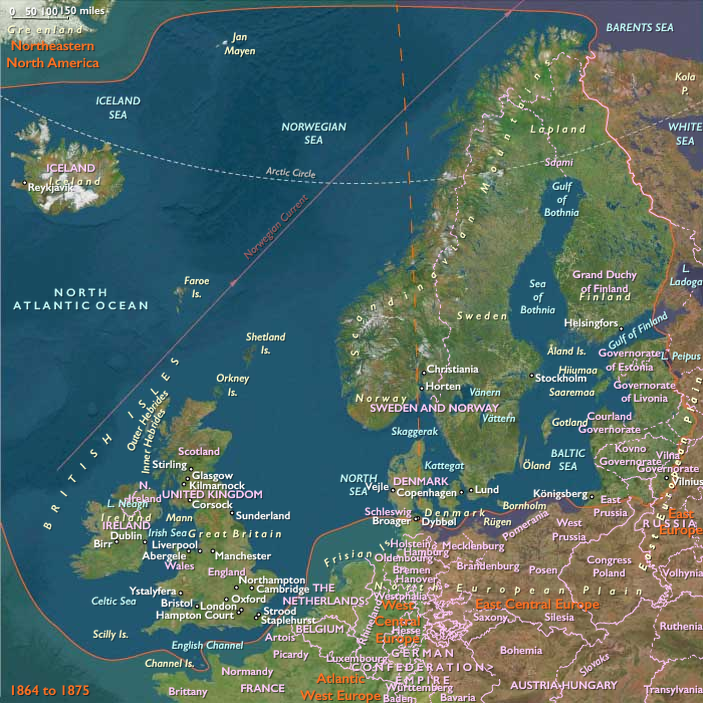
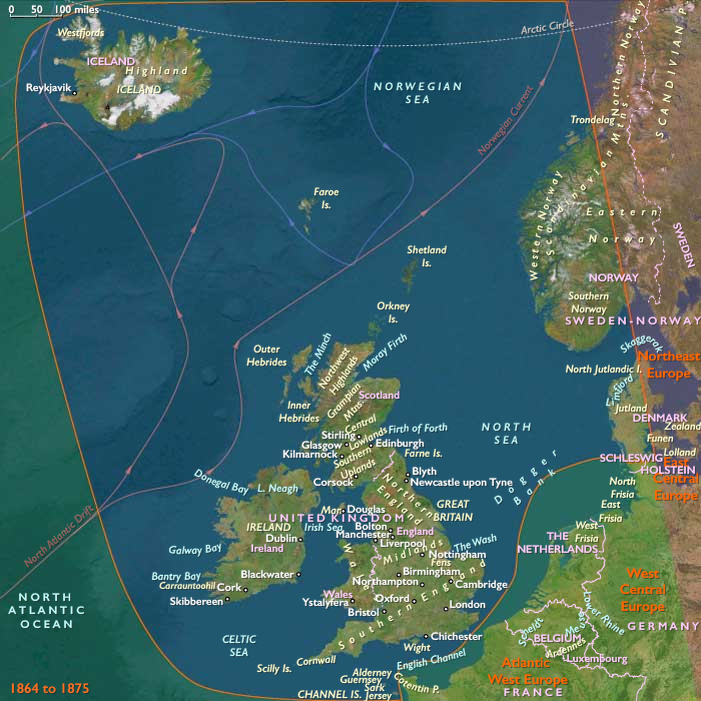
North Europe
View →Subregions