
The Succession Crisis After Richard I’s Death …
Years: 1199 - 1199
May
The Succession Crisis After Richard I’s Death and the Decline of the Angevin Empire (1199 CE)
With no legitimate heirs and only one acknowledged illegitimate son, Philip of Cognac, Richard I was succeeded as King of England on May 27, 1199, by his youngest and only surviving brother, John. However, Richard’s death without a direct heir marked the first step in the dissolution of the Angevin Empire, as John’s rule was immediately challenged in France.
John’s Inheritance: A Kingdom in Crisis
- John inherited a realm in turmoil, with England in financial bankruptcy due to Richard’s ruinously expensive wars in France and the Third Crusade.
- The war with Philip II of France had weakened Angevin control on the Continent, leaving many of Richard’s conquests vulnerable.
The Succession Dispute: John vs. Arthur of Brittany
- John’s claim to the Angevin lands was disputed by his nephew, Arthur of Brittany, the 12-year-old son of Geoffrey of Brittany (Richard and John’s deceased older brother).
- By modern standards, Arthur’s claim was stronger than John’s:
- Arthur was the son of John’s older brother, meaning he had a direct line of succession.
- The French nobility preferred Arthur, viewing him as a more legitimate heir.
- John, however, had the support of English and Norman barons, as well as the backing of Eleanor of Aquitaine, their formidable mother, who saw John as the best candidate to preserve Plantagenet rule.
The Beginning of the End for the Angevin Empire
- Philip II of France seized the opportunity to exploit the succession crisis, backing Arthur’s claim in an effort to break Angevin power in France.
- This conflict would escalate into the Anglo-French war of succession (1199–1204), ultimately leading to the loss of Normandy and much of Anjou to the Capetians.
- Though English kings would continue to claim lands in France, they would never again command the vast Angevin territories that Richard I had inherited.
Conclusion: The Angevin Empire Begins to Unravel
- Richard I’s lack of an heir led directly to the collapse of Angevin control in France.
- John’s tenuous hold on his French lands led to rebellion and invasion, allowing Philip II to dismantle Angevin power on the continent.
- The dream of a vast Anglo-French Angevin Empire effectively ended with Richard’s death, though English kings would continue to fight for continental possessions for centuries.
The succession crisis of 1199 was the first irreversible step toward the dissolution of Angevin rule in France, marking the beginning of England’s long struggle to maintain a foothold on the Continent.
Locations
People
Groups
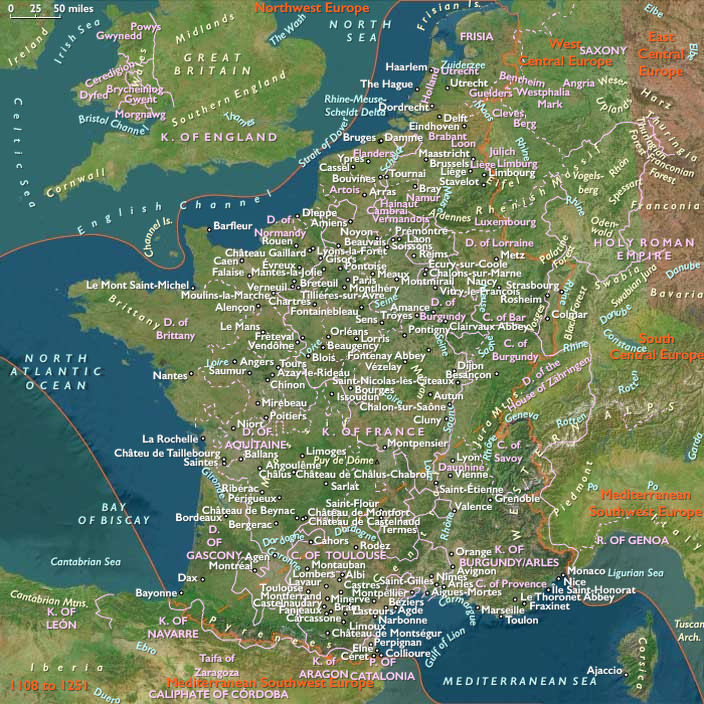
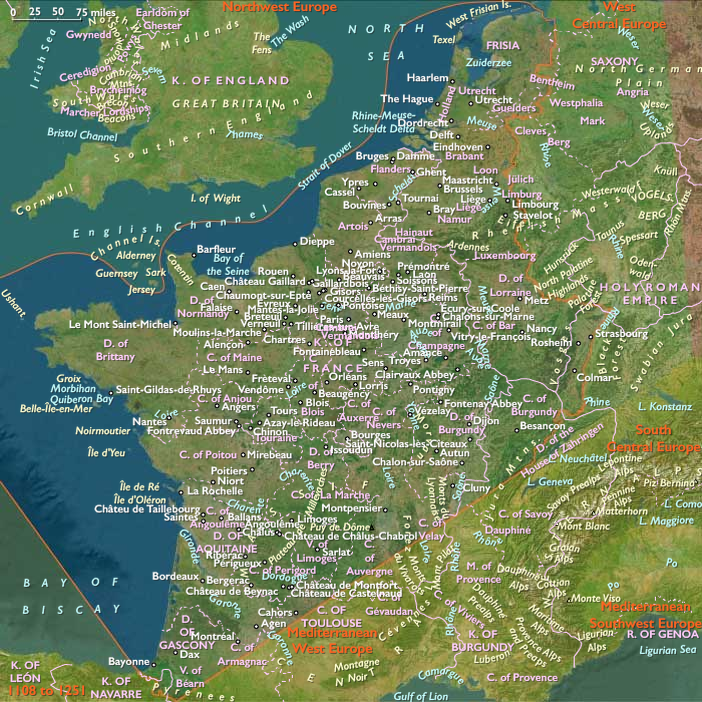
- Anjou, County of
- Normandy, Duchy of
- Brittanny, Duchy of
- Aquitaine, (Angevin) Duchy of
- France, (Capetian) Kingdom of
- England, (Plantagenet, Angevin) Kingdom of
- Angevin Empire
Commodoties
Subjects
Regions
Subregions
Related Events
Showing 10 events out of 47716 total
Years: 1199 - 1199
May
Locations
People
Groups
- Anjou, County of
- Normandy, Duchy of
- Brittanny, Duchy of
- Aquitaine, (Angevin) Duchy of
- France, (Capetian) Kingdom of
- England, (Plantagenet, Angevin) Kingdom of
- Angevin Empire
Commodoties
Subjects
Regions
Subregions