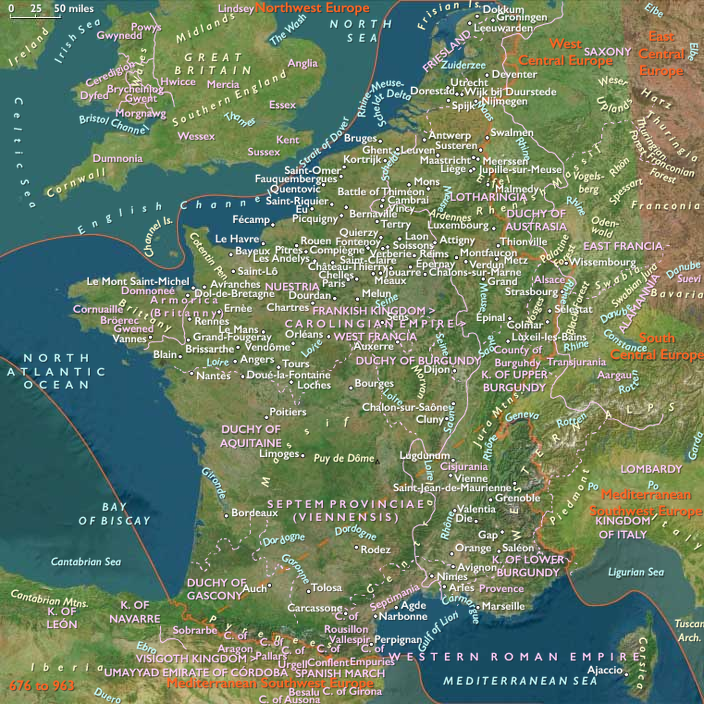
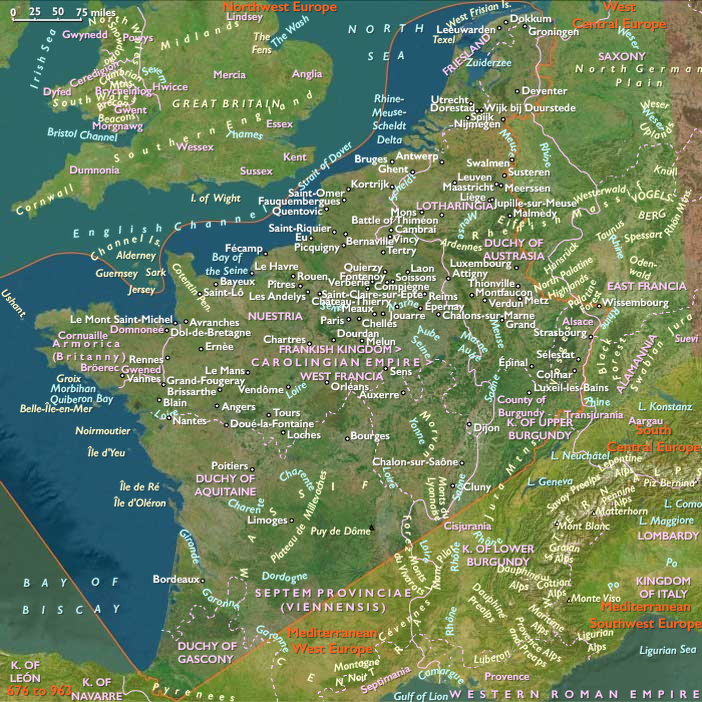
Rollo Consolidates Normandy: Land Distribution and Settlement (c. 924–930s)
After securing Normandy through the Treaty of Saint-Clair-sur-Epte (911) and further expanding his domain westward into Bayeux, Le Mans, and Bessin (924), Rollo begins the process of formally organizing and governing his territory. One of his key measures is the distribution of land among his most trusted chieftains, ensuring stability and long-term Norman control.
Dividing the Land Between the Epte and Risle
- Rollo grants land between the Epte and Risle rivers to his Norse followers, effectively settling Viking warriors as feudal lords.
- These settlements follow a Norse-style system, but gradually adapt to Frankish feudal traditions, blending Viking and Carolingian governance.
- By granting land to his chiefs, Rollo secures their loyalty, ensuring that Normandy becomes a defensible and well-organized stronghold.
Rouen as the De Facto Capital of Normandy
- Rollo establishes Rouen as his primary seat of power, making it the de facto capital of Normandy.
- The city becomes the administrative and military hub of the duchy, overseeing:
- Trade along the Seine River, connecting it to the rest of West Francia.
- Fortification projects, strengthening Norman defenses.
- Norse and Frankish cultural integration, as Norse settlers begin adopting Frankish language, religion, and legal customs.
The Long-Term Impact of Rollo’s Settlement Policy
-
Norman Stability
- By distributing land strategically among his chieftains, Rollo prevents internal conflicts and strengthens his rule.
-
Cultural Fusion
- Over time, the Norse settlers intermarry with local Frankish and Gallo-Roman populations, leading to the emergence of a distinct Norman identity.
-
Establishment of Norman Feudalism
- Rollo’s system of land grants lays the foundation for the feudal structure of Normandy, which will later influence feudal England after the Norman Conquest of 1066.
Conclusion: The Birth of Norman Governance
By dividing land among his followers and establishing Rouen as his capital, Rollo successfully transforms Normandy from a Viking raiding base into a structured feudal territory. His rule not only stabilizes the region but also ensures that Normandy becomes one of the most powerful feudal states in medieval France, ultimately shaping the future of European history.