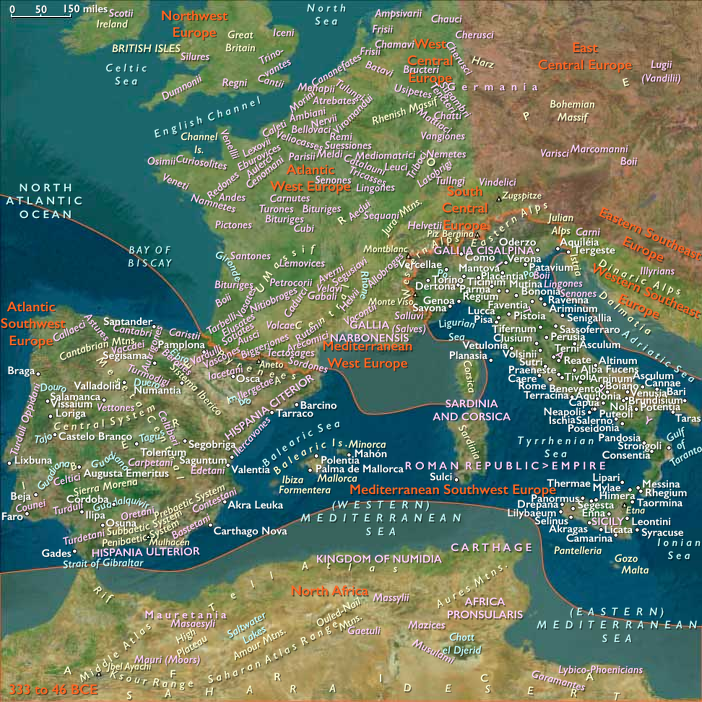
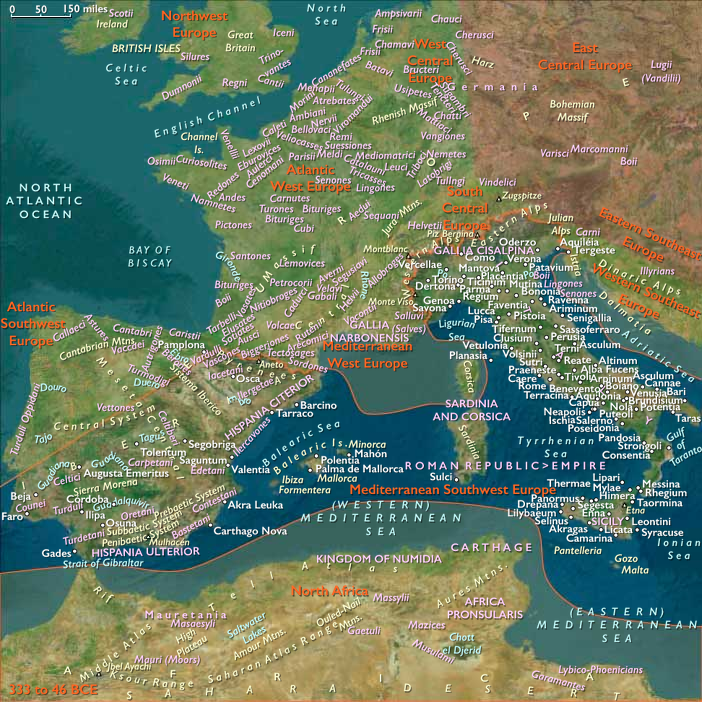
Roman expansion to the Straits of Messana …
Years: 264BCE - 264BCE
Roman expansion to the Straits of Messana (Messina), and Carthaginian occupation of Messana itself in 264 triggers a war between Rome and Carthage (later known as the first Punic War, from punicus, meaning "Carthaginian," after Punt, the Roman name for the Carthaginians’ original homeland of Phoenicia).
Allied Greek cities in southern Italy feel their commerce threatened, many Romans fear any powerful neighbor in Sicily, some aristocrats desire military glory, and many voters want plunder.
Although opinion in the Roman Senate is divided, the Roman Assembly honors a Messanian request for intervention.
The Carthaginians initially withdraw, then counterattack with aid from Hiero II, who, when Rome sides with the Mamertini, allies Syracuse with Carthage.
Locations
People
Groups
Topics
Commodoties
Subjects
Regions
Subregions
Related Events
Filter results
Showing 10 events out of 22 total
Maritime East Asia (1852–1863 CE): Reforms, Resistance, and Rebellion
Between 1852 and 1863 CE, Maritime East Asia—covering lower Primorsky Krai, the Korean Peninsula, the Japanese Archipelago south of northern Hokkaido, Taiwan, and southern, central, and northeastern China—faces continued Western pressure, internal rebellions, and significant political transformations, reshaping regional power structures and paving the way for dramatic changes in the decades ahead.
China: The Taiping Rebellion and Qing Decline
China remains embroiled in the devastating Taiping Rebellion, led by Hong Xiuquan, who had declared the establishment of the Heavenly Kingdom of Great Peace in 1851. The rebellion, blending Protestant ideals with anti-Manchu fervor, captures key cities such as Nanjing, asserting radical social reforms, communal land ownership, and strict moral codes. However, the rebellion’s radical ideology alienates the Confucian scholar-gentry, and internal feuds undermine its effectiveness.
In response, the Qing dynasty entrusts scholar-official Zeng Guofan with suppressing the Taiping. Zeng’s innovative "Hunan Army," funded by local taxes and led by scholar-generals, significantly strengthens the Qing's military capabilities. Despite ongoing battles against simultaneous uprisings like the Nien and Muslim Rebellions, Zeng’s actions mark the rise of a new Han Chinese elite and further erode Qing central authority.
Qing Efforts at Modernization
Facing internal turmoil and external threats, Qing China initiates cautious modernization efforts under forward-thinking Han officials. They adopt Western science and diplomatic practices, open specialized schools in urban centers, and establish arsenals, factories, and shipyards modeled after Western methods. This practical approach, however, remains secondary to the dynasty's primary goal of preserving traditional structures.
The Tongzhi Restoration (1862–1874), led by Empress Dowager Cixi, represents this cautious modernizing impulse, seeking practical solutions within traditional frameworks. Although it partially stabilizes the regime, it falls short of the comprehensive reforms needed to effectively meet external threats and internal challenges.
Japan: The Bakufu’s Response to Western Pressure
In Japan, the Tokugawa shogunate continues to grapple with the impact of Western pressure, intensified after Commodore Matthew C. Perry forces Japan open in 1853–54. The bakufu under Abe Masahiro initially attempts a cautious balance between accommodation and military preparedness, establishing naval training with Dutch instructors and translating Western texts.
However, internal divisions deepen. Tokugawa Nariaki, a vocal advocate for imperial restoration and opponent of foreign influence, represents growing nationalist and anti-Western sentiment. After the death of the shogun without a clear heir, the political struggle intensifies, eventually leading to the arrest of Nariaki and his favored candidate, Tokugawa Yoshinobu, and the execution of prominent nationalist intellectual Yoshida Shoin. The bakufu's concessions to foreign powers—including extraterritorial rights and increased trade access—further erode its credibility and authority, fueling domestic unrest.
Joseon Korea: Deepened Isolation and Resistance
Joseon Korea, observing the aggressive Western actions in China and Japan’s forced opening, doubles down on isolation. Hostility toward Western influences intensifies, especially against Catholicism, leading to harsh persecutions. The government firmly rejects foreign trade overtures, further isolating Korea from international developments. This reactionary stance exacerbates internal tensions and economic decline, laying the foundation for future internal uprisings and external conflicts.
Legacy of the Era: Resistance, Reform, and Continued Instability
The period from 1852 to 1863 CE leaves Maritime East Asia marked by ongoing resistance to Western pressures, uneven and cautious reforms, and deep internal instability. China struggles to quell devastating rebellions and preserve its weakening dynasty, Japan faces rising nationalist opposition to the increasingly compromised shogunate, and Korea remains rigidly closed, storing tensions that will soon erupt into significant upheaval. These developments profoundly shape the trajectory of the region, setting the stage for major transformations in the late nineteenth century.
To defeat the Taiping rebellion, the Qing court needs, besides Western help, an army stronger and more popular than the demoralized imperial forces.
In 1860 scholar-official Zeng Guofan (1811-72), from Hunan Province, is appointed imperial commissioner and governor-general of the Taiping-controlled territories and placed in command of the war against the rebels.
Zeng's Hunan army, created and paid for by local taxes, becomes a powerful new fighting force under the command of eminent scholar-generals.
Zeng's success gives new power to an emerging Han Chinese elite and erodes Qing authority.
Simultaneous uprisings in north China (the Nien Rebellion) and southwest China (the Muslim Rebellion) further demonstrated Qing weakness.
Amid these activities in China comes an attempt to arrest the dynastic decline of the Qing by restoring the traditional order.
The effort is known as the Tongzhi Restoration, named for the Tongzhi Emperor (1862-74), and is engineered by the young emperor's mother, the Empress Dowager Cixi (1835-1908).
The restoration, however, which applies "practical knowledge" while reaffirming the old mentality, is not a genuine program of modernization.
The rude realities of the Opium War, the unequal treaties, and the mid-century mass uprisings have caused Qing courtiers and officials to recognize the need to strengthen China.
Chinese scholars and officials have been examining and translating "Western learning" since the 1840s.
Under the direction of modern-thinking Han officials, Western science and languages are studied, special schools are opened in the larger cities, and arsenals, factories, and shipyards were established according to Western models.
Western diplomatic practices are adopted by the Qing, and students are sent abroad by the government and on individual or community initiative in the hope that national regeneration can be achieved through the application of Western practical methods.
The Muslim rebellion in Shensi against their Qing Manchu overlords promptly spreads to Kansu and the Tarim Basin, where it will last for fifteen years.
Their leader Yaqub Bek establishes an independent government at Kashgar.
Maritime East Asia (1864–1875 CE): Restoration, Modernization, and Rising Nationalism
Between 1864 and 1875 CE, Maritime East Asia—encompassing lower Primorsky Krai, the Korean Peninsula, the Japanese Archipelago south of northern Hokkaido, Taiwan, and southern, central, and northeastern China—experiences critical efforts at restoration and modernization, rising nationalist sentiments, and significant political restructuring, laying the foundations for profound regional transformations.
China: The Self-Strengthening Movement and Foreign Encroachments
Following the devastating Taiping Rebellion, Qing China embarks on the Self-Strengthening Movement, driven by scholar-generals such as Li Hongzhang and Zuo Zongtang. These leaders advocate adopting Western science, technology, and military strategies to strengthen China internally while preserving traditional political structures. Between 1861 and 1875, China sees the establishment of modern arsenals, shipyards, factories, schools, and improved diplomatic methods.
However, modernization efforts face significant internal resistance. The conservative bureaucracy, still deeply influenced by Neo-Confucian traditions, slows comprehensive reform. Simultaneously, foreign pressures intensify: Russia seizes significant territories in Manchuria, while Western powers further consolidate economic concessions through extraterritorial rights and treaty ports, severely limiting Qing sovereignty.
The Tongzhi Restoration (1862–1874), under the guidance of Empress Dowager Cixi, seeks to stabilize Qing rule through cautious reform and restoration of traditional authority. Yet, despite modest improvements, Qing China continues to struggle with internal fragmentation and external vulnerabilities.
Japan: The Meiji Restoration and Rapid Transformation
In Japan, internal conflicts culminate dramatically with the fall of the Tokugawa shogunate and the establishment of the Meiji Restoration in 1868. This marks the end of over two centuries of feudal rule, and power formally returns to the imperial court under Emperor Mutsuhito, who reigns as Emperor Meiji. The Restoration fundamentally restructures Japanese governance, aiming to modernize and centralize authority rapidly.
The Charter Oath of 1868 outlines Japan’s new goals: establishing deliberative assemblies, allowing social mobility, embracing international knowledge, and discarding outdated customs. Feudal domains (han) are abolished and replaced by prefectures, dramatically centralizing authority. Comprehensive reforms reshape the social order, economy, military, and education system, heavily influenced by Western models.
Influential leaders such as Okubo Toshimichi, Saigo Takamori, Kido Koin, and Iwakura Tomomi emerge as architects of modernization, promoting industrialization, infrastructure expansion, military enhancement, and international diplomatic engagement. A landmark diplomatic mission, the Iwakura Mission (1871–1873), travels extensively through the United States and Europe to learn and implement Western governance practices, technology, and education.
Korea: Continued Isolation and Internal Strife
Joseon Korea maintains its stringent isolationist policies amid escalating Western pressure on neighboring nations. Harsh persecution of Christians continues, reflecting deep suspicion toward foreign influence. Economic hardship intensifies due to governmental inaction and societal rigidity, fueling internal unrest and widespread poverty.
The rigid isolation contributes to deepening internal instability, setting the stage for growing social unrest and major rebellions in subsequent decades. Despite awareness of international developments in Japan and China, the Joseon court resolutely resists change, increasingly alienating progressive factions within the kingdom.
Legacy of the Era: Foundations of Modernization and Persistent Challenges
The years 1864 to 1875 CE witness crucial steps toward modernization and nation-building in Mariime East Asia. While Japan rapidly transforms into a centralized, modern nation-state, China's conservative approach limits the effectiveness of its reforms, leaving it vulnerable to continued external exploitation and internal tensions. Meanwhile, Korea’s determined isolation preserves immediate stability at the cost of long-term preparedness, foreshadowing severe challenges in the rapidly changing international environment. This era thus profoundly shapes the region’s trajectory, determining each nation’s path into the late nineteenth century.

Russia, which had been expanding into Central Asia, had taken the first step in the foreign powers' effort to carve up the Qing Empire.
By the 1850s, tsarist troops also had invaded the Heilongjiang watershed of Manchuria, from which their countrymen had been ejected under the Treaty of Nerchinsk.
The Russians had used the superior knowledge of China they had acquired through their century-long residence in Beijing to further their aggrandizement.
In 1860 Russian diplomats had secured the secession of all of Manchuria north of the Heilongjiang and east of the Wusuli Jiang (Ussuri River).
Foreign encroachments had increased after 1860 by means of a series of treaties imposed on China on one pretext or another.
The foreign stranglehold on the vital sectors of the Chinese economy is reinforced through a lengthening list of concessions.
Foreign settlements in the treaty ports becomes extraterritorial—sovereign pockets of territories over which China has no jurisdiction.
The safety of these foreign settlements is ensured by the menacing presence of warships and gunboats.
The effort to graft Western technology onto Chinese institutions becomes known as the Self-Strengthening Movement.
The movement is championed by scholar-generals like Li Hongzhang (1823-1901) and Zuo Zongtang (1812-85), who had fought with the government forces in the Taiping Rebellion.
From 1861 to 1894, leaders such as these, now turned scholar-administrators, will be responsible for establishing modern institutions, developing basic industries, communications, and transportation, and modernizing the military, but despite its leaders' accomplishments, the Self-Strengthening Movement does not recognize the significance of the political institutions and social theories that had fostered Western advances and innovations.
This weakness leads to the movement's failure.
Modernization during this period would have been difficult under the best of circumstances.
The bureaucracy is still deeply influenced by Neo-Confucian orthodoxy.
Chinese society is still reeling from the ravages of the Taiping and other rebellions, and foreign encroachments continue to threaten the integrity of China.
Qing dynasty China has suffered immeasurable damage and devastation in the various rebellions of the mid-nineteenth century.
Both the Taiping and the pacifiers are guilty of brutality and destruction.
A contemporary estimate of twenty million to thirty million victims is certainly far less than the real number.
In the course of the Taiping Rebellion, the lower Yangtze provinces have lost much of their surplus population, but hereafter immigrants from less damaged areas will resettle the region. (Its ruined industry and agriculture will not fully recover even by the beginning of the twentieth century.)
The area of the Muslim rebellions, too, has suffered catastrophic devastation and depopulation.
The locus of power shifts, after the final defeat of the Taiping at Nanking in 1864, from the Manchu to those Chinese who have played the main part in putting down the rebellions.
The Muslim rebels of Shensi, defeated by the Imperial army, flee to Kansu, which becomes the main theater of fighting.