
Roman poet Virgil, born Publius Vergilius Maro …
Years: 36BCE - 36BCE
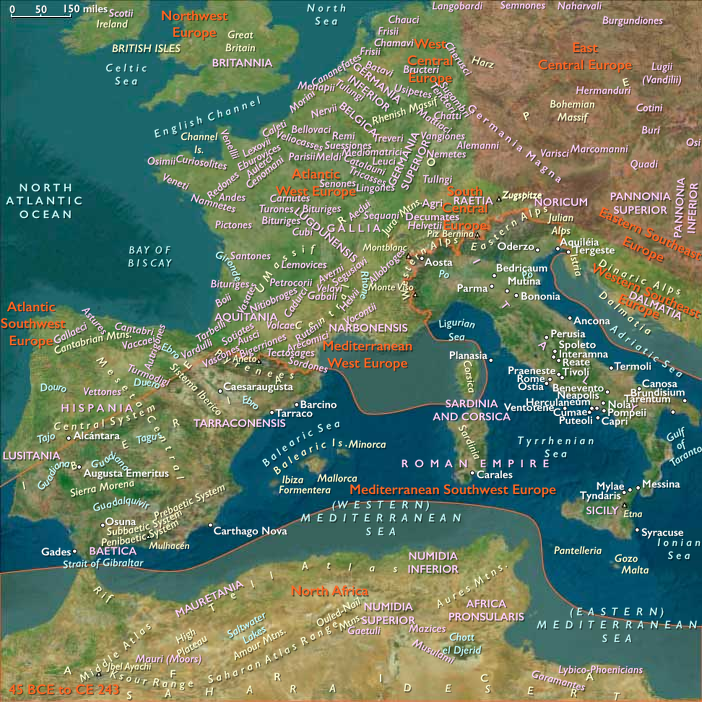
Roman poet Virgil, born Publius Vergilius Maro in Andes, a village near Mantua in northern Italy, had passed his childhood on his father's farm and was educated at Cremona, Milan, and then Rome, where he had studied rhetoric and met poets and diplomats who were to play an important part in his life.
When civil war erupted in 49 BCE, the twenty-one-year-old poet Vergil had retired to Naples where he studied philosophy with the Epicurean Siro.
By 37 BCE, Virgil had completed his Bucolics (also called the Eclogues), innovatively arranging these ten poems to fit the design of the book as a whole.
Some of the Bucolics, modeled after the bucolic poems of Theocritus, portray an idyllic Arcadia with Roman political concerns and real people in pastoral guise, offering a dramatic and mythic interpretation of revolutionary change at Rome in the turbulent period between roughly 44 and 38 BCE.
The fourth prophesies a new golden age heralded by the birth of an unnamed child; the sixth is a unique blend of cosmology and myths.
Much admired in contemporary literary circles for the quiet beauty and charm with which they evoke the pastoral landscape, the Bucolics secure Virgil’s reputation.
The subsequent adaptation of these to the stage as mimes would make Virgil a popular, if elusive, figure.
He now begins work on a didactic poem on farming, the Georgics (from Greek, "On Working the Earth", because farming is their apparent theme, in the tradition of Greek Hesiod).
Locations
People
Groups
Topics
Commodoties
Subjects
Regions

Subregions
Related Events
Showing 10 events out of 62273 total
Years: 36BCE - 36BCE
Locations
People
Groups
Topics
Commodoties
Subjects
Regions
Subregions