
Roman sources place the homeland of the …
Years: 1386 - 1386
Roman sources place the homeland of the Jute tribe north of the river Eider and that of the Angles to its south, who in turn abutted the neighboring Saxons.
The population of Schleswig by the early Middle Ages consisted of Danes to the north of Danevirke and Schlei and on the peninsula Schwansen, North Frisians on the west coast below a line slightly south of the present border and on the islands, and Saxon (or Low German) in the far South.
The population on Schwansen during the fourteenth century has begun to speak German, but otherwise the ethnic mix had become increasingly German from the fourteenth century onward.
Southern Jutland (the Duchy of Schleswig) had in the 1230s been allotted as an appanage to Abel Valdemarsen, Canute's great-grandson, a younger son of Valdemar II of Denmark.
Abel, having wrested the Danish throne to himself for a brief period, left his duchy to his sons and their successors, who had pressed claims to the throne of Denmark for much of the next century, so that the Danish kings were at odds with their cousins, the dukes of Slesvig.
Feuds and marital alliances have brought the Abel dynasty into a close connection with the German Duchy of Holstein by the late fourteenth century.
The latter is a fief subordinate to the Holy Roman Empire, while Schleswig remains a Danish fief.
These dual loyalties are to become a main root of the dispute between the German states and Denmark in the nineteenth century, when the ideas of romantic nationalism and the nation-state won popular support.
The Danish duchy of Schleswig and the German county of Holstein are from 1386 united.
Locations
Groups
- Saxons
- Germans
- Frisians
- Holstein, County of
- Schleswig, Duchy of
- Denmark, Kingdom of (Personal Union of Denmark and Norway)
Subjects
Regions
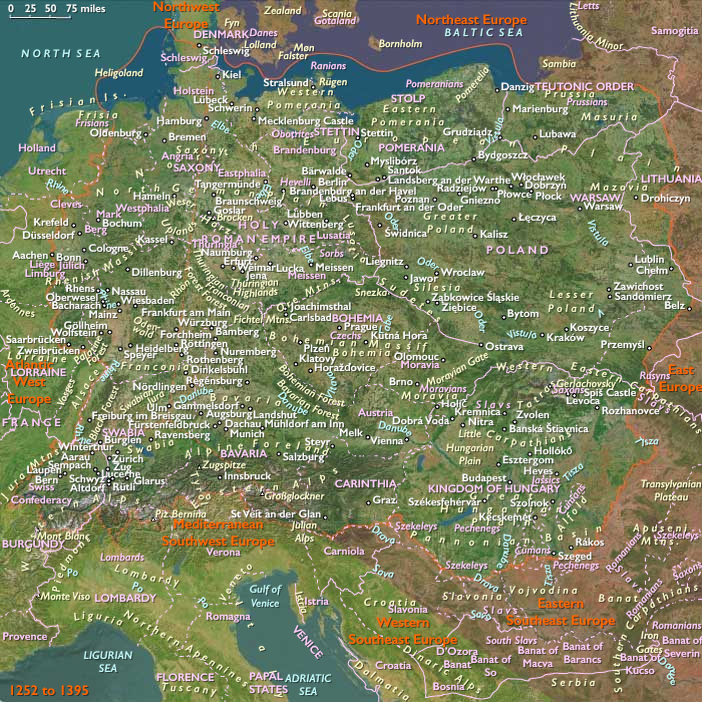
Subregions
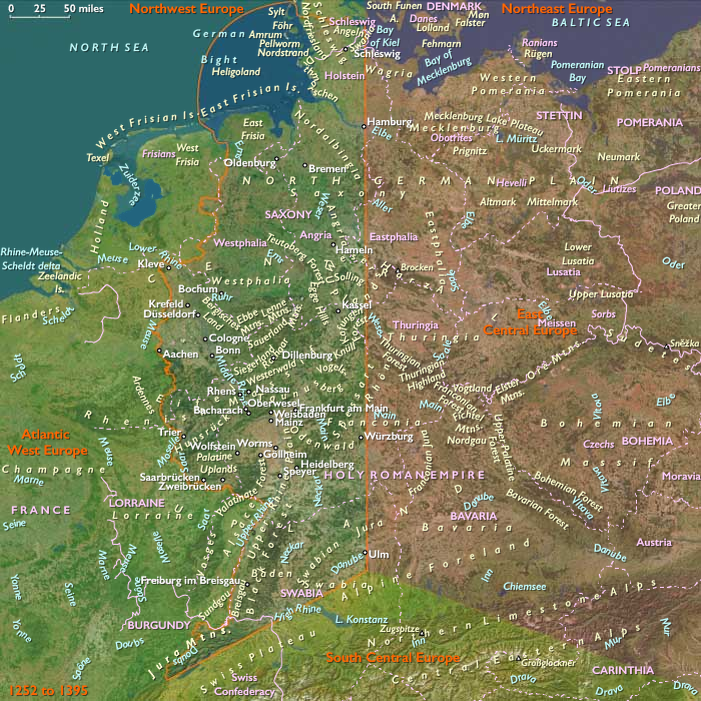
Related Events
Showing 10 events out of 43564 total
Years: 1386 - 1386
Locations
Groups
- Saxons
- Germans
- Frisians
- Holstein, County of
- Schleswig, Duchy of
- Denmark, Kingdom of (Personal Union of Denmark and Norway)
Subjects
Regions
Subregions