
Rudrasena II, who in 380 had become…
405 CE
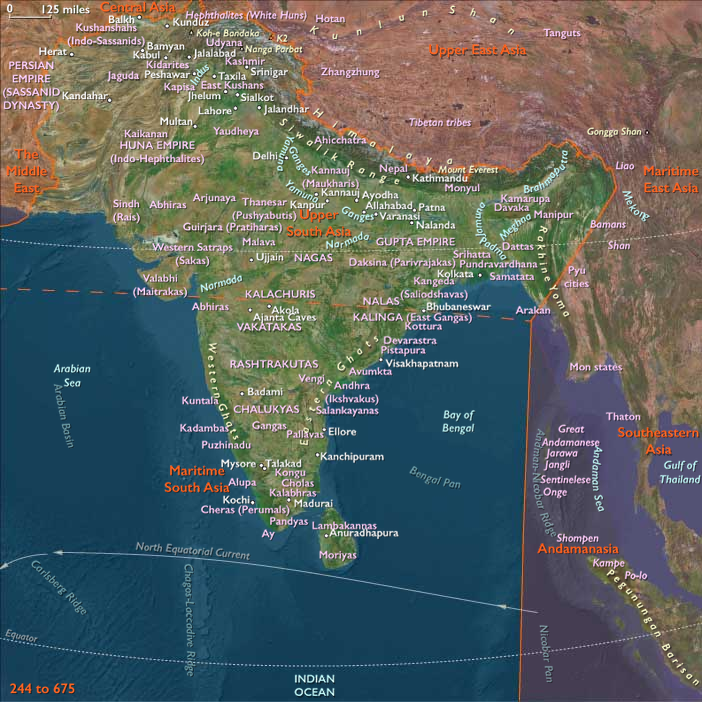
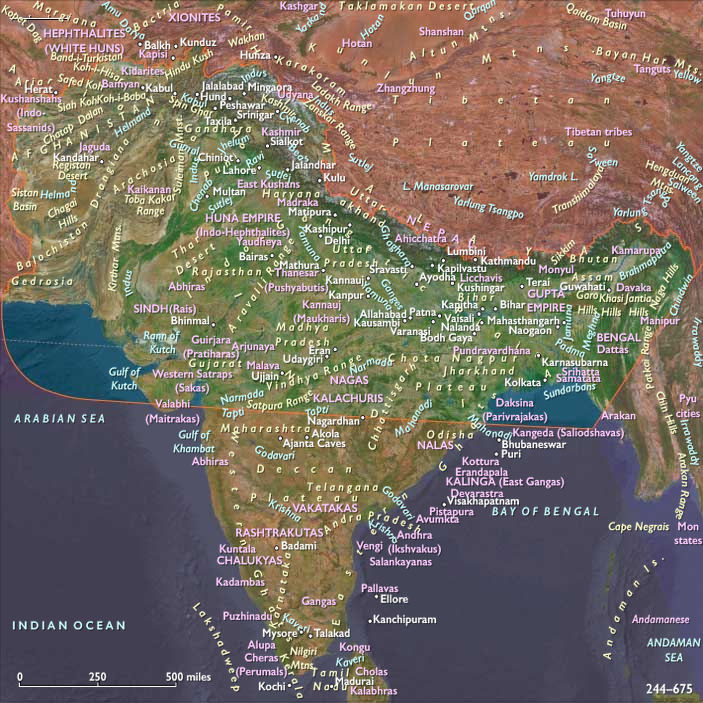
Rudrasena II, who in 380 had become emperor of Vakataka in the Deccan Plateau of India, is said to have married Prabhavatigupta, the daughter of the Gupta King Chandragupta II (375-413/15).
Rudrasena II had died in 385 after a very short reign, following which Prabhavatigupta has ruled as a regent on behalf of her two sons, Divakarasena and Damodarasena (Pravarsena II) for twenty years.
During this period the Vakataka realm has been practically a part of the Gupta Empire.
Locations
Groups
Commodities
Subjects
Regions
South Asia
View →Subregions
Upper South Asia
View →Related Events
Showing 10 events out of 69 total
The Khitan, of Xianbei origin, had been part of the Kumo Xi tribe until 388, when the Kumo Xi-Khitan tribal grouping was roundly defeated by the newly established Northern Wei, allowing the Khitan to resume their own tribe and entity, and beginning the Khitan written history.
First mentioned in Chinese chronicles in 405, the Khitan wander along the boundaries of Kara-muren, and had formed part of the Donghu confederation destroyed by the Xiongnu in 150 BCE.
Murong De, who had by 405 has established Southern Yan and become its emperor, has become aware that Murong Chao is being detained in Chang'an, and sends secret messengers to encourage him to flee to Southern Yan.
Murong Chao, not daring to tell even his mother and wife, flees to Southern Yan.
On the way, he passes through the territory of the general Murong Fa, the governor of Yan Province (modern western Shandong), and Murong Fa, believing that he is not truly of imperial descent, disrespects him, leading Murong Chao to bear grudges against Murong Fa in the future.
Murong De is greatly pleased when Murong Chao arrives at the capital, Guanggu (in modern Qingzhou, Shandong), and Murong Chao presents him the golden knife that Murong De had left Lady Gongsun before leaving.
Murong De mourns his mother and brother greatly, but creates Murong Chao to be the Prince of Beihai—the same title that Murong Na had held.
As Murong De has no surviving sons, he considers Murong Chao his probable heir, and he selects talented men to be Murong Chao's assistants.
Murong Chao, at this time, is described to be a careful servant to his uncle and appropriate in all his outward actions, leading the officials and the populace to be happy with him.
In autumn 405, Murong De falls ill, and considers creating Murong Chao crown prince.
During the discussion, an earthquake occurs, and Murong De, taking the earthquake as a bad omen, temporarily terminates the discussion, but his illness grows worse during the night, and he is no longer able to speak.
His wife Empress Duan Jifei asks him whether Murong Chao should be summoned and created crown prince, and Murong De nods, so Murong Chao is created crown prince.
Murong De dies that night, and the next day, Murong Chao takes the throne as emperor.
He honors Empress Duan as empress dowager.
However, Murong Chao immediately shows himself to be capricious and unwilling to listen to criticism.
He immediately makes one of his associates, Gongsun Wulou, a major general, despite Gongsun's commonly perceived lack of qualifications, and he disassociates himself from the officials Murong Zhong, the Prince of Beidi, and Duan Hong, whom Murong De had entrusted with great responsibilities.
He is further described as being surrounded by flatterers and engaging his time on hunting and tours, refusing all advice against doing so.
Moreover, he wishes to restore punishments that include facial tattooing, cutting off noses, cutting off feet, and castration, but in the face of popular opposition, he does not carry out these actions.
He is also described as imposing heavy tax and labor burdens on the people.
Gongsun, in order to grab even more power, falsely accuses Murong Zhong of treason in 406.
Murong Zhong, Murong Fa, and Duan Hong therefore enter into a conspiracy in which Feng Song and Empress Dowager Duan are also involved, but Empress Dowager Duan, in fear, eventually reveals the plot to Murong Chao.
Feng is executed, and Murong Chao sends generals Murong Zhen, the Prince of Guilin, and Han Fan to attack Murong Zhong, Murong Fa, and Duan Hong.
Duan Hong flees to Northern Wei, while Murong Zhong and Murong Fa flee to Later Qin.
Liu Bobo was born in 381, when his father Liu Weichen was an important Xiongnu chief and a vassal of Former Qin.
It is not known whether his mother Lady Fu was Liu Weichen's wife or concubine.
He was one of Liu Weichen's younger sons.
After Former Qin collapsed in light of various rebellions after its emperor Fu Jiān's defeat at the Battle of Fei River in 383, Liu Weichen took control of what is now part of Inner Mongolia south of the Yellow River and extreme northern Shaanxi, and while he nominally submitted to both Later Qin and Western Yan as a vassal, he was actually a powerful independent ruler.
However, in 391, he sent his son Liu Zhilidi to attack Northern Wei's prince Tuoba Gui, and Tuoba Gui not only defeated Liu Zhilidi, but crossed the Yellow River to attack Liu Weichen's capital Yueba (in modern Ordos, Inner Mongolia), capturing it and forcing Liu Weichen and Liu Zhilidi to flee.
The next day, Liu Weichen was killed by his subordinates, and Liu Zhilidi was captured.
Tuoba Gui seized Liu Weichen's territory and people and slaughtered his clan.
However, Liu Bobo escaped and fled to the Xuegan tribe, whose chief Tai Xifu refused to turn him over despite Northern Wei demands.
Instead, Tai delivered Liu Bobo to the Xianbei tribal chief Mo Yigan, the Duke of Gaoping, a Later Qin vassal, and Mo Yigan not only gave Liu Bobo refuge but also married one of his daughters to Liu Bobo.
Liu Bobo, from that point on, became highly dependent on his father-in-law.
(Meanwhile, in 393, Tuoba Gui, because of Tai Xifu's refusal to deliver Liu Bobo to him, attacked Tai and slaughtered his people, although Tai himself escaped and fled to Later Qin.)
Little is known about Liu Bobo's life during the following years.
In 402, Tuoba Gui's brother Tuoba Zun, the Prince of Changshan, attacked Mo's home base of Gaoping (in modern Guyuan, Ningxia), and Mo was forced to flee to Later Qin, abandoning his own people, who were scattered about, although later Later Qin recaptured Gaoping and gave that city back to Mo.
Sometime before 407, Liu Bobo, who has become known for being handsome, ability to speak well, alertness, and intelligence, had come to the attention of Later Qin's emperor Yao Xing.
Yao Xing had been so impressed by Liu Bobo's abilities when he met Liu Bobo that he wanted to make him a major general to defend against Northern Wei.
Yao Xing's brother Yao Yong, however, spoke against it, believing Liu Bobo to be untrustworthy.
Yao Xing initially, at Yao Yong's counsel, did not give Liu Bobo a commission, but eventually was so seduced by his talent that he made him a general and the Duke of Wuyuan, giving him the responsibility of defending Shuofang (in modern Ordos as well).
In 407, after suffering a number of losses against Northern Wei, Yao Xing decides to make peace with Northern Wei.
Upon hearing this, Liu Bobo becomes angry, because his father had been killed by Northern Wei, and he plans rebellion.
He therefore forcibly seizes the horses that Yujiulü Shelun), the khan of Rouran, had recently offered to Yao Xing as a tribute, and then makes a surprise attack on his father-in-law Mo Yigan, capturing Gaoping and killing Mo, seizing his troops.
He then declares himself a descendant of Yu the Great, the founder of Xia Dynasty, and names his state Xia.
He claims the title "Heavenly Prince" (Tian Wang).
Despite Liu Bobo's stated hatred for Northern Wei, he concentrates his efforts on undermining Later Qin, continually harassing Later Qin's northern territories and draining Later Qin's resources.
He therefore does not settle in a capital city; rather, he roved about with his mobile cavalry, constantly looking for Later Qin cities to pillage.
Also in 407, Liu Bobo seeks marriage with a daughter of the Southern Liang prince Tufa Rutan, but Tufa Rutan refuses.
In anger, Liu Bobo launches a punitive raid against Southern Liang, then retreats.
Tufa Rutan gives chase and, believing that he greatly outpowers Liu Bobo, is careless in his military actions.
Liu Bobo leads him into a canyon and locks the exit with ice and wagons, then ambushes him.
The defeat is such that it was said that sixty to seventy percent of Southern Liang's famed officials and generals died in the battle.
Tufa Rutan barely escapes capture.
Murong Chao sends his official Feng Kai to Later Qin in 407 to negotiate to have Yao Xing turn his mother and wife over to him.
Yao Xing demands that he submit as a vassal and further gives Later Qin either the court musicians of Former Qin (who had, after much travels, settled down in Southern Yan by this point) or one thousand captives from Jin.
Murong Chao readily agrees to be a vassal, but hesitates at both alternative demands.
Eventually, in fear of retaliation from Jin, he chooses to turn over one hundred and twenty musicians.
Yao Xing then delivers his mother Lady Duan and wife Lady Huyan to him.
Yao Xing sends his general Qi Nan to launch a major attack on Liu Bobo in 408.
Liu Bobo initially withdraws to let Qi believe that he fears Qi, and Liu Bobo makes a surprise counterattack and captures Qi.
Subsequently, much of Later Qin's northern territories fall into Xia hands.
Murong Chao honors Lady Duan as empress dowager in 408, and creates Lady Huyan empress.
Yao Xing himself launches an attack on Liu Bobo in 409, but when he reaches Ercheng (in modern Yan'an, Shaanxi), he is nearly trapped by Liu Bobo, and escapes only after major casualties.
This defeat forces Yao Xing to cancel a mission, commanded by his general Yao Qiang, to try to save Southern Yan from being destroyed by Jin.
(Without Later Qin aid, Southern Yan will fall in 410.)
Tuoba Si was born in 392 after his father Tuoba Gui had founded Northern Wei in 386 but before he had conquered most of rival Later Yan's territory and claimed an imperial title in 399.
His mother was Tuoba Gui's favorite consort, Consort Liu, the daughter of the Xiongnu chief Liu Toujuan.
He was born at the capital Yunzhong (in modern Hohhot, Inner Mongolia.)
Heis Tuoba Gui's oldest son, and his father was said to be so pleased by this late arrival of a son that he declared a general pardon.
(It should be noted that based on Northern Wei's official history, Tuoba Gui would only be twenty-one at this point; this might be further evidence corroborating the alternative version of his life history.)
As Tuoba Si grew, he was said to be a wise and kind young man, whose actions were all in accordance with proper protocol.
In contrast, his oldest younger brother Tuoba Shao was a frivolous and violent young man, and often received punishment from Emperor Daowu.
Tuoba Si tried to correct his brother's behavior by rebukes, but this made Tuoba Shao angry at him.
In 403, Tuoba Gui, by this point Emperor Daowu, created him the Prince of Qi.
In 409, Emperor Daowu is intent on creating Tuoba Si crown prince, but based on the Tuoba tradition that when an heir is decided upon, his mother must be put to death, the emperor forces Consort Liu to commit suicide.
Either before or after he does so, he summons Tuoba Si to explain to him that this tradition is also in accordance with Emperor Wu of Han's rationale to put to death his favorite concubine, Consort Zhao (the mother of Emperor Zhao of Han), to avoid overly great maternal influence on a young emperor.
After Tuoba Si leaves his father's presence, because of the affection that he has for his mother, he mourns greatly.
Hearing this, Emperor Daowu summons him back to the palace—and, because Emperor Daowu, in his late reign, often displays great paranoid and violent tendencies, the new crown prince's attendants suggest that he not go to the palace but hide in the country.
Tuoba Si agrees and flees the capital, Pingcheng, where Emperor Daowu had moved the capital in 398.
Meanwhile, Emperor Daowu, because of the crimes of Tuoba Shaos, had imprisoned Tuoba Shao's mother Consort Helan and planned to execute him.
Consort Helan sends her son a message, asking him to save her.
In response, Tuoba Shao assassinates Emperor Daowu, then tries to take over as emperor, attempting to seize control of the troops.
Tuoba Si, upon hearing this news, returns to Pingcheng but hides himself, while trying to gather supporters gradually.
Tuoba Shao tries to seek him out in order to to kill him, but the imperial guards gradually shift to Tuoba Si's side, and the imperial guards arrest Tuoba Shao and present him to Tuoba Si.
Tuoba Si executes Tuoba Shao, Consort Helan, and Tuoba Shao's associates.
He then takes the throne as Emperor Mingyuan.
Murong Chao holds the traditional imperial gathering on lunar new year 409.
Lamenting the lack of imperial musicians, he proposes an attack on Jin to capture people to be trained as musicians, despite the opposition from Han Zhuo (Han Fan's brother).
A month later, Murong Chao sends the generals Murong Xingzong, Hugu Ti, and Gongsun Gui (Gongsun Wulou's brother) to attack Jin, capturing Suyu (in modern Suqian, Jiangsu) and twenty-five hundred men and women, who are given to the music director to be taught music.
Encouraged by the success, Murong Chao carries out more raids against Jin.