
The Suez Canal Company is formed in…
November 1854 CE
Although the alleged difference in sea levels could be problematic for construction, the idea of finding a shorter route to the east remains alive.
In 1830, F. R. Chesney had submitted a report to the British government that stated that there was no difference in elevation and that the Suez Canal was feasible, but his report received no further attention.
Lieutenant Waghorn had established his "Overland Route", which transported post and passengers to India via Egypt.
Linant de Bellefonds, a French explorer of Egypt, became chief engineer of Egypt's Public Works.
In addition to his normal duties, he surveyed the Isthmus of Suez and made plans for the Suez Canal.
French Saint-Simonianists had showed an interest in the canal and in 1833, Barthélemy Prosper Enfantin had tried to draw Muhammad Ali's attention to the canal but was unsuccessful.
Alois Negrelli, the Austrian railroad pioneer, became interested in the idea in 1836.
In 1846, Prosper Enfantin's Société d'Études du Canal de Suez invited a number of experts, among them Robert Stephenson, Negrelli and Paul-Adrien Bourdaloue to study the feasibility of the Suez Canal (with the assistance of Linant de Bellefonds).
Bourdaloue's survey of the isthmus is the first generally accepted evidence that there is no practical difference in altitude between the two seas.
Britain, however, fears that a canal open to everyone might interfere with its India trade and therefore prefers a connection by train from Alexandria via Cairo to Suez, which is eventually built by Robert Stephenson.
Ferdinand de Lesseps had corresponded at least once with the Société d'Études du Canal de Suez during the reign of Abbas I in Egypt, but Abbas had closed off most of Egypt to foreign influence.
Upon Abbas' assassination in 1854, Lesseps makes inquiries with a former, if short-term, acquaintance and successor in Egypt, Said Pasha.
On November 7, 1854, he had landed at Alexandria; on the 30th of the same month Said Pasha signs the concession authorizing him to build the Suez Canal.
People
Groups
Regions
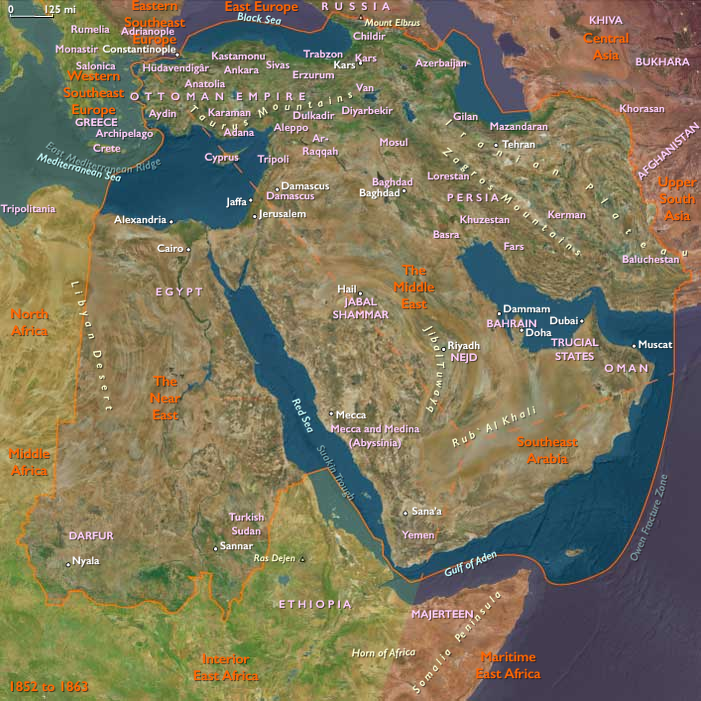
The Near and Middle East
View →Subregions
