
Samarkand’s Masjid-i Jami', or Congregational Mosque, had …
Years: 1405 - 1405
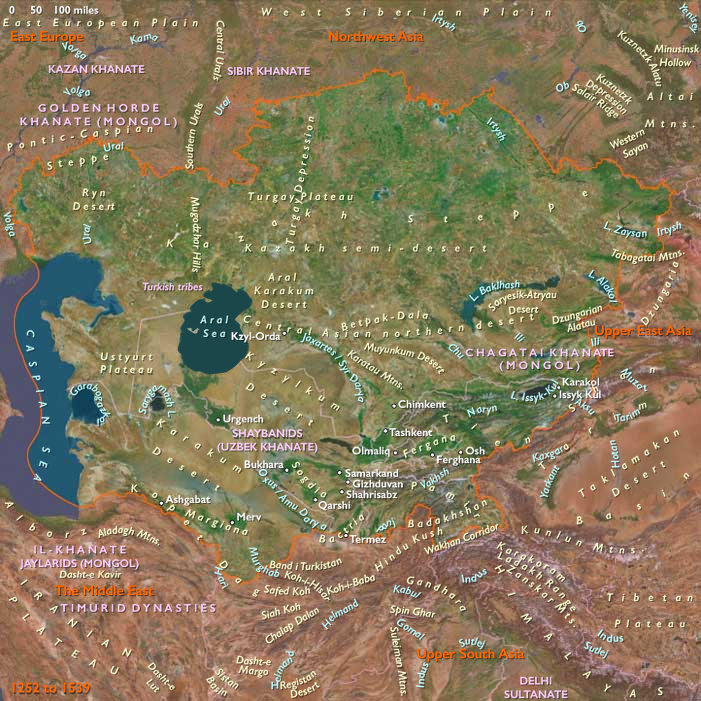
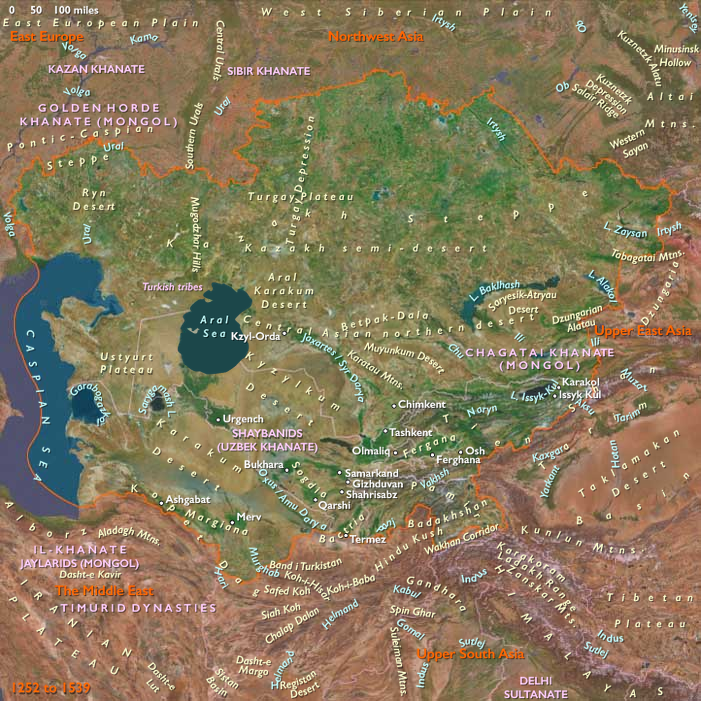
Samarkand’s Masjid-i Jami', or Congregational Mosque, had been built immediately after Timur's return in 1399 from his campaign in India.
According to Ruy Gonzáles de Clavijo, ninety captured elephants were employed merely to carry precious stones looted from this conquest, so as to erect a mosque at Samarkand—what historians today believe is the Bibi-Khanym Mosque.
Construction had been completed around 1404.
(However, the mosque slowly fell into disuse, and crumbled to ruins over the centuries, likely due to the fact it pushed the construction techniques of the time to the very limit, and the fact it was built too quickly.
It eventually partially collapsed in 1897 when an earthquake occurred, but in 1974 began to undergo reconstruction by the Government of Uzbekistan.
The current mosque is effectively a brand-new building, as no original work remains.)
Timur’s impressive mausoleum, the azure-domed Gur-e Amir, is completed in 1405, as is Samarkand’s Shah-i Zinda Necropolis, featuring over a dozen domed tombs lining a narrow hillside lane.
The octahedral Gur-e Mir, famous for its simplicity of construction and for its solemn monumentality of appearance, occupies an important place in the history of Islamic Architecture as the precursor and model for the great Mughal tombs of Humayun in Delhi and the Taj Mahal in Agra, built by Timur's descendants, the ruling Mughal dynasty of North India.
The construction of the mausoleum itself began in 1403 after the sudden death of Muhammad Sultan, Tamerlane's heir apparent and his beloved grandson, for whom it was intended.
Timur had built himself a smaller tomb in Shahrisabz near his Ak-Saray palace.
However, when Timur died in 1405 on campaign on his way to conquer China, the passes to Shahrisabz were snowed in, so he is buried here instead.
Locations
People
Groups
Topics
Commodoties
Subjects
Regions
Subregions
Years: 1405 - 1405
Locations
People
Groups
Topics
Commodoties
Subjects
Regions
Subregions