
The life of Quintus Septimius Florens Tertullianus, …
Years: 198 - 198
The life of Quintus Septimius Florens Tertullianus, known in English as Tertullian. is mostly known from passing references in his own writings.
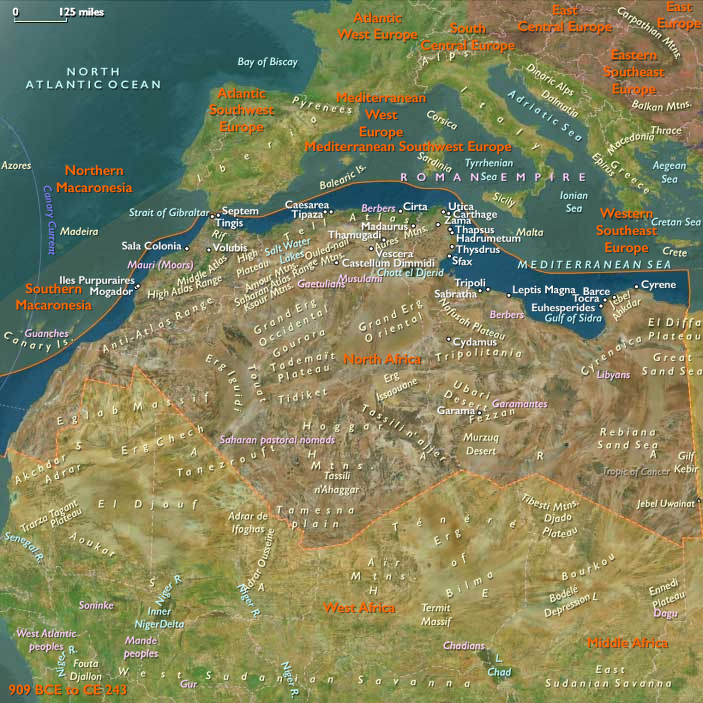
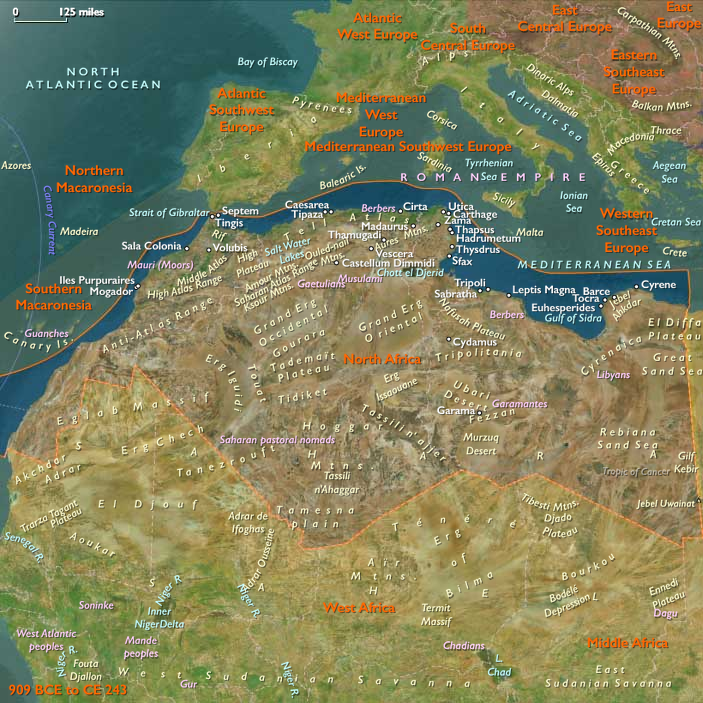
According to church tradition, he was raised in Carthage and was thought to be the son of a Roman centurion, a trained lawyer, and an ordained priest.
These assertions rely on the accounts of Eusebius of Caesarea, Church History, II, ii. 4, and Jerome's De viris illustribus (On famous men) chapter 53.
Jerome claimed that Tertullian's father held the position of centurio proconsularis ("aide-de-camp") in the Roman army in Africa.
However, it is unclear whether any such position in the Roman military ever existed.
Further, Tertullian has been thought to have been a lawyer based on his use of legal analogies and an identification of him with the jurist Tertullianus, who is quoted in the Pandects.
Although Tertullian utilizes a knowledge of Roman law in his writings, his legal knowledge does not demonstrably exceed that of what could be expected from a sufficient Roman education.
The writings of Tertullianus, a lawyer of the same cognomen, exist only in fragments and do not denote a Christian authorship. (Tertullianus was misidentified only much later with the Christian Tertullian by church historians.)
Finally, any notion of Tertullian being a priest is also questionable.
In his extant writings, he never describes himself as ordained in the church and seems to place himself among the laity.
Roman Africa is famous as the home of orators.
This influence can be seen in his style with its archaisms or provincialisms, its glowing imagery and its passionate temper.
Tertullian is a scholar with an excellent education.
He writes at least three books in Greek, in which he refers to himself, but none of these are extant.
His principal study is jurisprudence and his methods of reasoning reveal striking marks of his juridical training.
He shines among the advocates of Rome, as Eusebius reports.
His conversion to Christianity perhaps takes place about 197–198, but its immediate antecedents are unknown except as they are conjectured from his writings.
The event must have been sudden and decisive, transforming at once his own personality.
He said of himself that he could not imagine a truly Christian life without such a conscious breach, a radical act of conversion: "Christians are made, not born" (Apol, xviii).
Two books addressed to his wife confirm that he was married to a Christian wife.
Locations
People
Groups
Topics
Subjects
Regions
Subregions
Years: 198 - 198
Locations
People
Groups
Topics
Subjects
Regions
Subregions