Walter Scott had championed Scottish independence in…
August 1822 CE
Walter Scott had championed Scottish independence in 1817 in his fourth historic novel, Rob Roy.
His fame has grown as his explorations and interpretations of Scottish history and society capture popular imagination.
Impressed by this, the Prince Regent (the future George IV) had given Scott permission to search for the fabled but long-lost Crown Jewels ("Honours of Scotland"), which during the years of the Protectorate under Cromwell had been squirreled away and had last been used to crown Charles II.
Scott and a small team of military men in 1818 had unearthed the Honours from the depths of Edinburgh Castle.
A grateful Prince Regent had granted Scott the title of baronet.
After George's accession to the throne, the city government of Edinburgh had invited Scott, at the King's behest, to stage-manage the King's entry into Edinburgh.
With only three weeks for planning and execution, Scott creates a spectacular and comprehensive pageant, designed not only to impress the King, but also in some way to heal the rifts that had previously destabilized Scots society.
He uses the event to contribute to the drawing of a line under an old world that had pitched his homeland into regular bouts of bloody strife.
He, along with his 'production team', mounts what in modern days could be termed a PR event, in which the (rather plump) King is dressed in tartan (worn over pink tights), and is greeted by his people, many of whom are also dressed in similar tartan ceremonial dress.
This form of dress, previously proscribed after the 1745 rebellion against the English, will subsequently become one of the seminal, potent and ubiquitous symbols of Scottish identity.
Images

Henry Raeburn's portrait of Sir Walter Scott in 1822 (oil on canvas, 76.20 x 63.50 cm; National Galleries of Scotland)
Subjects
Regions
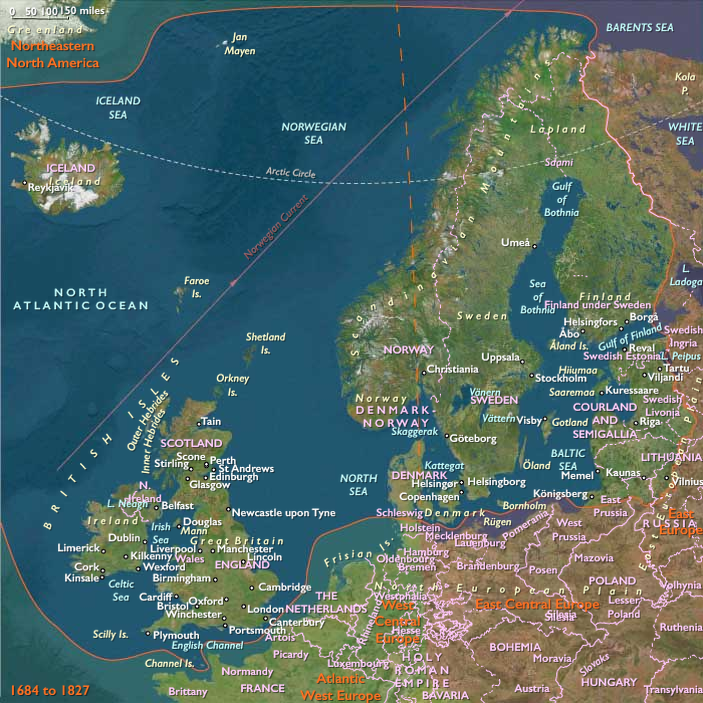
North Europe
View →Subregions