
Daniel Rutherford discovers nitrogen by the isolation…
1772 CE
When Joseph Black was studying the properties of carbon dioxide, he found that a candle would not burn in it.
Black had turned this problem over to his student at the time, Rutherford, a botanist.
Rutherford keeps a mouse in a space with a confined quantity of air until it dies.
Then, he burns a candle in the remaining air until it goes out.
Afterward, he burns phosphorus in that, until it will not burn.
The air is then passed through a carbon dioxide absorbing solution.
The remaining component of the air dioes not support combustion, and a mouse can not live in it.
Rutherford calls the gas (which we now know would have consisted primarily of nitrogen) “noxious air” or “phlogisticated air”.
Rutherford reports the experiment in 1772.
He and Black are convinced of the validity of the phlogiston theory, so they explain their results in terms of it.
The son of Professor John Rutherford (1695–1779) and Anne Mackay, Daniel was born in Edinburgh on November 3, 1749, left home at the age of sixteen to go to college, and has been educated at Mundell's School and Edinburgh University (MD 1772).
Topics
Subjects
Regions
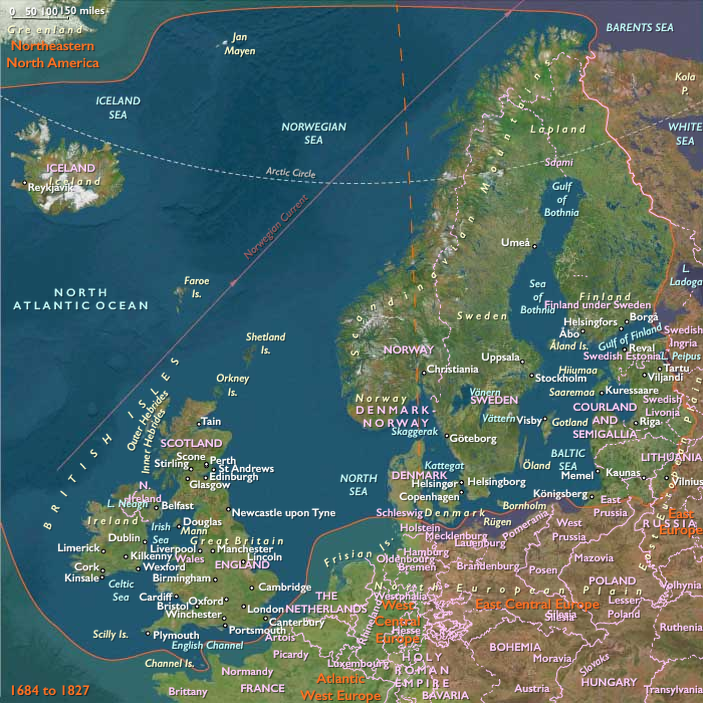
North Europe
View →Subregions
