
Sebastian Brant, a German humanist and moralist…
1494 CE
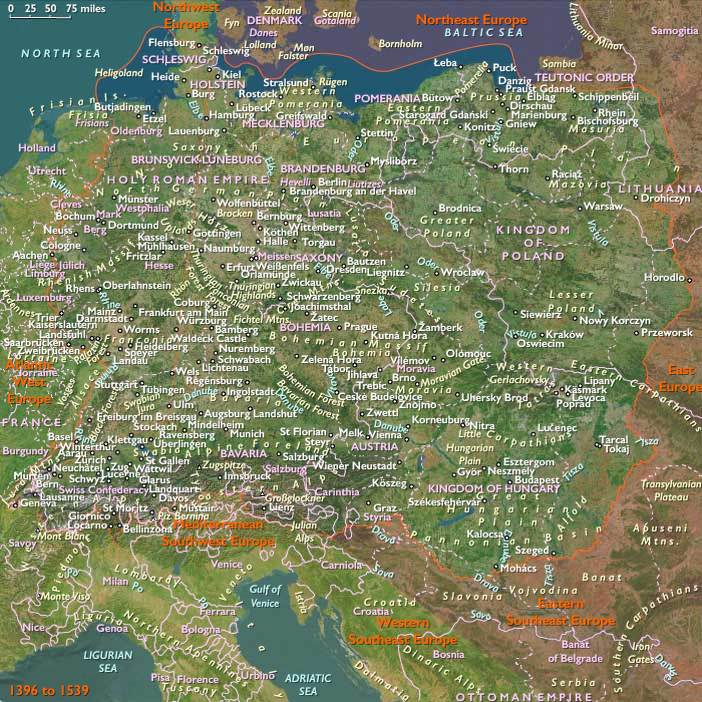
Sebastian Brant, a German humanist and moralist who edits and translates a commonsense practical lore, writes the satirical verse allegory Das Narren Schyff (“Ship of Fools”), published in 1494.
The poem recounts the journey of a ship that never reaches its destination, Narragonia.
The narrator classifies the ship’s one hundred and twelve passengers according to their deficiencies and foibles, rather than their social class.
The poem resembles, in form, the “Dance of Death” and some of the earlier Shrovetide plays (“Fastnachtsspiele”).
People
Regions
Central Europe
View →Subregions

West Central Europe
View →Related Events
No active filters.
Showing 10 events out of 40232 total
Zahiruddin Muhammad, later to be famous as Babur, was born on February 14 [O.S.
], 1483 in the city of Andijan, Andijan Province, Fergana Valley, in contemporary Uzbekistan.
He is the eldest son of Umar Sheikh Mirza, ruler of the Fergana Valley, the son of Abū Saʿīd Mirza (and grandson of Miran Shah, who was himself a son of Timur) and his wife Qutlugh Nigar Khanum, daughter of Yunus Khan, the ruler of Moghulistan (and great-great grandson of Tughlugh Timur, the son of Esen Buqa I, who was the great-great-great grandson of Chaghatai Khan, the second born son of Genghis Khan).
Babur meaning "tiger” in Persian, is also transliterated as Baber or Babar).
Babur hails from the Barlas tribe, which is of Mongol origin and had embraced Turkic and Persian culture.
He had converted to Islam and resides in Turkestan and Khorasan.
Aside from the Chaghatai language, Babur is equally fluent in Persian, the lingua franca of the Timurid elite.
Hence Babur, though nominally a Mongol (or Moghul in Persian language), draws much of his support from the local Turkic and Iranian people of Central Asia, and his army is diverse in its ethnic makeup.
It includes Persians (known to Babur as "Sarts" and "Tajiks"), ethnic Afghans, and Arabs, as well as Barlas and Chaghatayid Turko-Mongols from Central Asia.
In 1494, at eleven years old, Babur becomes the ruler of Fergana, in present-day Uzbekistan, after Umar Sheikh Mirza dies in an accident.
During this time, two of his uncles from neighboring kingdoms, who had been hostile to his father, and a group of nobles who want his younger brother Jahangir to be the ruler, threaten his succession to the throne.
His uncles are relentless in their attempts to dislodge him from this position as well as from many of his other territorial possessions to come.
Babur is able to secure his throne mainly through help from his maternal grandmother, Aisan Daulat Begum, although there is also some luck involved.
The Muscovite army is successful in expanding into the Ukraine and a peace with Moscow, guaranteed by a marriage between Alexander and Helena, Ivan’s daughter, becomes a priority for Lithuania.
An "eternal" peace treaty is concluded on February 5, 1494.
The agreement marks the first Lithuanian territorial losses to Moscow: the Principality of Vyazma and a sizable region in the upper reaches of the Oka River—the lost area is estimated to be approximately eighty-seven thousand square kilometers (thirty-four thousand square miles).
A day after the official confirmation of the treaty, Alexander Jagiellon is betrothed to Helena (the role of the groom is performed by Stanislovas Kęsgaila).
Helena's Orthodox faith creates a number of complications.
Alexander has to receive a special permission from Pope Alexander VI to marry a non-Catholic and sign a formal agreement with Ivan III in October 1494 that Helena will not be forced to convert.
Alexander wants to add that if she wishes so herself, Helena can convert, but Ivan III adamantly rejects the amendment.
Ivan leaves Helena with detailed instructions on how to behave, who to invite for lunch, and where to pray (she is prohibited from visiting Catholic churches).
Ivan also requests that Alexander build an Orthodox church in Vilnius Castle Complex.
Moscow closes down the Hanseatic office in Novgorod in 1494.
Hanseatic merchants, most of them Livonians, are imprisoned.
The trade through Tallinn and Tartu diminishes significantly.
Nuremberg is an important and prosperous city, a center for publishing and many luxury trades.
It has strong links with Italy, especially Venice, a relatively short distance across the Alps.
Very soon after Dürer’s return to Nuremberg, and following an arrangement made during his absence, on July 7, 1494, at the age of twenty-three, he is married to Agnes Frey.
Agnes is the daughter of a prominent brass worker (and amateur harpist) in the city.
No children will result from the marriage, however.
Within three months of his marriage, Dürer leaves for Italy, alone, perhaps stimulated by an outbreak of plague in Nuremberg.
Ismail, the last in line of hereditary Grand Masters of the Safaviyah Sufi order, prior to his ascent to a ruling dynasty, was born on July 17, 1487 in Ardabil.
His father, Haydar, is the sheikh of the Safaviyya Sufi order and a direct descendant of its Kurdish founder, Safi-ad-din Ardabili.
His mother, Martha, better known as Halima Begum, i the daughter of Uzun Hasan by his Pontic Greek wife Theodora Megale Komnene, better known as Despina Khatun, the daughter of Emperor John IV of Trebizond.
(She had married Uzun Hassan in a deal to protect the Greek Empire of Trebizond from the Ottomans.)
Ismail is a great-great grandson of Emperor Alexios IV of Trebizond and King Alexander I of Georgia.
In 1488, Ismail’s father had been killed in a battle at Derbent against the forces of the Shirvanshah Farrukh Yassar and his overlord, the Aq Qoyunlu, a Turkmen tribal federation that controls most of Iran.
In 1494, the Aq Qoyunlu capture Ardabil, killing Ali Mirza Safavi (the eldest son of Haydar), and forcing the seven-year old Ismail to go into hiding in Gilan, where he received education under the guidance of renowned scholars.
Before he died, Ali Mirza had designated his younger brother as leader of the Safaviyya.
Aldus Manutius (family name Mannucci or Manuzio), educated in Rome and Ferrara, founds the Aldine Press, a pioneering family printing firm.
It becomes the first press to produce printed editions of many of the Greek and Latin classics and the first to use italic type, a font created to accommodate the requirements for pocket-size books, another of the Aldine Press’s significant innovations.
Caterina Sforza, the wily countess of Forli and Imola, has continued to defend her domains from the papacy following the death of her first husband.
The states of Forlì and Imola are smaller than the great Italian states but, due to their geographical position, have a considerable strategic importance on the political affairs.
In these years there are significant events that change the geopolitical situation of Italy.
Lorenzo il Magnifico, whose shrewd policy had curbed claims and rivalries of the various Italian states, had died on April 8, 1492.
On 25 July of that year, Pope Innocent VIII also died, and was replaced by Cardinal Rodrigo Borgia, who had taken the name of Pope Alexander VI.
His election would seem to have to strengthened Caterina's rule, as while she and her husband had lived in Rome, the Cardinal had often been a guest at their home, and was godfather to her son Ottaviano.
These events directly threaten the stability and peace in Italy.
With the death of Lorenzo there had come about friction between the Duchy of Milan and the Kingdom of Naples, leading up to the crisis of September 1494, when, incited by Ludovico il Moro, King Charles VIII of France enters into Italy to claim Naples as the Anjou heir.
At first Pope Alexander VI also gives his support to Charles' claim, leading to four years of war.
During the conflict between Naples and Milan, Caterina, who knows that she is placed in a strategic position of passage for anyone who wants to go to the south, tries to remain neutral.
She knows Forlì is exposed to invasion, located in a strategic position on the way to Rome.
On one side, her uncle Ludovico had allied with Charles VIII; on the other side, Pope Alexander VI now oppose France's ambitions in Italy, and her brother-in-law, Cardinal Riario, argues in favor of the incumbent King Ferdinand II.
Caterina chooses to join Naples and the Pope, and prepares the defense of Imola and Forlì against the French.
Betrayed by her Neapolitan allies, who at the first French attack do not help her, Caterina changes sides and submits to Charles VIII, giving his army via libera ("free passage") to Naples; however, he prefers to avoid the Romagna and cross the Apennines, following the road of the Cisa pass.
Vigevano is crowned by the Castello Sforzesco, a stronghold rebuilt 1492–94 for Ludovico Maria Sforza (Ludovico il Moro), the great patron born in the town, who has transformed the fortification/hunting lodge of Luchino Visconti (who in turn had reused a Lombard fortress) into a rich noble residence, at the cusp of Gothic and Renaissance.
Leonardo da Vinci is his guest at Vigevano, as is Bramante, who is ascribed with the tall tower that watches over the piazza from the Castello Sforzesco.
The old castle has a unique raised covered road, high enough for horsemen to ride through, that communicates between the new palace and the old fortifications; there is a Falconry, an elegant loggiato supported by forty-eight columns, and, in the rear area of the mastio, the Ladies' Loggia made for Duchess Beatrice d'Este.
Vigevano's main attraction is one of the finest piazzas in Italy, the Piazza Ducale, which is also said to have been laid out by Bramante, and is certainly built for Ludovico il Moro, starting in 1492-93 and completed in record time, unusual for early Renaissance town planning.
Piazza Ducale is actually planned to form a noble forecourt to his castle, unified by the arcades that completely surround the square, an amenity of the new North Italian towns built in the thirteenth century.
The town's main street enters through a sham arcaded façade that preserves the unity of the space as at the Place des Vosges.
Ludovico had demolished the former palazzo of the commune of Vigevano to create the space.
The earliest records of Vigevano date from the tenth century CE, when it was a favored residence of the Lombard king Arduin, for the sake of the good hunting in the vicinity.
Vigevano had been a Ghibelline commune, favoring the Emperor and was accordingly besieged and taken by the Milanese in 1201 and again in 1275.
It finally surrendered in 1328 to Azzone Visconti, and thereafter shared the political fortunes of Milan.
The Church of San Pietro Martire (St Peter Martyr) was built, with the adjacent Dominican convent, by Filippo Maria Visconti in 1445.
In the last years of Visconti domination it sustained a siege by Francesco Sforza.
Once he was settled in power in Lombardy, Sforza arranged for Vigevano to be set up as the seat of a bishop and provided its revenues.
Antonio Vivarini’s son Alvise, a more original painter than his late father or his uncle Bartolomeo, draws inspiration from Antonello da Messina, whose style is clearly echoed in the crisp modeling and firm outlines of “Christ Blessing,” executed in 1494.
The works of Vivarini show an advance on those of his predecessors, and some of them are productions of high attainment; one of the best was executed for the Scuola di San Girolamo in Venice, representing the saint caressing his lion, and some monks decamping in terror.
The architecture and perspective in this work are superior.
Many churches in Venice have examples.
Other works by Vivarini are in Treviso, Milan and the National Gallery, London.
He paints some remarkable portraits.
The Adoration of Christ dated 1476, in the sacristy of the church of Montefiorentino, is one of his early productions.
In 1480 he had painted a Virgin and Saints for San Francesco, Treviso, now in the Venice Accademia.
To about this date belong the SS.
Matthew and John the Baptist, in the same collection; and the fresco of Christ Carrying His Cross in Santi Giovanni e Paolo.
In 1488, Alvise Vivarini had written a letter to the Signory of Venice, requesting permission to share with Bellini in the commission to decorate the Hall of Great Council in the Doge's Palace.
To this he received a favorable reply, and thereupon executed two paintings, which were burned in the fire of 1577.
The subjects, Vasari tells us, were Otho promising to mediate between Venice and Barbarossa and Barbarossa receiving his Son.
The Council were so pleased with the pictures that, in 1492, Alvise was named Depentor in Gran Conseio, with a salary of five ducats a month.
Alonso Fernández de Lugo had been granted the right to conquer the island of Tenerife in December 1493 by the Catholic Monarchs (Queen Isabella I of Castile and King Ferdinand II of Aragon)
Coming from Gran Canaria, the conqueror lands on the coast of present-day Santa Cruz de Tenerife in April 1494 and disembarks with about two thousand men on foot and two hundred on horseback.
After taking the fort, the army prepared to move inland, later capturing the native kings of Tenerife and presenting them to Isabella and Ferdinand.